

Existing law appropriates certain unallocated moneys and other specified moneys deposited into the Fair and Exposition Fund, a continuously appropriated fund, to the Secretary of Food and Agriculture for capital outlay to California fairs for, among other things, fair projects involving public health and safety, fair projects involving major and deferred maintenance, and fair projects necessary due to any emergency, as specified. This bill would instead appropriate those moneys described above to the secretary for capital outlay to California fairs for fair projects involving public health, fire and life safety, and emergency services improvement projects at fairs, California Code of Regulations compliance projects, and maintenance projects at fairgrounds, as specified. By expanding the purposes for which those moneys may be used, the bill would make an appropriation. The bill would require moneys deposited into the fund after November 1 of each year to be allocated within 90 days of the receipt of the moneys, as provided. The bill would require all available moneys in the fund to be allocated to the network of California fairs pursuant to an approved expenditure plan no later than December 31 of each calendar year, except that beginning January 1, 2027, and every year thereafter, a reasonable amount may be retained from year to year as a prudent reserve for contingencies, as specified.
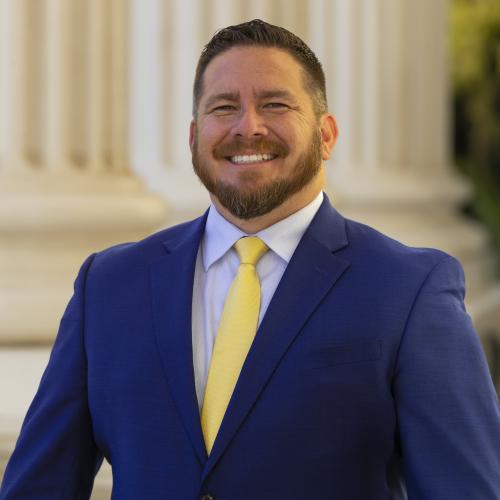
Rep. Juan Alanis
Sponsored bills
Existing law creates the Office of Farm to Fork within the Department of Food and Agriculture, and requires the office, to the extent that resources are available, to work with various entities, including, among others, the agricultural industry and other organizations involved in promoting food access, to increase the amount of agricultural products available to underserved communities and schools in the state. This bill would require the office, upon appropriation by the Legislature, to establish the Healthy Food for California Public Institutions Program for the purpose of identifying vendors in California that have the capacity to provide healthy foods to California public institutions, as defined. The bill would require the office, to the extent that funding is available, to implement initiatives under the program, including, but not limited to, an initiative to develop a list of approved vendors that public institutions can use to procure food products that are whole or minimally processed and are grown or produced in California using climate-smart agriculture practices and climate-smart agriculture production systems.
Existing law establishes various programs and services for older adults, as defined, including, among other things, the Adult Education Program under the administration of the Chancellor of the California Community Colleges and the Superintendent of Public Instruction, and health promotion and preventative health services for older adults under the administration of the State Department of Public Health. This bill would authorize a local health department, area agency on aging, community college, public or private college, public or private university, or other appropriate county department, as determined by a county, to establish a Healthy Aging Community Partnership Program for older individuals designed to promote healthy aging, social engagement, and independent living in collaboration with relevant local entities, including school districts, libraries, faith institutions, and community organizations. The bill would authorize program activities to include, among other things, technology assistance, physical activity, and other community-based enrichment activities that support healthy aging and social connection. The bill would make implementation of these provisions subject to the availability of local resources and partnerships. The bill would specify that these provisions do not duplicate or supplant specified current adult education courses, classes, and services provided by the California Community Colleges, including through the Adult Education Program, as provided.
Existing law requires the State Board of Education, on or before January 31, 2024, to appoint an independent panel of experts for the purpose of creating an approved list of evidence-based, culturally, linguistically, and developmentally appropriate screening instruments for pupils in kindergarten and grades 1 and 2 to assess pupils for risk of reading difficulties, including possible neurological disorders such as dyslexia, as specified. Existing law requires the governing board or body of a school district, county office of education, or charter school serving pupils in kindergarten or grades 1 or 2 to adopt, on or before June 30, 2025, one or more screening instruments from the approved list to assess pupils for risk of reading difficulties, as specified, and commencing no later than the 2025–26 school year, requires those local educational agencies to assess each pupil in kindergarten and grades 1 and 2 for risk of reading difficulties using the screening instrument or instruments adopted by the governing board or body of the local educational agency, as specified. This bill would, on or before July 31, 2027, require the state board to approve and the State Department of Education to post on its internet website criteria and guidance for selecting evidence-based, culturally, linguistically, and developmentally appropriate mathematics diagnostic assessments for pupils in kindergarten and grades 1 and 2 to assess pupils' mathematics knowledge and learning needs and identify pupils in need of additional support. The bill would require the department, on or before January 31, 2028, to (1) publish on its internet website a list of approved diagnostic assessments that meet the criteria, and (2) post on its internet website additional guidance to assist local educational agencies in selecting diagnostic assessments from the approved list, as provided. The bill would require the list to include diagnostic assessments that are developed for both English learners and non-English learners, as provided. The bill would require the state board and the department to solicit stakeholder input when developing the criteria, guidance, and list of diagnostic assessments pursuant to these provisions and to allow for public comment. The bill would authorize the department to periodically update the list of approved assessments. The bill would require the governing board or body of a school district, county office of education, or charter school serving pupils in kindergarten or grades 1 or 2 to adopt, on or before June 30, 2028, one or more diagnostic assessments from the published list of approved diagnostic assessments to assess pupils' mathematics knowledge and learning needs. The bill would authorize a local educational agency to satisfy this requirement by using a diagnostic assessment that is not on the published list if the governing board or body self-certifies that the assessment tool meets the above-described criteria. The bill, commencing no later than the 2028–29 school year, would require those local educational agencies to assess each pupil in kindergarten and grades 1 and 2 for mathematics knowledge using the diagnostic assessment or assessments adopted by the governing board or body of the local educational agency. The bill would require a local educational agency to provide parents or guardians of pupils eligible for assessment with information about the assessment and to make pupil results available to parents or guardians, as required by the state board, as provided. By imposing additional duties on local educational agencies, the bill would impose a state-mandated local program. The bill would require the department, by April 30, 2028, to curate and maintain on its internet website guidance and resources on evidence-based support, intervention, and instructional strategies aligned with the Mathematics Framework for California Public Schools: Kindergarten Through Grade Twelve. The California Constitution requires the state to reimburse local agencies and school districts for certain costs mandated by the state. Statutory provisions establish procedures for making that reimbursement. This bill would provide that, if the Commission on State Mandates determines that the bill contains costs mandated by the state, reimbursement for those costs shall be made pursuant to the statutory provisions noted above.
Existing law authorizes the legislative body of a local agency, as defined, to, by ordinance, make any violation of an ordinance subject to an administrative fine or penalty. Existing law requires a local agency to set forth, by ordinance, the administrative procedures that govern the imposition, enforcement, collection, and administrative review of those administrative fines or penalties. Existing law requires the administrative procedures to provide for a reasonable period of time, as specified in the ordinance, for a person responsible for a continuing violation to correct or otherwise remedy the violation prior to the imposition of administrative fines or penalties, when the violation pertains to building, plumbing, electrical, or other similar structural or zoning issues, that do not create an immediate danger to health or safety. This bill would require, for any violation pertaining to building, plumbing, electrical, or other similar structural or zoning issues, that do not create an immediate danger to health or safety, of any ordinance enacted by the local agency, the reasonable period of time to correct or otherwise remedy the violation to be no less than 6 months if certain conditions are met, including that the property involved is an owner-occupied residential property containing 4 units or less and the current owner of the property submits a sworn affidavit that the current owner was not responsible for any action that caused the violation and that the current owner had no knowledge of the violation at the time the owner took title to the property. These provisions would not apply to an administrative fine or penalty imposed for a violation of various laws, regulations, and ordinances, as specified. By requiring a sworn affidavit, the bill would expand the crime of perjury, thereby imposing a state-mandated local program. The bill would require a local agency to extend the reasonable period of time described above by an additional 6 months upon a showing by the current owner of a good faith effort to correct or otherwise remedy the violation, and would authorize the agency to extend the reasonable period of time beyond that extension in its discretion, as specified. The bill would include findings that changes proposed by this bill address a matter of statewide concern rather than a municipal affair and, therefore, apply to all cities, including charter cities. The California Constitution requires the state to reimburse local agencies and school districts for certain costs mandated by the state. Statutory provisions establish procedures for making that reimbursement. This bill would provide that no reimbursement is required by this act for a specified reason.
The Donahoe Higher Education Act establishes the California Community Colleges, under the administration of the Board of Governors of the California Community Colleges, the California State University, under the administration of the Trustees of the California State University, and the University of California, under the administration of the Regents of the University of California, as the 3 segments of public postsecondary education in the state. Existing law establishes uniform residency requirements for purposes of ascertaining the amount of tuition and fees to be paid by students of public postsecondary education institutions. Existing law, until July 1, 2032, entitles a Team USA student athlete, as defined, who trains in the state in an elite level program approved by the United States Olympic and Paralympic Committee to resident classification for the purpose of determining tuition and fees. After July 1, 2032, existing law entitles an amateur student athlete in training at the United States Olympic Training Center in the City of Chula Vista to resident classification for that same purpose. These provisions apply to the University of California only to the extent that the regents, by appropriate resolution, make them applicable. This bill would remove the July 1, 2032, sunset provision, and make conforming changes, thereby extending the provisions that entitle a Team USA student athlete who trains in the state in an elite level program approved by the United States Olympic and Paralympic Committee to resident classification indefinitely. To the extent the bill would require community college districts to exempt more students from nonresident tuition, the bill would impose a state-mandated local program. The California Constitution requires the state to reimburse local agencies and school districts for certain costs mandated by the state. Statutory provisions establish procedures for making that reimbursement. This bill would provide that, if the Commission on State Mandates determines that the bill contains costs mandated by the state, reimbursement for those costs shall be made pursuant to the statutory provisions noted above.
The Donahoe Higher Education Act sets forth the missions and functions of California's public segments of higher education and their respective institutions of higher education. The California Community Colleges, the California State University, and the University of California are the 3 public segments of postsecondary education in the state. Provisions of the act apply to the University of California only to the extent that the Regents of the University of California act, by appropriate resolution, to make them applicable. This bill would establish the Cal-Bridge Program as a fully intersegmental partnership program between the California Community Colleges, the California State University, and the University of California to create a pathway that promotes the advancement of California's diverse undergraduate public postsecondary student population who major in science, technology, engineering, and mathematics (STEM) disciplines to pursue STEM doctors of philosophy (PhDs) and become members of California's professorate or leaders in California's technology industry. The bill would specify the goals of the Cal-Bridge Program, including, among others, preparing students to apply to PhD programs in STEM disciplines, as specified. The bill would include 5 Cal-Bridge subprograms to provide resources, research opportunities, and financial support to qualifying public postsecondary undergraduate, PhD, and postdoctoral STEM scholars. The bill would also establish the ENLACE Program as an operationally independent program that works in collaboration with the Cal-Bridge Program to create pathways that prepare California's high school and college students for all levels of postsecondary STEM education and the state's STEM workforce, as specified. The bill would require the ENLACE Program to consist of the ENLACE High School and Undergraduate Program to provide support to qualifying students in high school and undergraduate studies across all STEM disciplines at public postsecondary educational institutions, as specified. The bill would authorize funding appropriated for purposes of the Cal-Bridge Program or the ENLACE Program to be used for specified activities. The bill would require the Cal-Bridge Program to submit an annual programmatic progress report to the office of the President of the University of California that includes data on implementation of the Cal-Bridge Program's activities and the allocation of funding for those activities, as specified. The bill would apply to the University of California only to the extent that the Regents of the University of California, by appropriate resolution, make it applicable.
This measure would proclaim the month of October 2026 as California Firefighter Appreciation Month and October 3, 2026, as California Firefighters Memorial Day.
Existing law establishes an archery season for the taking of deer with bow and arrow. Existing law generally prohibits a person taking or attempting to take deer during that archery season from carrying, or having under their immediate control, a firearm of any kind, except for an active or honorably retired peace officer, as specified. This bill would repeal that prohibition.
Existing law regulates the sale, manufacture, and exchange of toys in the state and prohibits the manufacture, sale, or exchange, possession with intent to sell or exchange, and exposition or offer for sale or exchange to a retailer a toy that is contaminated with a toxic substance, as provided. Violation of these provisions is punishable as a misdemeanor. Existing law requires an operator of a companion chatbot platform, as defined, to issue a clear and conspicuous notification indicating that the companion chatbot is artificially generated and not human if a reasonable person interacting with a companion chatbot would be misled to believe that the person is interacting with a human. For these purposes, existing law defines a "companion chatbot" to mean an artificial intelligence system with a natural language interface that provides adaptive, human-like responses to user inputs and is capable of meeting a user's social needs, including by exhibiting anthropomorphic features and being able to sustain a relationship across multiple interactions. Existing law also requires an operator to take certain actions with respect to a user the operator knows is a minor, including to disclose to the user that the user is interacting with artificial intelligence. Violation of these provisions is subject to civil liability. This bill would, until January 1, 2031, prohibit the manufacture, sale, exchange, possession with intent to sell or exchange, and exposition or offer for sale or exchange to a retailer a toy, as defined, that includes a companion chatbot, and would make violations of the bill subject to the same civil liability as violations of the provisions applicable to operators of companion chatbots in the above-described paragraph.