

Existing law requires the governing board of a school district to have general control of, and be responsible for, all aspects of the interscholastic athletic policies, programs, and activities in its school district, as provided, and requires the governing board of a school district to ensure that all interscholastic policies, programs, and activities in the school district comply with state and federal law. Existing law authorizes the governing board of a school district to enter into associations or consortia with other governing boards for purposes of governing regional or statewide interscholastic athletics, as provided. Existing law describes the California Interscholastic Federation (CIF) as a voluntary organization that consists of school and school-related personnel with responsibility for administering interscholastic athletic activities in secondary schools and states the intent of the Legislature that the CIF, in consultation with the State Department of Education, implement specified policies relating to interscholastic athletics. Existing law, the 1998 California High School Coaching Education and Training Program, declares the intent of the Legislature to establish a California High School Coaching Education and Training Program, to be administered by school districts with an emphasis on specific components, including, among other components, sports psychology. Existing law requires every high school sports coach to complete, at their own expense, a coaching education program that meets the guidelines established by the California High School Coaching Education and Training Program. This bill would add a component on mental health training, as specified, to the list of components to be emphasized by the 1998 California High School Coaching Education and Training Program. The bill, commencing with the 2027–28 school year, would require a person who serves as a coach in an interscholastic athletic program at a high school, including a private school, that is a member of the California Interscholastic Federation to complete an initial training, and a subsequent training every 2 years, on mental health, as provided. The bill, commencing with the 2027–28 school year, would also require a school district, county office of education, or charter school that elects to offer an athletic program, other than an interscholastic athletic program, to ensure that the athletic program's coaches complete an initial training, and a subsequent training every 2 years, that covers sudden cardiac arrest, as provided, and youth athletics behavioral and mental health training, as provided. This bill would incorporate additional changes to Section 35179.1 of the Education Code proposed by AB 1626 to be operative only if this bill and AB 1626 are enacted and this bill is enacted last. This bill would make the operation of its provisions contingent upon the enactment of AB 1626 of the 2025–26 Regular Session.
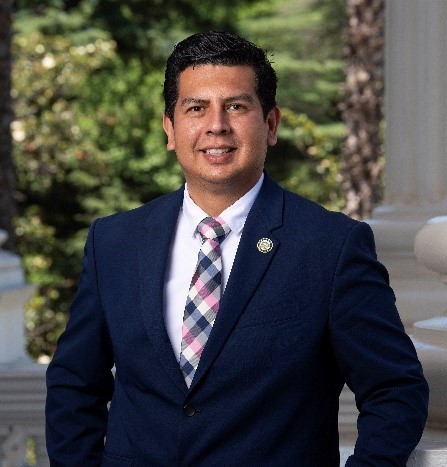
Rep. David Alvarez
Sponsored bills
Existing law establishes the California State University, under the administration of the Trustees of the California State University, and the University of California, under the administration of the Regents of the University of California, as 2 of the 3 segments of public postsecondary education in the state. This bill, commencing with the 2027–28 academic year, would require the California State University, and would request the University of California, to adopt a plan to increase the number of students participating in exchange programs with Mexican public universities, as provided. The bill would require these provisions to become operative only upon an appropriation of funds for its purposes.
The California Constitution confers the right to vote on a United States citizen who is 18 years of age and a resident of this state, except as specified. The California Constitution requires candidates for congressional and state elective offices in California to be selected via a voter-nominated primary election at which all voters may vote for any candidate without regard to the political party preference disclosed by the candidate or the voter. The top two vote-getters at a voter-nominated primary election for a congressional or state elective office, regardless of party preference, are nominated to compete in the ensuing general election. The California Constitution requires the Legislature to provide for partisan elections for presidential candidates, and political party and party central committees, including an open presidential primary whereby the candidates on the ballot are those found by the Secretary of State to be recognized candidates throughout the nation or throughout California for the office of President of the United States. This measure would prohibit an eligible voter from being excluded from meaningful participation at any integral stage of any publicly funded election, including a primary election, on any basis, including political party preference.
Existing law generally regulates classes of insurance, including automobile liability insurance. Existing law prohibits classifying a private passenger motor vehicle as a commercial vehicle, for-hire vehicle, permissive use vehicle, or livery solely because its owner allows it to be shared, if specified criteria are met. In the event of a loss or injury that occurs during any time period when the vehicle is under the operation and control of a person other than the vehicle owner, existing law requires the personal vehicle sharing program to assume all liability of the owner and is considered the owner of the vehicle for all purposes. Existing law requires a personal vehicle sharing program to provide insurance coverages for the vehicle and operator at a minimum of $45,000 for bodily injury or death for one person, $90,000 for bodily injury or death for all persons, and $15,000 for property damage, and, on and after January 1, 2031, to provide liability coverage at least 3 times the minimum insurance requirements for private passenger vehicles. This bill would, instead of requiring a personal vehicle sharing program to assume all liability of the owner, require the program to assume liability of the owner for bodily injury or property damage to injured third parties resulting from personal vehicle sharing in amounts stated in the personal vehicle sharing program agreement, and not less than $250,000 for bodily injury or death for one person, $500,000 for bodily injury or death for all persons, and $100,000 for property damage. The bill would make these provisions inapplicable if the vehicle owner acts in concert with a shared vehicle driver who fails to return the shared vehicle pursuant to the terms of the personal vehicle sharing program agreement.
The California Environmental Quality Act (CEQA) requires a lead agency, as defined, to prepare, or cause to be prepared, and certify the completion of, an environmental impact report on a project that it proposes to carry out or approve that may have a significant effect on the environment or to adopt a negative declaration if it finds that the project will not have that effect. CEQA also requires a lead agency to prepare a mitigated negative declaration for a project that may have a significant effect on the environment if revisions in the project would avoid or mitigate that effect and there is no substantial evidence that the project, as revised, would have a significant effect on the environment. CEQA, until January 1, 2033, exempts from its requirements certain actions for affordable housing projects that meet specified requirements, including confirmation by a public agency that, among other things, the project site satisfies specified requirements and a vacant project site does not contain tribal cultural resources that could be affected by the development that were found pursuant to a consultation and the effects of which cannot be mitigated, as provided. This bill would extend the operation of the above-described exemption to January 1, 2037, and would expand the exemption to also include a public university or public college housing project, as defined, that meets specified requirements. Because the bill would extend the operation of the exemption and would increase duties on a lead agency related to the expansion of this exemption, the bill would impose a state-mandated local program. The California Constitution requires the state to reimburse local agencies and school districts for certain costs mandated by the state. Statutory provisions establish procedures for making that reimbursement. This bill would provide that no reimbursement is required by this act for a specified reason.
This measure would urge the President of the United States and Congress of the United States to immediately restore full and consistent funding and staffing for the National Park Service.
Maddy summaryCalifornia Assembly Resolution 140 designates August 2026 as Children's Get Offline and Get Outdoors Month to promote awareness of the benefits of screen-free play for child development. The resolution cites research linking excessive social media use and reduced free play time to increased rates of anxiety, depression, and other behavioral issues among teenagers. It encourages families and communities to support unstructured outdoor activities and highlights ongoing federal efforts to protect children's mental health through technology guardrails.
Existing law, the World Language Teacher Exchange and Recruitment Law of 1963, requires the State Board of Education to adopt rules and regulations under which teachers employed by California school districts may exchange positions with teachers in schools in other countries for a period of one year or less. Existing law requires the arrangements for the exchanges to be made through the State Department of Education and in cooperation with the teacher exchange programs administered by agencies of the federal government. This bill would revise and recast those provisions by, among other things, (1) no longer requiring the state board to adopt regulations, (2) no longer requiring the department to administer the program or take actions necessary to carry out the program, (3) expressly providing for exchanges with Mexico and Spain, (4) expanding the authorized exchanges to include county offices of education and charter schools, (5) eliminating the one-year time limit on the exchanges, and (6) , if regulations are adopted, requiring those regulations to authorize specified visa sponsors designated by the United States Department of State to sponsor teachers from other countries, including Mexico and Spain, for placement in California school districts, county offices of education, and charter schools to promote cultural exchange for specified purposes.
Existing law establishes the California Community Colleges, under the administration of the Board of Governors of the California Community Colleges, as one of the segments of public postsecondary education in this state. Existing law establishes community college districts throughout the state and authorizes them to provide instruction at the campuses they operate. Existing law authorizes the Board of Governors of the California Community Colleges, in consultation with the California State University and the University of California, to authorize the establishment of community college district baccalaureate degree programs, as provided. This bill would authorize the Chancellor of the California Community Colleges to authorize the Southwestern Community College District to offer no more than 4 workforce-aligned baccalaureate degree programs, one each in forensic studies, allied health education and leadership, interaction design, and teaching English to speakers of other languages, as provided. The bill would require the Legislative Analyst's Office to, on or before July 1, 2031, conduct and present to the Legislature and the Governor an interim evaluation of any of the baccalaureate degree programs that are offered pursuant to that authorization and, on or before July 1, 2035, a final evaluation of those degree programs, as provided. The bill would repeal these provisions on January 1, 2037. This bill would make legislative findings and declarations as to the necessity of a special statute for the Southwestern Community College District. This bill would not become operative if either AB 2694 or SB 960 of the 2025–26 Regular Session, or both of those bills, are enacted and take effect on or before January 1, 2027.
Maddy summaryCalifornia Assembly Resolution 137 formally recognizes the Diwali festival scheduled for November 8, 2026, and encourages state residents to participate in the celebration. The resolution highlights the cultural significance of the holiday for Indian Americans and South Asian communities, noting its themes of unity, joy, and the triumph of light over darkness. It also acknowledges that California previously designated Diwali as an official state holiday in 2025. This measure serves as a commemorative statement rather than a law with new regulatory or financial provisions.