

(1) Existing law, commonly referred to as the Density Bonus Law, requires a city or county to grant a density bonus, other incentives or concessions, and waivers or reductions of development standards, as specified, to an applicant for a housing development when the applicant seeks a density bonus for the housing development, as specified, if the applicant agrees to construct, among other things, a specified percentage of units for very low income, lower income, or senior citizen housing, and meets other requirements. This bill would, instead, require a city or county to grant a density bonus, other incentives or concessions, and waivers or reductions of development standards, as specified, to an applicant for a housing development when the applicant submits an application for a housing development that a city, county, or city and county determines meets specified criteria, including, among others, the housing development includes specified percentage of units for very low income, lower income, or senior citizen housing. (2) Existing law defines density bonus for the purposes of the Density Bonus Law to mean a density increase over the otherwise base density, as specified. Existing law specifies the base density calculation standards and requires base density to be determined using dwelling units per acre, except as otherwise provided. For the purpose of calculating a density bonus, existing law requires the residential units to be on contiguous sites that are the subject of one development application, as specified. Existing law also requires the density bonus to be permitted in geographic areas of the housing development other than the areas where the units for the lower income households are located. This bill would allow an applicant who provides a base density study, as defined, to elect to receive a density bonus in the form of a percentage increase in maximum floor area ratio, as specified. The bill would create an additional exception to the requirement that base density be determined using dwelling units per acre for applicants who elect to provide a base density study. This bill would revise and recast the provisions related to permitting of a density bonus relative to the geographic area to instead require a density bonus, incentive, or concession, or waiver or reduction, on sites that are the subject of the same housing development, as specified. (3) Existing law requires a city or county to adopt procedures and timelines for processing a density bonus application and to notify the applicant for a density bonus whether the application is complete in a manner consistent with specified timelines. If the local government notifies the applicant that the application is deemed complete, this bill would require the city or county to provide the applicant with a determination that the project is eligible for a density bonus. (4) Existing law authorizes an applicant for a density bonus to submit to a city or county a proposal for the specific incentives or concessions that the applicant requests and requires the city or county to grant the concession or incentive requested by the applicant unless the city or county makes a certain written finding, based upon substantial evidence. Existing law specifies the number of incentives or concessions an applicant is eligible to receive based on certain criteria. This bill would make revisions to certain of those calculations related to incentives or concessions. (5) The California Environmental Quality Act (CEQA) requires a lead agency, as defined, to prepare, or cause to be prepared, and certify the completion of an environmental impact report on a project that it proposes to carry out or approve that may have a significant effect on the environment or to adopt a negative declaration if it finds that the project will not have that effect. CEQA also requires a lead agency to prepare a mitigated negative declaration for a project that may have a significant effect on the environment if revisions in the project would avoid or mitigate that effect and there is no substantial evidence that the project, as revised, would have a significant effect on the environment. Existing law specifies that the granting of a density bonus or incentive or concessions shall not require or be interpreted to require a general plan amendment, local coastal plan amendment, zoning change, or other discretionary approval. Existing law also specifies that the granting of an incentive or concessions shall not require or be interpreted to require a study. This bill would specify that the granting of a waiver or reduction of development standards shall not require or be interpreted to require a general plan amendment, local coastal plan amendment, zoning change, study, or other discretionary approval. The bill would also specify that the granting of a density bonus, incentive or concession, or waiver or reduction of development standards shall not be discretionary. The bill would specify that the granting of a density bonus, incentive or concession, or waiver or reduction of development standards shall not require or be interpreted to require environmental review under CEQA. (6) The bill would include findings that changes proposed by this bill address a matter of statewide concern rather than a municipal affair and, therefore, apply to all cities, including charter cities. (7) This bill would incorporate additional changes to Section 65915 of the Government Code proposed by AB 2480, SB 1383, or both, to be operative only if this bill and AB 2480, SB 1383, or both, are enacted and this bill is enacted last. (8) By imposing new requirements on local governments, the bill would impose a state-mandated local program. The California Constitution requires the state to reimburse local agencies and school districts for certain costs mandated by the state. Statutory provisions establish procedures for making that reimbursement. This bill would provide that no reimbursement is required by this act for a specified reason.
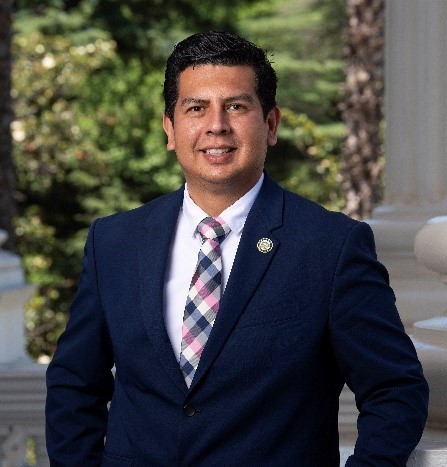
Rep. David Alvarez
Sponsored bills
This measure would call on Congress to enact legislation that restores and strengthens the full protections of the Voting Rights Act of 1965, and it would call on the President to sign the legislation.
Existing law requires the Office of the State Fire Marshal to develop and make available on its internet website a Wildland-Urban Interface Fire Safety Building Standards Compliance training intended for use in the training of local building officials, builders, and fire service personnel, as specified. Existing law authorizes the Office of the State Fire Marshal to allow certification of contractors who conduct defensible space, home hardening, fuel reduction, roadside clearance, and other contracting activities for wildlife resiliency efforts and who have completed specified training programs. Existing law requires the Office of the State Fire Marshal to develop and update a Wildland-Urban Interface Products listing of products and construction assemblies that comply with prescribed regulations regarding building in a wildland-urban interface area. Existing law authorizes the Office of the State Fire Marshal to expend funds from the Building Standards Administration Special Revolving Fund, upon an appropriation by the Legislature, for the purposes of researching and developing the products listing and the educational and training provisions. Existing law requires the Office of the State Fire Marshal to establish the State Fire Marshal's Wildfire Mitigation Advisory Committee. This bill would require, on or before January 1, 2028, the State Fire Marshal's Wildfire Mitigation Advisory Committee to develop an implementation plan for a home hardening certification program that identifies home hardening measures, including defensible space, that can be voluntarily implemented during renovation or property improvement projects, or both, to substantially reduce the risk of loss during a fire and bring existing building stock into alignment with state building standards for wildland-urban interface areas. The bill would require the committee, in developing the implementation plan for the home hardening certification program, to provide specified recommendations. The bill would authorize the Office of the State Fire Marshal to expend funds from the Building Standards Administration Special Revolving Fund, upon an appropriation by the Legislature, for the purposes of developing the implementation plan for the home hardening certification program. The bill would require the committee, on or before January 1, 2028, to provide a report to specified legislative committees on its findings and recommendations pursuant to these provisions. The bill would require, on or before January 1, 2029, the State Fire Marshal to establish the home hardening certification program based on the recommendations made by the Wildfire Mitigation Advisory Committee.
Under existing law, there is in the Natural Resources Agency, the Department of Parks and Recreation, conducted under the control of an executive officer known as the Director of Parks and Recreation, charged with administration, protection, and development of the state park system. Existing law designates all parks, public campgrounds, monument sites, landmark sites, and sites of historical interest established or acquired by the state, or that are under its control, as the state park system, except as specified. Under existing law, the Department of Parks and Recreation controls the state park system, which is made up of units. One unit is the San Pasqual Battlefield State Park. This bill would require the state to quitclaim forthwith to the San Pasqual Band of Mission Indians, at no cost to the tribe, and subject to specified conditions, all interests of the state in the land owned within the San Pasqual Battlefield State Park, consisting of 3 parcels of land totaling approximately 3.68 acres. The bill would exempt the land from property taxation. By imposing additional duties on locals in the administration of this exemption, the bill would impose a state-mandated local program. This bill would provide that if the City of San Diego agrees to the transfer, the state would be required, at no cost to the tribe, to relinquish or transfer to the San Pasqual Band of Mission Indians all rights and interests that the state has in those lands through lease, permit, or otherwise, and to take any and all other actions necessary to effectuate the city's transfer of the land to the San Pasqual Band of Mission Indians. This bill would make legislative findings and declarations as to the necessity of a special statute for the San Pasqual Band of Mission Indians. This bill would make legislative findings and declarations related to a gift of public funds. The California Constitution requires the state to reimburse local agencies and school districts for certain costs mandated by the state. Statutory provisions establish procedures for making that reimbursement. This bill would provide that, if the Commission on State Mandates determines that the bill contains costs mandated by the state, reimbursement for those costs shall be made pursuant to the statutory provisions noted above. Existing law requires the state to reimburse local agencies annually for certain property tax revenues lost as a result of any exemption or classification of property for purposes of ad valorem property taxation. This bill would provide that, notwithstanding those provisions, no appropriation is made and the state shall not reimburse local agencies for property tax revenues lost by them pursuant to the bill.
Existing law, the Protecting Our Kids from Social Media Addiction Act, prohibits an operator of an addictive internet-based service or application from providing an addictive feed, as defined, to a user unless the operator does not have actual knowledge that the user is a minor, as specified, or the operator has obtained verifiable parental consent to provide an addictive feed to the user who is a minor. Existing law, the Digital Age Assurance Act, beginning January 1, 2027, requires a person who owns, maintains, or controls a software application, as defined, to request age bracket data sent by a real-time secure application programming interface or operating system with respect to a particular user from an operating system provider or a covered application store when the application is downloaded and launched. This bill would prohibit a covered platform, as defined, from providing an addictive feature, as defined, to a user who is under 16 years of age and would require a covered platform to implement reasonable measures to ensure that users under 16 years of age are not offered or provided any addictive feature on the covered platform. The bill would also authorize the Attorney General to adopt regulations to implement and enforce the bill in order to further the purpose of protecting minors online, including by altering the scope of "covered platform" if the Attorney General determines that doing so is necessary to ensure that "covered platform" applies to internet websites, online services, online applications, or mobile applications that make addictive features, as defined, available to users under 16 years of age. This bill would impose a civil penalty upon a noncompliant platform and would require its provisions to be enforced by a civil action brought only by the Attorney General or a local public prosecutor, as specified. This bill would also establish the e-Safety Advisory Commission within the Department of Justice as an independent advisory body that is only for administrative purposes to advise state government on certain matters related to online safety and would require the commission to, on or before January 1 of each year, report to the Legislature and the Governor on, among other things, its activities under the bill.
The Budget Act of 2026 appropriates, for the 2026–27 fiscal year, $1,000,000,000 from the General Fund to the State Department of Education to administer the California Community Schools Partnership Program to distribute funding to local educational agencies, as defined, in accordance with a specified formula, to support a network of their eligible schoolsites to implement new, and provide ongoing support for existing, community schools, as provided. Existing law authorizes a local educational agency who receives funds under these provisions to retain up to 10% of the total funds awarded for its eligible schoolsites each fiscal year to be used for specified activities, including, among other things, administering community schools established at eligible schoolsites. This bill, to be known as the It Takes a Village Act of 2026, would (1) require any retained funds described above to be used consistent with a specified community schools framework, as provided, and (2) authorize a local educational agency that retains those funds to also use those funds to serve as a network lead for multiple schoolsites located in a Promise Neighborhood, as provided. By expanding the purposes for which previously appropriated moneys may be expended, the bill would make an appropriation. This bill would incorporate additional changes to Section 8903 of the Education Code proposed by AB 133 or SB 133 to be operative only if this bill and either AB 133 or SB 133 are enacted and this bill is enacted last.
Existing law requires the Governor to proclaim various days as days of remembrance or recognition. This bill would require the Governor to annually proclaim September 25 as Dolly Parton Day. This bill would declare that it is to take effect immediately as an urgency statute.
The Alcoholic Beverage Control Act imposes restrictions on the means and manner by which alcoholic beverages are imported into the state for delivery or use within the state, as provided. Existing law provides an exception to these restrictions that allows an adult to bring a reasonable amount of alcoholic beverages into this state from without the United States for personal or household use. Existing law limits that personal or household use exception by restricting a California resident returning to the United States by a vehicle that is not a common carrier, or any adult entering the United States as a pedestrian, to the amount of alcoholic beverages that is exempt from the payment of duty in accordance with existing provisions of federal law. This bill would instead limit the personal or household use exception by restricting any adult entering the United States as a pedestrian or by a vehicle that is not a common carrier to 6 liters of alcoholic beverages every 31 days.
Existing law authorizes the Board of Governors of the California Community Colleges, in consultation with the California State University and the University of California, to authorize the establishment of community college district baccalaureate degree programs, as provided. Existing law requires a governing board of a community college district that is seeking authorization to offer a baccalaureate degree program to submit specified information for review by the Chancellor of the California Community Colleges and approval by the Board of Governors of the California Community Colleges. Beginning January 1, 2028, this bill would additionally require, among other things, a community college district to submit information relating to a determination of unmet current or future projected workforce need and consultation with the California State University and the University of California regarding collaborative approaches to meeting regional workforce needs. The bill would require this information to be submitted for review by the Chancellor of the California Community Colleges and the Chancellor of the California State University, and approval by the Board of Governors of the California Community Colleges. Existing law requires the Chancellor of Community Colleges to ensure, for the application and review process for community college districts to participate in the baccalaureate degree program, that only 15 baccalaureate degree programs are approved during each application period and that the total number of baccalaureate degree programs offered by a community college district, at any time, does not exceed 25% of the total number of associate degree programs offered, among other things. This bill would instead prohibit a community college district from submitting more than 3 applications during an academic year and would require a community college district offering a baccalaureate degree program to not displace enrollment opportunities for students seeking associate degrees, associate degrees for transfer, certificates, or noncredit instruction, and maintain access to lower division instructional offerings. Existing law requires the Chancellor of the California Community Colleges to consult with and seek feedback from the Chancellor of the California State University, the President of the University of California, and the President of the Association of Independent California Colleges and Universities on proposed baccalaureate degree programs, as specified. Existing law authorizes the California State University and the University of California to assess whether proposed baccalaureate degree programs are duplicative of existing baccalaureate programs offered by state universities. If the California State University or the University of California believes there is program duplication, existing law requires them to submit written objections with supporting evidence to the Chancellor of the California Community Colleges within 30 working days of receipt of the proposal, and requires the Chancellor of the California Community Colleges, within 30 working days after receiving the written objections, to convene with the applicant and the segment or segments that raised an objection to collaborate and establish a written agreement before the program is approved. This bill would instead require written objections with supporting evidence to be submitted to the Chancellor of the California Community Colleges within 45 working days of receipt of the proposal, except as provided, and would require the Chancellor of the California Community Colleges to provide the application to the Secretary of Labor and Workforce Development within 30 working days, as specified. Upon receipt of a written objection filed by the California State University, the bill would instead require the Secretary of Labor and Workforce Development to determine if the proposed baccalaureate degree program addresses an unmet current or projected future workforce need and if the capacity of the substantially similar academic program of the California State University is sufficient to meet the regional workforce needs, as specified. This bill would require the Chancellor of the California Community Colleges to report annually to the Legislature, no later than March 1, on the status of all baccalaureate degree programs approved under these provisions, as provided. This bill would incorporate additional changes to Section 78042 of the Education Code proposed by SB 960 to be operative only if this bill and SB 960 are enacted and this bill is enacted last. This bill would make the operation of its provisions contingent upon the enactment of SB 960 of the 2025–26 Regular Session.
Existing law establishes the Medi-Cal program, which is administered by the State Department of Health Care Services and under which qualified low-income individuals receive health care services. The Medi-Cal program is in part governed by, and funded pursuant to, federal Medicaid program provisions. Under existing law, certain vision care benefits are covered under the Medi-Cal program, relating to, among other things, optometric and optician services and eyeglasses, as specified. This bill would require the department, by no later than January 1, 2028, to establish a list of performance measures to ensure that the vision services under the Medi-Cal program meet quality and access criteria. The bill would require that the performance measures be designed to evaluate utilization, access, and availability of Medi-Cal vision services. The bill would require certain information within the performance measures, relating to providers and examinations, among other factors. The bill would require the department, when evaluating performance measures, to consider certain criteria, including trended data and other state performance and quality measures. The bill would require the department to report on each performance measure only to the extent that the department has existing data sources from which to calculate the applicable measure, as specified. The bill would specify a timeline for the posting of performance measures and data on the department's internet website. The bill would also require the department to establish benchmarks for each performance measure and to annually prepare a summary report on complaints and grievances, as specified.