

The Donahoe Higher Education Act sets forth the missions and functions of the public institutions of higher education, including the University of California, administered by the Regents of the University of California, the California State University, administered by the Trustees of the California State University, and the California Community Colleges, administered by the Board of Governors of the California Community Colleges. The provisions of the Donahoe Higher Education Act apply to the University of California only to the extent that the Regents of the University of California, by appropriate resolution, make them applicable. This bill would prohibit the University of California, California State University, or California Community Colleges from disqualifying a student from being hired for an employment position due to the student's failure to provide proof of federal work authorization, except where that proof is required by federal law or where that proof is required as a condition of a grant that funds the particular employment position for which the student has applied. This bill would require the University of California, the California State University, and the California Community Colleges to treat a specified prohibition in federal law on hiring undocumented noncitizens as inapplicable because that provision does not apply to any branch of state government. The bill would further provide that, to the extent student employment is considered a "benefit" for purposes of federal law, the bill constitutes authorization to provide that benefit for purposes of specified federal law. This bill would require the University of California, the California State University, and the California Community Colleges to implement the bill by January 6, 2027. The bill's provisions would apply to the University of California, unless it is found inapplicable to the University of California and then only to the extent that the Regents of the University of California, by appropriate resolution, make them applicable. By imposing new duties on community college districts, the bill would impose a state-mandated local program. The California Constitution requires the state to reimburse local agencies and school districts for certain costs mandated by the state. Statutory provisions establish procedures for making that reimbursement. This bill would provide that, if the Commission on State Mandates determines that the bill contains costs mandated by the state, reimbursement for those costs shall be made pursuant to the statutory provisions noted above.
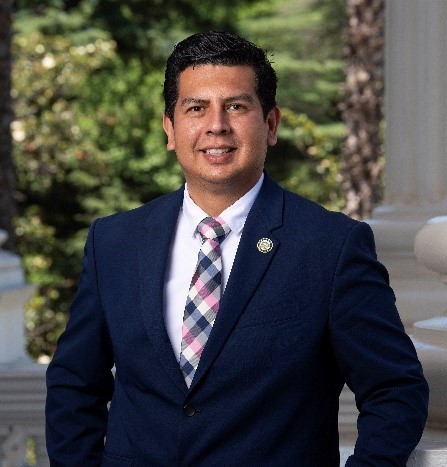
Rep. David Alvarez
Sponsored bills
Existing law generally designates the State Air Resources Board as the state agency with the primary responsibility for the control of vehicular air pollution, and designates air pollution control districts and air quality management districts with the primary responsibility for the control of air pollution from all sources other than vehicular sources. Existing law requires the state board to inventory sources of air pollution within the air basins of the state, determine the kinds and quantity of air pollutants, and monitor air pollutants in cooperation with districts and other agencies. Existing law requires the state board to adopt standards of ambient air quality for each air basin in consideration of the public health, safety, and welfare, including, but not limited to, health, illness, irritation to the senses, aesthetic value, interference with visibility, and effects on the economy. Existing law authorizes these standards to vary from one air basin to another. This bill would require the state board, in consultation with specified entities, to develop, as provided, a response framework that establishes best practices and guidance for addressing fugitive and natural sources of hydrogen sulfide gas and for community preparation and response to hydrogen sulfide exposure events originating from these sources. The bill would require the state board, in developing the response framework, to conduct at least 3 public workshops, including at least one located in the Tijuana River Valley region, at least one located in the Salton Sea region, and at least one selected in consultation with a community that has experienced significant hydrogen sulfide exposure. The bill would require the Office of Environmental Health Hazard Assessment to update the acute and chronic reference exposure levels for hydrogen sulfide and to develop additional health guidance values for hydrogen sulfide, if the need is identified by the state board, in consultation with the office, during development of the response framework.
Maddy summaryThis bill designates September 2026 as Childhood Cancer Awareness Month. It directly affects state agencies and organizations by encouraging them to recognize this specific month for awareness activities. The measure does not change laws or allocate funding but serves as a formal commemorative resolution.
Existing law requires the State Fire Marshal to identify areas in the state as moderate, high, and very high fire hazard severity zones, as specified. Existing law also requires the State Fire Marshal to classify lands within state responsibility areas into fire hazard severity zones, and, by regulation, to designate fire hazard severity zones and assign to each zone a rating reflecting the degree of severity of fire hazard that is expected to prevail in the zone. Existing law requires the State Fire Marshal to periodically review very high fire hazard severity zones that are not state responsibility areas, and designated and rated zones that are state responsibility areas, as provided. This bill would require the Office of the State Fire Marshal, on or before January 1, 2028, to develop home hardening standards, as provided. The bill would require the State Fire Marshal to, on or before January 1, 2030, compile a report concerning homes in moderate, high, and very high fire hazard severity zones in state and local responsibility areas. The bill would require the State Fire Marshal, on or before July 1, 2030, to make the completed report available on its internet website and to submit copies to the Legislature, as provided. The bill would require the report to include, among other things, estimates of both the number of homes that meet those home hardening standards and the number of homes that require more home hardening to meet those standards in each responsibility area and county.
The Mills-Deddeh Transit Development Act establishes the San Diego Metropolitan Transit Development Board, also known as the San Diego Metropolitan Transit System (MTS) , governed by a 15-member board with specified powers and duties related to the operation of public transit services in the southern portion of the County of San Diego. The act authorizes MTS to impose a transactions and use tax of up to 0.5% for public transit purposes within its jurisdiction, or a portion of its jurisdiction, pursuant to the Transactions and Use Tax Law and subject to voter approval and various other requirements. This bill would also authorize those taxes to be imposed by a qualified voter initiative. To the extent that the bill would impose additional duties on a county elections official, the bill would impose a state-mandated local program. The Transactions and Use Tax Law limits the combined rate of all taxes that may be imposed in accordance with that law in any county to 2%. This bill would prohibit the tax rate of 0.5% described above that may be imposed by MTS or a qualified voter initiative from being considered for purposes of the combined rate limit under the Transactions and Use Tax Law. The California Constitution requires the state to reimburse local agencies and school districts for certain costs mandated by the state. Statutory provisions establish procedures for making that reimbursement. This bill would provide that, if the Commission on State Mandates determines that the bill contains costs mandated by the state, reimbursement for those costs shall be made pursuant to the statutory provisions noted above.
This measure would recognize and affirm the important role of artists, arts organizations, creative arts therapists, and arts for health initiatives in supporting behavioral health, promoting recovery, strengthening community resilience, and contributing to public safety. The measure would encourage and recognize exploration, support, and integration of arts and behavioral health within California's health care, behavioral health, and community-based systems.
Existing law vests the Public Utilities Commission with regulatory authority over public utilities, including electrical corporations and gas corporations. Existing law finds and declares that the California Council on Science and Technology (CCST) was organized as a nonprofit corporation at the request of the Legislature for the specific purpose of offering expert advice to the state government on public policy issues significantly related to science and technology. Existing law requests the CCST, every 3 years, to assess the infrastructure project types, scale, and pace necessary to achieve the state's energy, climate change, and air quality goals, as specified. This bill would require the CCST to establish, on or before March 1, 2027, upon appropriation by the Legislature, a program to, upon request of the Legislature, analyze legislation that would establish a mandated requirement or program, as defined, or otherwise affect electrical corporation or gas corporation ratepayers, as specified. The bill would require the analysis to include, among other things, whether the legislation will increase electricity or natural gas utility rates, and if so, would require an assessment of specified financial impacts. The bill would require the CCST to develop and implement conflict-of-interest provisions to prohibit a person from participating in an analysis for which the person knows or has reasons to know that the person has a material financial interest. The bill would repeal these provisions on January 1, 2032.
The Donahoe Higher Education Act sets forth the missions and functions of California's public segments of higher education and their respective institutions of higher education. The California Community Colleges, the California State University, and the University of California are the 3 public segments of postsecondary education in the state. Provisions of the act apply to the University of California only to the extent that the Regents of the University of California act, by appropriate resolution, to make them applicable. This bill would establish the Cal-Bridge Program as a fully intersegmental partnership program between the California Community Colleges, the California State University, and the University of California to create a pathway that promotes the advancement of California's diverse undergraduate public postsecondary student population who major in science, technology, engineering, and mathematics (STEM) disciplines to pursue STEM doctors of philosophy (PhDs) and become members of California's professorate or leaders in California's technology industry. The bill would specify the goals of the Cal-Bridge Program, including, among others, preparing students to apply to PhD programs in STEM disciplines, as specified. The bill would include 5 Cal-Bridge subprograms to provide resources, research opportunities, and financial support to qualifying public postsecondary undergraduate, PhD, and postdoctoral STEM scholars. The bill would also establish the ENLACE Program as an operationally independent program that works in collaboration with the Cal-Bridge Program to create pathways that prepare California's high school and college students for all levels of postsecondary STEM education and the state's STEM workforce, as specified. The bill would require the ENLACE Program to consist of the ENLACE High School and Undergraduate Program to provide support to qualifying students in high school and undergraduate studies across all STEM disciplines at public postsecondary educational institutions, as specified. The bill would authorize funding appropriated for purposes of the Cal-Bridge Program or the ENLACE Program to be used for specified activities. The bill would require the Cal-Bridge Program to submit an annual programmatic progress report to the office of the President of the University of California that includes data on implementation of the Cal-Bridge Program's activities and the allocation of funding for those activities, as specified. The bill would apply to the University of California only to the extent that the Regents of the University of California, by appropriate resolution, make it applicable.
Existing law, as added by Proposition 9, the Victims' Bill of Rights Act of 2008: Marsy's Law (Marsy's Law) , at the November 4, 2008, statewide general election, requires a law enforcement agency investigating a criminal act and an agency prosecuting a criminal act to, at the time of initial contact with a crime victim, during followup investigation, or as soon thereafter as deemed appropriate, provide or make available to the victim a "Marsy Rights" card that contains the constitutional rights of crime victims without charge or cost to the victim. Marsy's Law provides that its provisions shall not be amended by the Legislature except by a statute passed in each house by rollcall vote entered in the journal, 34 of the membership of each house concurring. Marsy's Law also provides that the Legislature may amend its provisions to expand the scope of its application, to recognize additional rights of victims of crime, or to further the rights of victims of crime by a statute passed by a majority vote of the membership of each house. Existing law requires a law enforcement agency investigating a criminal act and an agency prosecuting a criminal act to, at the time of initial contact with a crime victim, during followup investigation, or as soon thereafter as deemed appropriate by investigating officers or prosecuting attorneys, inform each victim of the rights they have under applicable law relating to the victimization and provide each victim without charge or cost a "Victim Protections and Resources" card. Existing law requires the Attorney General to design and make available in PDF or other imaging format this card with specified information on the card, including information about federal immigration relief available to certain victims of crime. Commencing no later than January 1, 2028, this bill, the Defending Immigrant Victims Act, would require a law enforcement agency investigating a criminal act and an agency prosecuting a criminal act, at the time of initial contact with a crime victim, during followup investigation, or as soon thereafter as deemed appropriate by investigating officers or prosecuting attorneys, to inform each victim, the victim's next of kin if the victim is deceased, or the victim's parent or guardian if the victim is a minor of the rights they may have under applicable law relating to immigration relief. The bill would require a law enforcement agency and a prosecuting agency to provide a victim an "Immigrant Victims Rights and Resources" card that would provide specified information pertaining to the victim's rights, including a statement explaining how to consult an immigration attorney to help determine eligibility for immigration relief. The bill would require the Attorney General, by January 1, 2028, to design the card and make it available in English, Spanish, and any other language in which the "Marsy Rights" card is currently translated, and in a PDF or other imaging format, to law enforcement agencies and agencies prosecuting crimes, as specified. Because this bill would result in additional duties on local law enforcement and prosecuting agencies in informing victims, this bill would impose a state-mandated local program. This bill would make a conforming change. The California Constitution requires the state to reimburse local agencies and school districts for certain costs mandated by the state. Statutory provisions establish procedures for making that reimbursement. This bill would provide that, if the Commission on State Mandates determines that the bill contains costs mandated by the state, reimbursement for those costs shall be made pursuant to the statutory provisions noted above.
Existing law requires the State Energy Resources Conservation and Development Commission to undertake various actions in furtherance of meeting the state's clean energy and pollution reduction objectives. Existing law requires the commission, beginning November 1, 2003, and biennially thereafter, to adopt an integrated energy policy report that contains an overview of major energy trends and issues facing the state, presents policy recommendations based on an in-depth and integrated analysis of the most current and pressing energy issues facing the state, and includes an assessment and forecast of system reliability and the need for resource additions, efficiency, and conservation, as specified. Existing law requires the commission, as part of the 2027 edition of the integrated energy policy report, to include an assessment of the potential for fusion energy to contribute to California's power supply, as specified. This bill would require the commission, in coordination with specified agencies, to develop a strategic plan for the development of fusion energy in California, as specified. The bill would require the commission to submit the strategic plan to the Legislature on or before December 31, 2029. This bill would require the commission, in coordination with relevant agencies and the fusion energy industry, to (1) develop a strategy for the expansion and development of fusion research and development in California, (2) develop a strategy for supporting the commercialization of fusion energy in California, (3) develop a regulatory framework for fusion energy and a roadmap for licensing and permitting for new fusion energy research and fusion energy facilities, and (4) assess the level at which fusion energy at scale would best support California's long-term renewable energy and greenhouse gas emission reduction goals. The bill would require the information described in this paragraph to be included in the strategic plan, as specified. Existing law authorizes persons proposing specified electrical generation, electrical transmission, hydrogen production, energy storage, and geothermal projects to apply, on or before June 30, 2030, to the commission to certify sites and related facilities as environmental leadership development projects, as specified. Existing law makes a site and related facility certified by the commission subject to streamlining benefits related to the California Environmental Quality Act (CEQA) with no further action by the applicant or the Governor. Under existing law, the commission's certification is in lieu of any permit, certificate, or similar document required by any governmental agency and supersedes any applicable statute, ordinance, or regulation, except as specified. This bill would expand the types of facilities eligible to be certified as environmental leadership development projects by the commission to include a discretionary project, as described, for the manufacture, production, or assembly of specialized products, components, or systems that are integral to fusion energy.