

The California FAIR Plan Association is a joint reinsurance association in which all insurers licensed to write basic property insurance participate to administer a program for the equitable apportionment of basic property insurance for persons who are unable to obtain that coverage through normal channels. Existing law requires the Insurance Commissioner to approve the association's plan of operation and authorizes the commissioner to examine the association's books, records, files, papers, and documents that relate to its operation. Existing law authorizes the commissioner to impose civil penalties for various violations of the Insurance Code. This bill would require the association to take corrective actions, as specified by the commissioner or their designee, to rectify violations of applicable statutes, regulations, accounting principles, the plan of operation, or other legally binding applicable rules identified in a report of examination or other operational report. The bill would subject the association to a penalty of not more than $20,000 for failing to take the specified corrective action within a timeframe agreed upon by the commissioner or their designee. The bill would set other civil penalty amounts for violations of provisions relative to the association as not to exceed $10,000 for each act in violation or not to exceed $20,000 if the act was willful, and would require the commissioner to impose those penalties, as specified. The bill would also authorize the commissioner to require the association to both adjust the policy limits available under programs underwritten by the association and make additional coverage offerings available for fair rental value coverage under the association's renters' property insurance program. This bill would incorporate additional changes to Section 10095 of the Insurance Code proposed by AB 69 to be operative only if this bill and AB 69 are enacted and this bill is enacted last.
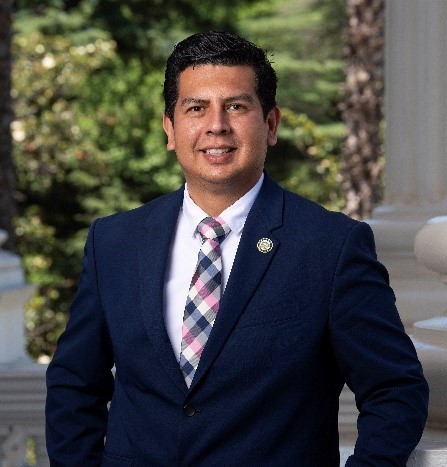
Rep. David Alvarez
Sponsored bills
This measure would declare the Legislature's opposition to any federal executive action that restricts, burdens, or interferes with California's vote by mail system and would call upon the United States Congress to reject any federal legislation that would restrict or eliminate vote by mail options and to protect the constitutional authority of states to administer their own elections.
Existing law establishes the California State University and its various campuses under the administration of the Trustees of the California State University. Existing law provides that the name "California State University" and the names of various campuses of the California State University, and abbreviations of those names, including "Cal Maritime," are the property of the state, and prohibits the use of any of these names without the permission of the trustees. Under existing law, a violation of this provision is punishable as a misdemeanor. This bill would add "Cal Poly Maritime" and "Cal Poly Maritime Academy" to the list of abbreviations of campus names of the California State University that are the property of the state. By expanding the scope of a crime, the bill would create a state-mandated local program. This bill would require the Trustees of the California State University, on or before January 1, 2028, to submit a report to the Legislature regarding the Cal Poly Maritime Academy following its integration with California Polytechnic State University, San Luis Obispo, as provided. The California Constitution requires the state to reimburse local agencies and school districts for certain costs mandated by the state. Statutory provisions establish procedures for making that reimbursement. This bill would provide that no reimbursement is required by this act for a specified reason.
Maddy summaryThis bill designates 2026 as the International Year of the Woman Farmer to acknowledge the vital contributions of women in agriculture. It functions as a formal proclamation rather than a law that changes regulations or allocates funding. The measure directly affects the state by officially recognizing the importance of female agricultural workers during that year.
This measure would affirm the fundamental importance of indigent defense to due process, equal justice, and democratic governance, recognize public defenders as essential protectors of constitutional rights and the rule of law, and encourage the development of statewide approaches to indigent defense.
Maddy summaryThis bill designates June 2026 as Electronic Dance Music Month to recognize the genre's cultural significance. It directly affects communities and organizations involved in the electronic dance music scene by encouraging public awareness and celebration during that period. The measure requires no new funding or legal changes, serving instead as a symbolic declaration to highlight the month's theme.
Maddy summaryThis bill designates the month of June as Dairy Month throughout California. It directly affects the state by officially recognizing the dairy industry during this specific time period. The measure requires no changes to laws or regulations, as it serves only as a symbolic proclamation.
This measure would encourage the chief administrator of each public building or facility owned by the state, a county, or a municipality to display the 9/11 Remembrance Flag on September 11 of each year and to prescribe procedures necessary for its display. The measure would declare that any public official or chief administrator of a public building or facility may accept a donation of one or more 9/11 Remembrance Flags for the purpose of display at a public building or facility owned by the state, a county, or a municipality.
This measure would call on the state's Representatives in Congress to continue to support investments in the federal Local Food for Schools and Child Care program and would call on the President of the United States to work with Congress to support family farmers who produce fresh, locally sourced food for school meals.
Maddy summaryACR 61 designates April 9-15, 2025, as Filicide Awareness Week through a formal proclamation. This resolution does not create new laws or affect specific groups; it simply establishes a designated week for public awareness. The key mechanism is the official naming of the dates by the legislature to encourage community education about filicide (the killing of a child by a parent or caregiver). The bill has no policy changes or funding provisions, serving solely as a commemorative measure.