

Existing law establishes the Labor and Workforce Development Agency, consisting of various offices and entities, including the office of the Secretary of Labor and Workforce Development, the Agricultural Labor Relations Board, and the California Workforce Development Board. This bill would establish the Essential Worker Commission within the Labor and Workforce Development Agency, to review, investigate, and analyze issues relating to essential workers in the state, including workplace safety and health protections and wages and benefits for undocumented workers. The bill would require the Essential Worker Commission, based on that review, investigation, and analysis, to establish the Essential Worker Legal Work Program to provide essential workers with legal pathways to remain in California and work lawfully.
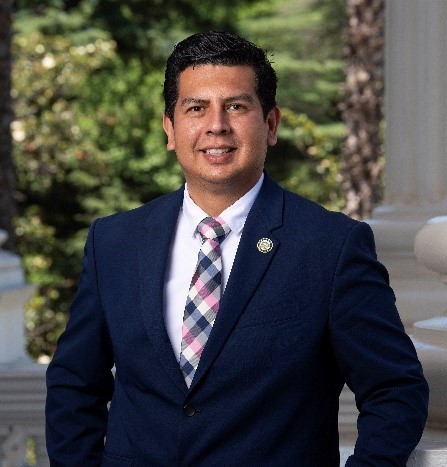
Asm. David Alvarez
Sponsored bills
Existing law provides that a candidate for a nonpartisan office who at a primary election receives votes on a majority of all the ballots cast for candidates for that office is elected to that office. This bill would exempt from that provision candidates for county nonpartisan offices, including a county office in a charter county, but not including a charter city and county, and would require the candidates who received the highest and second highest number of votes cast for nomination to that office to be placed on the ballot at the ensuing general election, except as specified. By imposing new duties on counties, including county elections officials, the bill would impose a state-mandated local program. The California Constitution requires the state to reimburse local agencies and school districts for certain costs mandated by the state. Statutory provisions establish procedures for making that reimbursement. This bill would provide that, if the Commission on State Mandates determines that the bill contains costs mandated by the state, reimbursement for those costs shall be made pursuant to the statutory provisions noted above.
Existing law establishes in the Business, Consumer Services, and Housing Agency a Department of Financial Protection and Innovation under the direction of the Commissioner of Financial Protection and Innovation. Under existing law, the department has charge of the execution of specified laws relating to various financial institutions and financial products and services. This bill would enact the California Elder Financial Abuse Prevention Act, which would authorize a depository institution, as defined, to take specified actions when, based on their own observations or information received from a governmental or law enforcement agency, the institution believes that an eligible adult, as defined, is the victim or target of financial abuse, including delaying or refusing a transaction involving the eligible adult and preventing the transfer of funds from the eligible adult's account. The bill would authorize a depository institution to notify an associated third party, as defined, if the depository institution believes an eligible adult may be the victim of financial abuse, and would exempt that disclosure from state privacy laws or requirements.
Existing law authorizes the Director of General Services to execute grants to real property belonging to the state in the name and upon behalf of the state, whenever the sale or exchange of real property is authorized or contemplated by law, if no other state agency is specifically authorized and directed to execute the grants. This bill would require the director to quitclaim to the San Pasqual Band of Mission Indians, at no cost to the tribe, all interests of the state in the land that it owns within the San Pasqual Battlefield State Park, consisting of 3 parcels of land totaling approximately 3.68 acres. This bill would encourage the City of San Diego to transfer to the San Pasqual Band of Mission Indians all of the city's interests in the land the city owns within the San Pasqual Battlefield State Park, and if the city agrees to the transfer, would require the state, at no cost to the tribe, to relinquish or transfer to the San Pasqual Band of Mission Indians all rights and interests that the state has in those lands through lease, permit, or otherwise, and to take any and all other actions necessary to effectuate the city's transfer of the land to the San Pasqual Band of Mission Indians. This bill would make legislative findings and declarations as to the necessity of a special statute for the San Pasqual Band of Mission Indians. This bill would make legislative findings and declarations related to a gift of public funds.
Existing law establishes the California College Promise, under the administration of the Chancellor of the California Community Colleges, to provide funding, upon appropriation by the Legislature, to each community college meeting prescribed requirements. Existing law authorizes a community college to use that funding to waive some or all of the fees for 2 academic years for first-time community college students and returning community college students, as defined, who are enrolled in 12 or more semester units or the equivalent, or less for students certified as "full time," as specified, and who complete and submit either a Free Application for Federal Student Aid or a California Dream Act application, except as provided. This bill would authorize extending the term of eligibility of the California College Promise for an additional 2 academic years for first-time community college students and returning community college students who matriculate into upper division coursework of a community college baccalaureate degree program, as specified.
Existing law requires the State Board of Education to adopt statewide academically rigorous content standards in the core curriculum areas of reading, writing, mathematics, history/social science, and science, as specified. Existing law requires the Instructional Quality Commission to, among other things, recommend curriculum frameworks to the state board and develop criteria for evaluating instructional materials. This bill would require the state board to, on or before January 1, 2028, develop and adopt academically rigorous content standards for ethnic studies instruction in high school. The bill would require the commission, on or before January 1, 2028, to review and recommend to the state board curriculum frameworks and instructional materials for ethnic studies instruction in high school, as specified. The bill would require the state board to provide the commission with evaluation criteria to use in providing its review and recommendations. The bill would state the intent of the Legislature to enact subsequent legislation to establish an advisory committee with a majority of the advisory committee's members being experts in African American studies, Asian American and Pacific Islander studies, Native American studies, and Latino and Chicanx studies, to provide input to the state board on proposed content standards and to the commission on proposed curriculum frameworks and instructional materials for ethnic studies instruction in high school. Existing law requires a pupil to complete designated coursework while in grades 9 to 12, inclusive, in order to receive a diploma of graduation from high school. These graduation requirements include, commencing for pupils graduating in the 2029–30 school year, the completion of a one-semester course in ethnic studies meeting specified requirements. Under existing law, the requirement to complete an ethnic studies course may be fulfilled by the completion of, among others, a course based on the model curriculum developed by the Instructional Quality Commission, an ethnic studies course taught as part of a course that has been approved as meeting the A–G requirements of the University of California and the California State University, or a locally developed ethnic studies course approved by the governing board of a school district or the governing body of a charter school. Existing law requires the curriculum, instruction, and instructional materials for these ethnic studies courses to meet specified requirements, including that they not reflect or promote any bias, bigotry, or discrimination against any person or group of persons on the basis of certain characteristics. Existing law makes these provisions relating to ethnic studies courses operative only upon an appropriation of funds by the Legislature for purposes of these provisions. This bill would require the curriculum, instruction, and instructional materials for any high school ethnic studies course, including ethnic studies courses meeting high school graduation requirements, to meet the above-described requirements, and would require the curriculum, instruction, and instructional materials for all high school ethnic studies courses to additionally, among other things, foster multicultural respect and understanding and focus on the domestic experience and stories of historically marginalized peoples in American society. To the extent that the bill would impose new duties on local educational agencies, the bill would impose a state-mandated local program. The bill would require a school district, county office of education, or charter school to provide, on or before June 30, 2026, the State Department of Education with a copy of all curricula, instruction, and instructional materials in ethnic studies that schools offer or plan to offer to pupils in any of grades 9 to 12, inclusive, and the adoption calendar for curricula, instruction, and instructional materials in ethnic studies proposed for adoption by the governing board or body of the local educational agency for instruction to these pupils. The bill would require a local educational agency that does not have an ethnic studies course in place for its pupils in any of grades 9 to 12, inclusive, on or before June 30, 2026, to provide the department with a copy of all curricula, instruction, and instructional materials in ethnic studies that its schools seek to adopt at least 60 days before being first presented at a public meeting of the governing board or body of the local educational agency for instruction to these pupils. The bill would require the department to post the information received pursuant to these requirements on its internet website. To the extent that the bill would impose new duties on local educational agencies, it would impose a state-mandated local program. The bill would require the department to monitor compliance with the requirements of this bill as part of its annual compliance monitoring of state and federal programs and to provide a report to the relevant policy and fiscal committees of the Legislature summarizing the data collected through compliance monitoring, as specified. The California Constitution requires the state to reimburse local agencies and school districts for certain costs mandated by the state. Statutory provisions establish procedures for making that reimbursement. This bill would provide that, if the Commission on State Mandates determines that the bill contains costs mandated by the state, reimbursement for those costs shall be made pursuant to the statutory provisions noted above.
The Otay Mesa East Toll Facility Act authorizes the San Diego Association of Governments (SANDAG) to carry out a construction project for the State Highway Route 11 corridor, including, among other things, highway improvements and international border crossing facilities, to be operated as a toll facility. Existing law authorizes SANDAG to fix and revise from time to time and charge and collect tolls and other charges only for entrance to or the use of the corridor, as provided. Existing law authorizes SANDAG to use specified alternative project delivery methods under certain conditions. Existing law requires toll revenues to be used for specified costs, as provided. Existing law defines "project" for purposes of the act to include facilities, whether or not now in existence, acquired or constructed to facilitate the movement of goods and people along the corridor or at the Otay Mesa East Port of Entry. This bill would revise and recast the act by, among other things, (1) revising the definition of "project" for purposes of the act to include facilities, whether or not now in existence, acquired or constructed to facilitate the movement of goods and people adjacent to the Otay Mesa East Port of Entry or to facilitate the generation of revenue for, or related to, the Otay Mesa East Port of Entry, (2) authorizing public-private partnerships, as specified, as an alternative project delivery method, (3) authorizing SANDAG to also impose tolls and other charges for the use of a project or property covered by the act, and (4) adding payments to a private partner under a public-private partnership agreement to the categories of costs for which toll revenues are used under the act, as provided. The bill would also make conforming changes.
The Personal Income Tax Law allows various credits against the taxes imposed by that law, including a young child tax credit to a qualified taxpayer in a specified amount multiplied by the earned income tax credit adjustment factor, as provided. That law also allows a payment from the continuously appropriated Tax Relief and Refund Account for an amount in excess of tax liability. Existing law defines "qualified taxpayer" for this purpose to include an eligible individual, as defined, who has a qualifying child, defined to be a child younger than 6 years of age as of the last day of the taxable year, and who meets other specified criteria. This bill, for taxable years beginning on or after January 1, 2025, would instead define a "qualifying child" to mean a child younger than a specified age as of the last day of the taxable year, as described. By increasing the payments from the Tax Relief and Refund Account, a continuously appropriated fund, the bill would make an appropriation. Existing law requires any bill authorizing a new tax expenditure to contain, among other things, specific goals that the tax expenditure will achieve, detailed performance indicators, and data collection requirements. This bill would include additional information required for any bill authorizing a new tax expenditure.
Existing law, the Knox-Keene Health Care Service Plan Act of 1975, provides for the licensure and regulation of health care service plans by the Department of Managed Health Care, and makes a willful violation of the act a crime. Existing law requires a prepaid health plan to apply for licensure as a health care service plan if the prepaid health plan operating lawfully under the laws of Mexico elects to operate a health care service plan in this state. Existing law requires the application for licensure to demonstrate compliance with specified requirements, including that the prepaid health plan offers and sells in this state only employer-sponsored group plan contracts exclusively for the benefit of Mexican nationals legally employed in the County of San Diego or the County of Imperial, and their dependents, that pay for the delivery of health care services that are provided wholly in Mexico, except as specified. Existing law also requires the application for licensure to demonstrate that the prepaid health plan maintains a tangible net equity of at least $1,000,000 or to demonstrate a reasonable acceptable alternative reimbursement arrangement that the Director of the Department of Managed Health Care is authorized, in the director's discretion, to accept. This bill would modify the above-described requirement that a prepaid health plan offers and sells in this state only employer-sponsored group plan contracts exclusively for the benefit of specified Mexican nationals to additionally include employer-sponsored group plan contracts for the benefit of individuals legally employed in the County of San Diego or the County of Imperial, and for the benefit of their dependents regardless of nationality. The bill would authorize a prepaid health plan operating lawfully under the laws of Mexico that is licensed to operate a health care service plan to offer and sell that employer-sponsored group plan contract only to an employer that provides alternative health care coverage through either a specified full-service health care service plan or a health insurance policy. The bill would modify the above-described requirement that a prepaid health plan maintains a tangible net equity of at least $1,000,000 to instead require a prepaid health plan to maintain a tangible net equity of at least $2,300,000 or to demonstrate an alternative reimbursement arrangement subject to the director's discretion, as described above. Because a willful violation of these provisions by a prepaid health plan, as described above, would be a crime, the bill would impose a state-mandated local program. The California Constitution requires the state to reimburse local agencies and school districts for certain costs mandated by the state. Statutory provisions establish procedures for making that reimbursement. This bill would provide that no reimbursement is required by this act for a specified reason.
Existing law, the World Language Teacher Exchange and Recruitment Law of 1963, requires the State Board of Education to adopt rules and regulations under which teachers employed by California school districts may exchange positions with teachers in schools in other countries for a period of one year or less. Existing law requires the arrangements for the exchanges to be made through the State Department of Education and in cooperation with the teacher exchange programs administered by agencies of the federal government. This bill would require the state board's rules and regulations for the exchanges to (1) expressly provide for exchanges with Mexico, (2) apply to school districts, county offices of education, and charter schools, and (3) authorize specified visa sponsors designated by the United States Department of State, in addition to the State Department of Education, to sponsor teachers from Mexico for placement in California school districts, county offices of education, and charter schools to promote cultural exchange for specified purposes.