

Existing law authorizes the Department of Toxic Substances Control (DTSC) , in consultation with the Department of Resources Recycling and Recovery, the State Water Resources Control Board, and affected local air quality management districts, to adopt regulations to establish management standards for metal shredding facilities for hazardous waste management activities within the DTSC's jurisdiction, as provided. Existing law provides that treated metal shredder waste that is managed in accordance with those regulations is deemed to be solid waste, and not hazardous waste, as provided. This bill would repeal those provisions. The bill would establish a comprehensive scheme for the regulation of metal shredding facilities that would be administered by the DTSC pursuant to authority separate from laws governing the control of hazardous waste. The bill would prohibit an owner or operator from operating a metal shredding facility, as defined, in the state unless they have a permit from the DTSC or are deemed to have a permit. The bill would prescribe the requirements for obtaining a permit, for being deemed to have a permit, for operating a metal shredding facility, and for transporting certain materials related to metal shredding, as specified. The bill would require, before a decision is made to approve or deny the application, the DTSC to hold a public meeting, as provided. The bill would require the department to take final action on a permit application by an existing facility within 3 years, as provided. The bill would require the department to post on its internet website general information about each metal shredding facility that has applied for or obtained a permit, and to conduct at least one site visit to the applicant's facility after receipt of the permit application. The bill would provide that certain materials related to metal shredding are not hazardous waste if they meet specified requirements. The bill would require any report required to be submitted by a metal shredding facility pursuant to a permit issued to be signed by the owner or operator and certified under penalty of law, including criminal penalties, as specified. The bill would require the DTSC to have primary responsibility for enforcing these provisions, would require the DTSC to conduct an annual compliance evaluation inspection of each metal shredding facility, and would authorize the DTSC to refer violations to a district attorney or the Attorney General for prosecution. The bill would also require the DTSC to inform the local health officer and the director of environmental health of a county, city, or district within 15 days after the DTSC becomes aware of any unlawful disposal of materials, as provided, and of any enforcement action against a metal shredding facility as a result of that unlawful disposal. Because the bill would expand the scope of a crime, the bill would impose a state-mandated local program. The bill would require an owner or operator of a metal shredding facility to report to the DTSC certain emergency situations, as specified. The bill would require an owner or operator of a metal shredding facility to submit to the DTSC a closure plan and a cost estimate for closing the metal shredding facility, as specified. The bill would also require the owner or operator of a metal shredding facility to provide written notice to the department at least 60 days before transferring ownership or operation of the facility. The bill would authorize the DTSC to enforce these provisions by revoking permits and by other specified means. The bill would authorize the DTSC to adopt regulations for the operation of metal shredding facilities as necessary to implement the requirements of the bill. The bill would require the DTSC to post information provided by owners and operators regarding a metal shredding facility on the department's internet website in a manner that is readily accessible to the public, except as otherwise required pursuant to existing law. Existing law authorizes the DTSC to collect an annual fee from all metal shredding facilities subject to the requirements of hazardous waste control laws or the DTSC's management standards for metal shredding facilities, as provided. Existing law requires the DTSC to adopt regulations necessary to administer the fee and authorizes the DTSC to adopt those regulations using emergency procedures, as provided. Existing law requires the Controller to establish a separate subaccount in the Hazardous Waste Control Account and for all fees collected to be placed into that subaccount, to be available for expenditure by the DTSC upon appropriation by the Legislature. This bill would instead require the DTSC to impose an annual fee on all metal shredding facilities subject to the provisions of this bill, as specified. The bill would require, beginning in the 2026–27 fiscal year, the rates established by the DTSC to be reviewed and increased or decreased annually, as provided. The bill would require the DTSC to adopt regulations necessary to administer the fee and would authorize the DTSC to adopt the regulations using emergency procedures, as specified. The bill would require a person who applies for a metal shredding facility permit to enter into a written agreement with the department pursuant to which that person would be required to reimburse the department for the direct costs reasonably incurred by the department in processing the application, as provided. The bill would require the Controller to establish a new and separate Metal Shredding Facility subaccount to be administered by the Director of Toxic Substances Control and would require all fees collected to be placed into that subaccount and made available for expenditure by the DTSC solely for the purpose of implementation and administration of these provisions, upon appropriation by the Legislature. Existing law requires the DTSC to require metal shredding facilities to monitor hazardous waste constituents requested by the DTSC and to report the results of that monitoring to the DTSC. Existing law also requires the DTSC to collect and analyze light fibrous material at the fence lines to determine the potential for release of hazardous waste. Existing law requires, on or before July 1, 2027, the DTSC to develop a procedure for community notification of the public for the area in which the metal shredding facility is located if that monitoring indicates any release of light fibrous material. In addition, existing law requires, on or before January 1, 2027, an air pollution control district or an air quality management district the jurisdiction of which includes metal shredding facilities, in consultation with the DTSC and the Office of Environmental Health Hazard Assessment (OEHHA) , to develop requirements for facilitywide fence-line air quality monitoring at metal shredding facilities. Existing law authorizes any reasonable regulatory costs incurred by the DTSC in implementing, and requires that the OEHHA's costs to implement, the above-described duties be reimbursed from a subaccount established in the Hazardous Waste Control Account for the deposit of fees from metal shredding facilities. This bill would limit the scope of those provisions to metal shredding facilities that are subject to the other provisions of the bill and would provide for the reimbursement of those costs from the Metal Shredding Facility Subaccount. The bill would include findings that changes proposed by this bill address a matter of statewide concern rather than a municipal affair and, therefore, apply to all cities, including charter cities. The California Constitution requires the state to reimburse local agencies and school districts for certain costs mandated by the state. Statutory provisions establish procedures for making that reimbursement. This bill would provide that no reimbursement is required by this act for a specified reason.
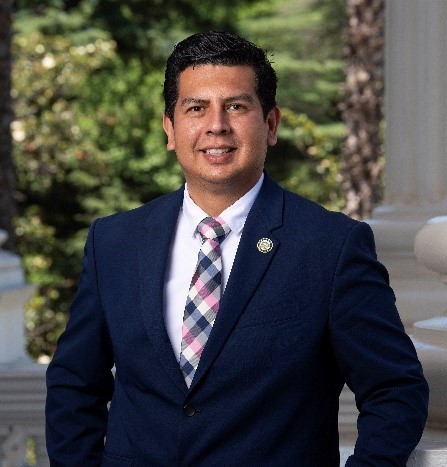
Asm. David Alvarez
Sponsored bills
Maddy summaryACR 116 is a ceremonial resolution honoring Reverend Dr. Martin Luther King, Jr. and commemorating Martin Luther King Jr. Day. It does not create new laws or affect specific groups, as it is a symbolic gesture of recognition. The measure was adopted by the Assembly on January 16, 2026, and is now pending in the Senate Committee on Rules and Legislative Services. This type of resolution typically serves to acknowledge historical figures or events without implementing policy changes.
Maddy summaryACR 118 designates January 13, 2026, as Korean American Day in recognition of Korean American contributions. This ceremonial resolution does not create new laws or affect policy; it simply formally proclaims a specific date for observance. The bill directly affects public acknowledgment of Korean American heritage within the state. It has advanced through committee approval and passed the Assembly with unanimous support.
This measure would proclaim the month of January 2026 as National Mentoring Month, and would proudly recognize Big Brothers Big Sisters of Central California for its unwavering commitment to the children and families of our region and its enduring impact on future generations.
Maddy summaryACR 122 designates the week of January 25-31, 2026, as Anesthesiologists Week to honor anesthesiologists for their contributions to patient care. This ceremonial resolution has no binding effect or policy changes - it simply recognizes the profession through a symbolic week-long observance. It directly affects the broader public by raising awareness of anesthesiologists' roles, but does not impose requirements or alter laws. The bill is currently pending in the Senate Committee on Rules and Licensing (RLS).
This measure would recognize January as National Blood Donor Month and urge all citizens to celebrate the cause of blood donation and recognize volunteer blood donors for their generous gifts, urge all eligible blood donors to donate regularly, and encourage businesses and organizations throughout the state to sponsor community-based blood drives with their local blood centers and provide citizens of our State with the opportunity to give.
This measure would designate the portion of State Route 101 in the County of Santa Clara from Story Road to the junction with State Highway Route 280 and State Highway Route 680 as the Little Saigon Freeway. The measure also would request the Department of Transportation to determine the cost of appropriate signs showing that special designation and, upon receiving donations from nonstate sources sufficient to cover the cost, to erect those signs.
Maddy summaryThis bill is a House Resolution that formally recognizes the history of Japanese American incarceration during World War II and honors the service of Japanese American veterans. It details how Executive Order 9066 led to the removal of over 125,000 people of Japanese ancestry from their homes and describes the subsequent military contributions of these individuals, including recipients of the Medal of Honor. The resolution also acknowledges the government's admission that the incarceration was based on racial prejudice rather than military necessity and notes previous state and federal apologies and reparations. By citing these historical facts, the bill serves to educate the public and reaffirm the state's commitment to preventing similar civil rights violations in the future.
Maddy summaryThis House Resolution officially recognizes February 17, 2026, as the beginning of the Lunar New Year in California. It acknowledges the cultural significance of the holiday for over 3 million Asian and Pacific Islander residents who celebrate it as a time to renew family ties and start fresh. The resolution highlights the state's diverse population and the contributions of Asian and Pacific Islander communities to California's social, cultural, and economic life. It formally extends best wishes for a peaceful and prosperous Lunar New Year to all Californians.