

Existing law allows an individual taxpayer to contribute amounts in excess of their personal income tax liability for the support of specified funds and accounts, including, among others, to the Native California Wildlife Rehabilitation Voluntary Tax Contribution Fund. This bill would allow, for taxable years beginning on or after January 1, 2026, and before January 1, 2033, an individual to designate on their tax return that a specified amount in excess of their tax liability be transferred to the continuously appropriated Black Cultural District Voluntary Tax Contribution Fund (fund) , which would be created by this bill. The bill would allocate moneys in the fund to, among other entities, the Arts Council for allocation for the construction and maintenance of the Black Cultural District designated in south City of Los Angeles. The bill would require the Franchise Tax Board to revise the tax return form to include a space for the designation of contributions to the fund. By establishing a new continuously appropriated fund, the bill would make an appropriation. This bill would provide that these provisions would remain in effect only until January 1, 2034, but would further provide for an earlier repeal if the Franchise Tax Board determines that the amount of contributions estimated to be received by September 1, 2028, and later calendar years will not at least equal the minimum contribution amount, in which case these provisions would be repealed on January 1 of the following year.
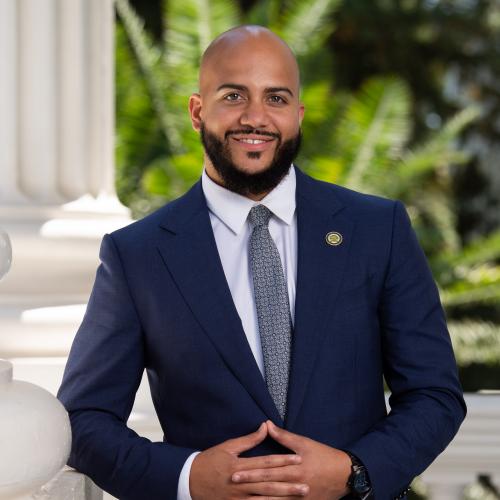
Rep. Isaac Bryan
Sponsored bills
Existing law establishes the California Work Opportunity and Responsibility to Kids (CalWORKs) program, under which each county provides cash assistance and other benefits to qualified low-income families and individuals using federal, state, and county funds. Existing law establishes the CalWORKs Recipients Education Program (program) in the California Community Colleges under which community college districts are required to provide educational services and special services to recipients of aid under CalWORKs who are attending a community college, to the extent funding is provided in the annual Budget Act. Existing law requires special services for CalWORKs recipients to assist CalWORKs recipient students and those students transitioning off of CalWORKs in achieving long-term self-sufficiency through coordinated student services offered at a community college. Existing law authorizes those special services to include workstudy. Existing law prohibits program payments to an employer for workstudy from exceeding 75% of the wage for the workstudy positions and requires an employer to pay at least 25% of the wage for the workstudy positions. This bill would add direct aid designed to meet basic needs and services, as described, as a special service for which program funds may be used. The bill would also require special services for CalWORKs recipients to assist CalWORKs recipient students and those students transitioning off of CalWORKs in achieving economic mobility through coordinated student services offered at a community college. The bill would authorize programs to waive the requirement that an employer pay at least 25% of the wage for workstudy positions if the number of on-campus and off-campus workstudy positions will not decrease. By expanding program services, the bill would impose a state-mandated local program. The California Constitution requires the state to reimburse local agencies and school districts for certain costs mandated by the state. Statutory provisions establish procedures for making that reimbursement. This bill would provide that, if the Commission on State Mandates determines that the bill contains costs mandated by the state, reimbursement for those costs shall be made pursuant to the statutory provisions noted above.
Existing law governs the obligations of tenants and landlords. Existing law prohibits a landlord who allows an animal on the premises from advertising or establishing rental policies in a manner that requires a tenant or a potential tenant with an animal to have that animal declawed or devocalized as a condition of occupancy, as provided. This bill would require a landlord or their agent to have a pet policy or pet addendum in writing and to provide access to the property's pet policy or addendum on the property's internet website, in digital advertisements, and in information provided to a residential rental search engine, as prescribed. The bill would require a landlord or their agent to provide a written copy of the property's established pet policy or pet addendum with any rental application form. The bill would require a pet policy or pet addendum to include specified information, including a description of the rights, responsibilities, and requirements for tenant pet owners at the property. The bill would establish conditions for a landlord or their agent to substantially comply with these provisions and would specify that a nonmaterial error or omission that is corrected upon notice does not constitute a violation of these provisions. The bill would specify that it does not affect obligations or rights under state or federal law relating to service and support animals. The bill would require any landlord or their agent who charges an application fee but fails to disclose the established pet policy or pet addendum before charging the fee, and due to the landlord's or their agent's failure to disclose that information, the applicant is no longer eligible to rent the unit or declines to proceed with the application, to refund the application fee to the applicant upon request, as specified. The bill would make its provisions operative on April 1, 2027.
The Planning and Zoning Law requires a city or county to adopt a general plan for land use development that includes, among other things, a housing element containing specified information, including an analysis of its special housing, emergency shelter, and supportive housing needs, as defined. Existing law defines the term "target population" for purposes of requirements applicable to the housing element to include certain persons, including persons with low incomes who have one or more disabilities and individuals eligible for specified developmental disability services. This bill, the Unseen and Unheard Housing Act, would provide that the definition of the term "target population" for the purposes of requirements applicable to the housing element, as described above, may include victims of domestic violence, victims of sexual assault, and victims of human trafficking, as specified.
Maddy summaryThis bill designates September 2026 as Childhood Cancer Awareness Month. It directly affects state agencies and organizations by encouraging them to recognize this specific month for awareness activities. The measure does not change laws or allocate funding but serves as a formal commemorative resolution.
This measure would recognize and affirm the important role of artists, arts organizations, creative arts therapists, and arts for health initiatives in supporting behavioral health, promoting recovery, strengthening community resilience, and contributing to public safety. The measure would encourage and recognize exploration, support, and integration of arts and behavioral health within California's health care, behavioral health, and community-based systems.
Existing law, subject to an appropriation in the annual Budget Act, requires the Department of Housing and Community Development to provide, under the Transitional Housing Program, funding to counties for allocation to child welfare services agencies to help young adults who are 18 to 24 years of age, inclusive, secure and maintain housing, with priority given to young adults formerly in the state's foster care or probation systems. Existing law, subject to an appropriation in the annual Budget Act, also requires the department to allocate funding to counties under the Housing Navigation and Maintenance Program to help young adults who are 18 to 24 years of age, inclusive, secure and maintain housing, with priority given to young adults currently or formerly in the foster care system. This bill would extend the age of eligibility for the Housing Navigation and Maintenance Program to young adults who are 18 to 28 years of age, inclusive, and would, instead, give priority to nonminor dependents and young adults formerly in the state's foster care or probation system, as defined. The bill would specify the eligible uses of the funding allocated to a county child welfare agency under the Housing Navigation and Maintenance Program. Existing law requires a child welfare agency that accepts any distribution of money under either program to report certain data to the department on an annual basis, including specified information relating to the number of homeless youth served and the number of former or current foster youth served, as defined. This bill would revise those reporting requirements to instead require information about the number of young adults served, including the number of young adults formerly in the state's foster care or probation system, as defined, and would require additional information to be reported under the Housing Navigation and Maintenance Program related to housing vouchers, as specified.
Existing law establishes the Natural Resources Agency, which consists of various departments, including the Department of Conservation, the Department of Fish and Wildlife, and the Department of Parks and Recreation. Existing law vests in the Natural Resources Agency various powers, including those related to conservation of lands. By Executive Order No. N-82-20, Governor Gavin Newsom directed the Natural Resources Agency to combat the biodiversity and climate crises by, among other things, establishing the California Biodiversity Collaborative and conserving at least 30% of the state's lands and coastal waters by 2030. Existing law requires the Secretary of the Natural Resources Agency to prepare and submit, on or before March 31, 2024, and annually thereafter, a report to the Legislature on the progress made in the prior calendar year toward achieving the goal to conserve 30% of California's lands and coastal waters by 2030. Existing law provides that it is the goal of the state to conserve at least 30% of California's lands and coastal waters by 2030, known as the 30x30 goal. Existing law establishes the Equitable Outdoor Access Act (act) , which sets forth the state's commitment to ensuring all Californians can benefit from, and have meaningful access to, the state's rich cultural and natural resources. Existing law declares that it is state policy, among other things, to ensure that all Californians have equitable opportunities to safe and affordable access to nature and access to the benefits of nature, and to prevent and minimize the intentional and unwarranted limitation of sustainable public access to public lands, where appropriate, including, but not limited to, local, regional, state, and federal parks, rivers, lakes, beaches, forests, mountain ranges, deserts, and other natural landscapes. Existing law requires specified state agencies to consider and incorporate, as appropriate, the state policy when revising, adopting, or establishing policies, regulations, or grant criteria, or making expenditures, as specified. Existing law requires all state agencies implementing the above-described state policy to do so in a manner consistent with the mission of their agency and that protects the health and safety of the public and conserves natural and cultural resources. This bill would establish the Outdoors for All initiative, to be administered by the Natural Resources Agency, in consultation with specified state entities, to advance the objectives of the act and to implement and update specified priorities, including, among other related priorities, establishing outdoor public recreation spaces, as defined, connecting people and the outdoors, and aligning funding to achieve the initiative's goals, as specified. The bill would require the agency to report, on or before January 1, 2028, and annually thereafter, to the appropriate policy and fiscal committees of the Legislature on the progress made to achieve the initiative's goals, as specified.
The California Voting Rights Act of 2001 (CVRA) prohibits a political subdivision from imposing or applying an at-large method of election for members of the political subdivision's governing body in a manner that impairs the ability of a protected class to elect candidates of its choice or its ability to influence the outcome of an election, as specified. Existing law requires courts to implement appropriate remedies, including the imposition of district-based elections, for violations of the CVRA. This bill would revise the CVRA. The bill would prohibit a political subdivision or state agency from implementing, imposing, or enforcing any election policy or practice, as defined, that results in, or is likely to result in, voter suppression. An election policy or practice would result in voter suppression if it (1) causes a material disparity in voter participation, access to voting opportunities, or the opportunity or ability to participate in the political process for members of a protected class, which is defined as any race, color, or language-minority group; or (2) based on the totality of circumstances, causes an impairment of the equal opportunity or ability of members of a protected class to participate in the political process. An election policy or practice would not violate the prohibition on voter suppression if the political subdivision or state agency demonstrates, by clear and convincing evidence, that the election policy or practice is necessary to significantly further a compelling and particularized governmental interest and there is no reasonable alternative that comparably furthers the governmental interest and results in a smaller disparity between members of a protected class and other members of the electorate. The bill would also prohibit a political subdivision from employing any method of election, as defined, that has the effect, or will likely have the effect, of diluting the vote of protected class members. Vote dilution would be established if there is an impairment of the equal opportunity or ability of protected class members to nominate or elect candidates of their choice, as provided, and another method of election or a change to the existing method of election would likely mitigate the impairment. The bill sets forth various factors that courts could, and could not, consider when evaluating whether voter suppression or vote dilution exists within a political subdivision. The Attorney General, or any voter who is a member of a protected class and who resides in a political subdivision where a violation is alleged, would have standing to bring an action in a superior court of competent jurisdiction or any county in which the Attorney General has an office. The bill would require a potential plaintiff, before filing an action alleging voter suppression or vote dilution, to send a notice letter to the political subdivision identifying the potential violation and how the party's proposed remedy would address it. For allegations of voter suppression, the bill would permit the potential plaintiff to file an action if the political subdivision has not enacted a remedy within 45 days of receipt of the notice letter or if the political subdivision's remedy would not redress the alleged violation. For allegations that a political subdivision's method of election results in vote dilution, the bill would permit the potential plaintiff to file an action if the political subdivision has not, within 60 days, passed a resolution outlining its intention to make changes to its method of election or petitioned a court for authorization to implement a different, appropriate remedy. Notwithstanding the notice requirement, the bill would authorize a potential plaintiff to file an action against a political subdivision at any time if the action is for a preliminary injunction with respect to an election that will occur within 180 days, another party has already submitted a notice letter alleging a substantially similar violation arising out of the same set of facts and the required number of days have passed, or the prospect of obtaining relief would otherwise be futile. If the political subdivision provides some or all of the relief sought in a potential plaintiff's notice letter, the bill would authorize the potential plaintiff to recover their costs, which would be capped at an amount equal to the present value of $30,000 in 2016, subject to an annual inflation adjustment. The bill would prohibit any political subdivision from enacting or administering any covered practice without obtaining preapproval from the Attorney General, if the political subdivision, within the previous 10 years, has entered into a settlement agreement admitting liability for a violation of, or been found by a court to have violated, this bill, the federal Voting Rights Act of 1965, or any other state law concerning the right to vote for protected class members. Under the bill, covered practices would include new or modified methods of election, annexations and deannexations, or reductions in language assistance. The bill would authorize the Attorney General to grant preapproval to a political subdivision only if the covered practice will not diminish the equal opportunity or ability of members of the protected class to participate in the political process or elect candidates of choice and the covered practice is unlikely to violate the provisions of the bill. The bill would require any law, regulation, charter, ordinance, or other enactment of any political subdivision relating to voting to be construed liberally in favor of the right to vote. Existing law generally prohibits using a voting system unless it has been certified or conditionally approved by the Secretary of State before any election at which it is to be used. This bill would require the Secretary of State to examine and test a voting system and, if the Secretary of State determines that it meets the applicable requirements, certify or conditionally approve the system for use in an election conducted using a method of election adopted to remedy a violation of the CVRA, as provided. Existing law requires the adoption of new election district boundaries for a legislative body that is elected using district-based elections following each federal decennial census. This bill would require a districting body responsible for the adoption of new election district boundaries to comply with the requirements of this bill when adopting new boundaries following the decennial census. By increasing the duties of local elections officials, the bill would create a state-mandated local program. The California Constitution requires the state to reimburse local agencies and school districts for certain costs mandated by the state. Statutory provisions establish procedures for making that reimbursement. This bill would provide that, if the Commission on State Mandates determines that the bill contains costs mandated by the state, reimbursement for those costs shall be made pursuant to the statutory provisions noted above.
Existing law requires the State Board of Education, on or before January 31, 2024, to appoint an independent panel of experts for the purpose of creating an approved list of evidence-based, culturally, linguistically, and developmentally appropriate screening instruments for pupils in kindergarten and grades 1 and 2 to assess pupils for risk of reading difficulties, including possible neurological disorders such as dyslexia, as specified. Existing law requires the governing board or body of a school district, county office of education, or charter school serving pupils in kindergarten or grades 1 or 2 to adopt, on or before June 30, 2025, one or more screening instruments from the approved list to assess pupils for risk of reading difficulties, as specified, and commencing no later than the 2025–26 school year, requires those local educational agencies to assess each pupil in kindergarten and grades 1 and 2 for risk of reading difficulties using the screening instrument or instruments adopted by the governing board or body of the local educational agency, as specified. This bill would, on or before July 31, 2027, require the state board to approve and the State Department of Education to post on its internet website criteria and guidance for selecting evidence-based, culturally, linguistically, and developmentally appropriate mathematics diagnostic assessments for pupils in kindergarten and grades 1 and 2 to assess pupils' mathematics knowledge and learning needs and identify pupils in need of additional support. The bill would require the department, on or before January 31, 2028, to (1) publish on its internet website a list of approved diagnostic assessments that meet the criteria, and (2) post on its internet website additional guidance to assist local educational agencies in selecting diagnostic assessments from the approved list, as provided. The bill would require the list to include diagnostic assessments that are developed for both English learners and non-English learners, as provided. The bill would require the state board and the department to solicit stakeholder input when developing the criteria, guidance, and list of diagnostic assessments pursuant to these provisions and to allow for public comment. The bill would authorize the department to periodically update the list of approved assessments. The bill would require the governing board or body of a school district, county office of education, or charter school serving pupils in kindergarten or grades 1 or 2 to adopt, on or before June 30, 2028, one or more diagnostic assessments from the published list of approved diagnostic assessments to assess pupils' mathematics knowledge and learning needs. The bill would authorize a local educational agency to satisfy this requirement by using a diagnostic assessment that is not on the published list if the governing board or body self-certifies that the assessment tool meets the above-described criteria. The bill, commencing no later than the 2028–29 school year, would require those local educational agencies to assess each pupil in kindergarten and grades 1 and 2 for mathematics knowledge using the diagnostic assessment or assessments adopted by the governing board or body of the local educational agency. The bill would require a local educational agency to provide parents or guardians of pupils eligible for assessment with information about the assessment and to make pupil results available to parents or guardians, as required by the state board, as provided. By imposing additional duties on local educational agencies, the bill would impose a state-mandated local program. The bill would require the department, by April 30, 2028, to curate and maintain on its internet website guidance and resources on evidence-based support, intervention, and instructional strategies aligned with the Mathematics Framework for California Public Schools: Kindergarten Through Grade Twelve. The California Constitution requires the state to reimburse local agencies and school districts for certain costs mandated by the state. Statutory provisions establish procedures for making that reimbursement. This bill would provide that, if the Commission on State Mandates determines that the bill contains costs mandated by the state, reimbursement for those costs shall be made pursuant to the statutory provisions noted above.