

Existing law contains numerous provisions governing the qualifications, standards, and training of peace officers. Existing law specifies circumstances that disqualify a person from holding office or being employed as a peace officer, including, among other things, any person previously employed in law enforcement in any state or United States territory or by the federal government whose name is listed in any of specified indexes whose certification as a law enforcement officer in that jurisdiction was revoked for misconduct or who, while employed as a law enforcement officer, engaged in serious misconduct that would have resulted in their certification being revoked by the commission if employed as a peace officer in this state. This bill would specify that, for purposes of the disqualification circumstances described above, the terms "employed in law enforcement" and "law enforcement officer" include a law enforcement officer employed in any state or United States territory or by the federal government who engages in immigration enforcement, as provided. The bill would make the provisions of the act severable. The bill would include findings that changes proposed by this bill address a matter of statewide concern rather than a municipal affair and, therefore, apply to all cities, including charter cities. This bill would incorporate additional changes to Section 1029 of the Government Code proposed by AB 1896 to be operative only if this bill and AB 1896 are enacted and this bill is enacted last.
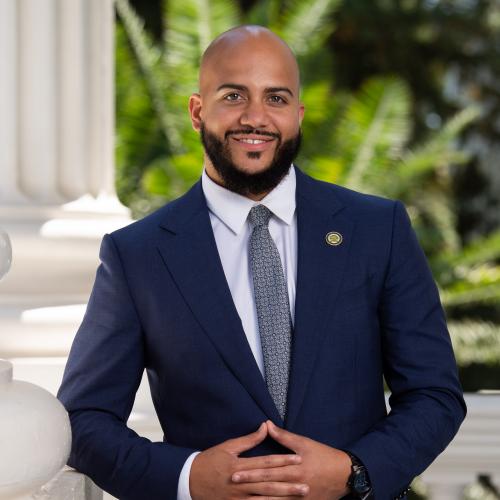
Rep. Isaac Bryan
Sponsored bills
Existing law establishes the Youth Bill of Rights for all youth confined in a juvenile facility, which includes the right to maintain frequent and continuing contact with parents, guardians, siblings, children, and extended family members, through in-person visits, among others. Existing law regulates the provision of these rights. This bill, the Hug Act, would require that all youth confined in a juvenile facility have the right to engage in certain types of consensual physical contact with visitors during in-person visits, as specified. The bill would require that limitations to this physical contact only be implemented when a significant safety and security concern is present, as described, and would require that all significant safety and security concerns and subsequent contact limitations be documented, as described. The bill would require all juvenile facilities to establish regulations and procedures consistent with these provisions. The bill would make related findings and declarations. To the extent that this bill would impose a higher level of service on local facilities, it would impose a state-mandated local program. The California Constitution requires the state to reimburse local agencies and school districts for certain costs mandated by the state. Statutory provisions establish procedures for making that reimbursement. This bill would provide that, if the Commission on State Mandates determines that the bill contains costs mandated by the state, reimbursement for those costs shall be made pursuant to the statutory provisions noted above.
(1) Existing law establishes the Department of Forestry and Fire Protection in the Natural Resources Agency and requires the department to coordinate programs of fire protection, fire prevention, pest control, and forest and range maintenance and enhancement. This bill would require the department, on or before July 1, 2029, in consultation with the Department of Insurance, the Natural Resources Agency, the Office of Emergency Services, and other relevant departments, to develop standards for state and local agencies to aggregate and make available data related to parcel-, neighborhood-, and community-level wildfire risk for the purpose of enabling a wildfire data sharing platform, as provided. The bill would require the department to incorporate those data standards into community wildfire risk reduction metrics. (2) Existing law creates the Department of Insurance, headed by the Insurance Commissioner, and prescribes their powers and duties. Existing law requires, on or before April 1, 2026, and every 2 years thereafter, an admitted insurer with written California premiums totaling $12,000,000 or more to submit a report to the Insurance Commissioner on its residential property experience data for the previous 2 years for policies written in California, as specified. Existing law requires this information submitted to the commissioner to be confidential, exempt from the California Public Records Act, and not subject to subpoena, as provided. This bill would authorize the Department of Insurance to provide information submitted to the department, including, among other things, the property experience data described above, to researchers and government agencies for the purpose of evaluating California wildfire risk, insurance protection gaps, or wildfire risk mitigation, as provided. The bill would require any published data product collected pursuant to the above-described authority that is provided to a researcher or government agency to be anonymized and aggregated sufficiently to avoid identification of individual company losses, claims data, or information on confidential business practices, as specified, and would prohibit subsequent reports from identifying an individual respondent or insurer. (3) Existing law requires the Department of Forestry and Fire Protection to annually provide to the Legislature a report detailing the department's fire prevention efforts and annually post on its internet website information regarding hazardous fuel reduction and vegetation management projects funded or conducted by the department, as provided. Existing law requires the department to develop a standardized protocol for monitoring implementation and evaluating the positive and negative ecological and fire behavior impacts from vegetation management projects undertaken by the state, as provided. This bill would repeal those requirements and would instead require the department, on or before March 1 of each year, to prepare and submit a report to the Legislature on the detailed efforts made in California towards wildfire prevention and community preparedness, as provided. Existing law requires the Wildfire and Forest Resilience Task Force, including the Natural Resources Agency and the department, among others, in coordination with certain public agencies, to develop a comprehensive implementation strategy to track and ensure the achievement of the goals and key actions identified in California's Wildfire and Forest Resilience Action Plan, as provided. This bill would require, on or before July 1, 2027, and every 5 years thereafter, the Secretary of the Natural Resources Agency, in consultation with the State Fire Marshal, the Wildfire and Forest Resilience Task Force, the Wildfire County Coordinator Program, and the State Hazard Mitigation Officer to prepare a comprehensive statewide community wildfire preparedness strategy, as provided. The bill would require the State Fire Marshal to support communities in the development of optional county-level community wildfire protection plans that align with the community wildfire preparedness strategy, as provided. The bill would require a local entity, in order to receive state funding to implement its community wildfire protection plan, to provide annual updates and progress on its efforts to meet the goals of its plan. (4) Existing law establishes the Continuation Account in the Wildfire Fund, to be administered by the Wildfire Fund Administrator, and continuously appropriates moneys in the Continuation Account for purposes of payment of eligible claims arising from wildfires ignited on or after September 19, 2025, as provided. Existing law requires each large electrical corporation to provide to the Public Utilities Commission a written notification of its election to participate, or not to participate, in the Continuation Account, and requires the commission, if all participating electrical corporations have provided their election to participate in the Continuation Account, to provide the administrator and other entities notification of their elections. Existing law authorizes the administrator, on or after the date the commission provides that notification, but not later than December 31, 2028, to determine if annual contributions from large electrical corporations are needed to enable the Continuation Account to fund the timely payment of eligible claims, as provided. Existing law requires the commission, within 15 days of receiving notification from the administrator that additional annual contributions are required, to initiate a rulemaking proceeding to consider using its authority to require the large electrical corporations to collect a nonbypassable charge from ratepayers to support the Continuation Account, including the payment of any bond issued for the support of the Continuation Account, as provided. Existing law authorizes the Department of Water Resources to issue bonds, in an aggregate amount up to $9,000,000,000, as provided, to support the Continuation Account. If the commission imposes the nonbypassable charge to support the Continuation Account, existing law requires the large electrical corporations, from calendar years 2029 to 2045, inclusive, to provide to the administrator their annual contributions, as specified, for deposit into the Continuation Account. This bill would, if the administrator provides that notification, additionally authorize the administrator to incur indebtedness and issue bonds solely for purposes of supporting the Continuation Account and other related expenses incurred by the administrator, provided that bonds authorized under this provision are payable solely from annual contributions and additional contributions, as provided. The bill would authorize bonds issued by the department, at the discretion of the administrator, to be secured solely by ratepayer contributions, as specified. The bill would prohibit the Wildfire Fund or Continuation Account from being terminated while bonds issued by the department remain outstanding, unless an amount sufficient to pay remaining debt service on those bonds has been irrevocably set aside for those purposes, as specified. Upon the determination of the administrator that the Wildfire Fund should be terminated, the bill would require any remaining Wildfire Fund assets to be transferred to the Continuation Account, and upon the determination of the administrator that the Continuation Account should be terminated, the bill would require any remaining funds to be transferred to the General Fund. By transferring those moneys into a continuously appropriated account, the bill would make an appropriation. The bill would make additional technical and conforming changes. Existing law requires revenues and bond proceeds received by the department to be deposited in the Department of Water Resources Charge Fund and continuously appropriates the moneys in the Department of Water Resources Charge Fund to the department for specified purposes, including transfers to the Wildfire Fund and payment of the bonds. This bill would require revenues and bond proceeds received by the department pursuant to the provisions related to the Continuation Account to be deposited into an account or subaccount within the Department of Water Resources Charge Fund, and to be held separate and apart from amounts held in the Department of Water Resources Charge Fund pursuant to provisions related to the Wildfire Fund, as specified. (5) This bill would create the California Wildfire Relief Fast-Pay Program and would require the California Catastrophe Response Council to appoint a fast-pay administrator to administer the fast-pay program. The bill would require the fast-pay administrator to establish and approve procedures for the review, approval, and timely payment of claims by individual claimants for damages as a result of an activating wildfire, as defined. If the eligible entity, defined as an electric utility or public agency that has a wildfire mitigation plan approved by the Office of Energy Infrastructure Safety (office) , is a participating electrical corporation, as defined, the bill would require settlements pursuant to the fast-pay program to count as settlements of eligible claims and to be paid from the account, as specified. If the eligible entity is not a participating electrical corporation, the bill would require the eligible entity to be solely responsible for directly paying amounts to satisfy settlement offers pursuant to the fast-pay program. This bill would, among other things, prohibit an individual, business corporation, or other entity from selling, assigning, or transferring any wildfire claim, or any right of recovery on a wildfire claim, to a private equity group, and would prohibit an individual, wildfire attorney, corporation, or other entity from selling, assigning, or transferring, in whole or in part, any contingency fee on an interest in a contingency fee, except as provided. This bill would prohibit a private equity group from paying any wildfire expenses with respect to a wildfire claim and from funding wildfire advertising costs with respect to any applicable wildfire that damages or destroys (1) more than 100 structures, or (2) more than 10,0000 acres of land, and would authorize the Attorney General or any district attorney to bring a civil action to enforce that prohibition, as specified. (6) Existing law regulates, among other things, fee agreements, legal advertising and referral services, the sale of financial products to a client, and unlawful solicitation. This bill would require an attorney who contracts to represent a client involving a claim against an electric utility involving an applicable wildfire shall provide a disclosure to the client the options and requirements involving the fast-pay program, as provided. The bill would prohibit a person, firm, partnership, association, or corporation from making an unsolicited targeted communication to solicit any business for any attorneys concerning a potential action for wrongful death, personal injury, or property damage within 30 days of an event, defined as an incident resulting in the proclamation of a state of emergency, as specified. The bill would prohibit, for any claim based on inverse condemnation against an electrical corporation arising from a covered wildfire caused by an electrical corporation, the fee for an attorney representing an insurer involving a subrogated claim from exceeding 10% of the settlement or judgment. (7) Existing law, the Bagley-Keene Open Meeting Act, requires, with specified exceptions, that all meetings of a state body be open and public and all persons be permitted to attend. Existing law authorizes certain state bodies to hold closed session meetings for certain purposes, including authorizing the governing board or advisory panel of the California Earthquake Authority (CEA) to hold closed sessions when addressing the development of rates, reinsurance, and strategy when discussion in open session concerning those matters would prejudice the position of the CEA. This bill would additionally authorize the California Catastrophe Response Council to hold closed sessions when addressing either the administration or evaluation of individual claims submitted for reimbursement from the Wildfire Fund or the Continuation Account, or the development of strategy related to reinsurance or other mechanisms to extend the durability of the Wildfire Fund or Continuation Account, as specified. The California Public Records Act requires a public agency, defined to mean a state or local agency, to make its public records available for public inspection and to make copies available upon request and the payment of a fee, unless the public records are exempt from disclosure. This bill would exempt records held by the California Catastrophe Response Council, or the California Earthquake Authority as the Wildfire Fund Administrator, that relate to the administration or evaluation of claims submitted for reimbursement from the Wildfire Fund or Continuation Account from the California Public Records Act, as specified. (8) Existing constitutional provisions require that a statute that limits the right of access to the meetings of public bodies or the writings of public officials and agencies be adopted with findings demonstrating the interest protected by the limitation and the need for protecting that interest. This bill would make legislative findings to that effect. (9) Existing law requires the Director of the Office of Energy Infrastructure Safety to issue a certificate to an electrical corporation if the electrical corporation provided documentation of certain conditions, including a condition that the electrical corporation has established (1) an executive incentive compensation structure approved by the Office of Energy Infrastructure Safety and structured to promote safety as a priority to ensure public safety and utility financial stability with performance metrics for all executive officers, which may include denying all incentive compensation if the electrical corporation causes a catastrophic wildfire that results in one or more fatalities and (2) a compensation structure that meets certain principles. This bill would revise the recast the requirement related to the executive incentive compensation structure, among other things, to require the electrical corporation to file the approved written executive incentive compensation structure with the office at least one year before the executive incentive compensation structure would become effective. The bill would require the office to approve an electrical corporation's executive incentive compensation structure if it is structured to promote safety as a priority and to ensure public safety and utility stability with performance metrics, includes a provision denying all short-term incentive compensation, as defined, to the chief executive officer, or the officer holding an equivalent position, for a calendar year in which the electrical corporation causes a catastrophic wildfire that results in one or more fatalities, and meets the principles specified in existing law for the compensation structure. For a large electrical corporation, as defined, the bill would additionally require the executive incentive compensation structure to meet certain requirements, including a requirement for the structure to include a written presumption that 35% of the total incentive compensation for each executive officer will be denied for at least one year in the event the electrical corporation causes a catastrophic wildfire that result in one or more fatalities. (10) Under existing law, a violation of an order, decision, rule, direction, demand, or requirement of the commission is a crime. Because a violation of a commission action implementing the bill's requirements would be a crime, this bill would impose a state-mandated local program. The California Constitution requires the state to reimburse local agencies and school districts for certain costs mandated by the state. Statutory provisions establish procedures for making that reimbursement. This bill would provide that no reimbursement is required by this act for a specified reason. (11) This bill would declare that it is to take effect immediately as an urgency statute.
Existing law provides comprehensive regulation of ticket sellers, defined as a person who, for compensation, commission, or otherwise, sells admission tickets to a sporting, musical, theater, or any other entertainment event. In this regard, existing law, among other things, prohibits specified ticket selling practices and imposes certain recordkeeping and disclosure requirements. If an event is canceled, existing law requires that the ticket price be fully refunded to the consumer whether by an original seller, event presenter, ticket reseller, or ticket resale marketplace, as specified. If an event is postponed, rescheduled, or replaced with another event at the same date and time, existing law requires the ticket seller to fully refund the purchaser upon request, as provided. Existing law makes a violation of those provisions a misdemeanor, and imposes civil penalties for certain violations. Existing unfair competition laws make various unfair competition practices unlawful, including any unlawful, unfair, or fraudulent business act or practice and unfair, deceptive, untrue, or misleading advertising. Existing law makes it unlawful for any person doing business in California and advertising to consumers in California to make any false or misleading advertising claim. Existing law makes a person who violates specified false advertising provisions liable for a civil penalty, as specified, and provides that a person who violates those false advertising provisions is guilty of a misdemeanor. This bill would generally revise and recast the provisions regulating the sale of event tickets to impose similar requirements, as applicable, to original sellers, event presenters, ticket resellers, and ticket resale marketplaces, as defined. This bill would prohibit a ticket seller from engaging in a speculative ticket sale, as defined. The bill would require that a ticket resale marketplace implement reasonable measures designed to prevent speculative ticket sales on its platform. The bill would make an original seller, ticket reseller, or ticket retail marketplace that violates particular law and fails to supply a ticket, as specified, civilly liable to the ticket purchaser for 2 times the contracted price of the ticket, in addition to any sum expended by the purchaser in nonrefundable expenses for attending or attempting to attend the event, and other fees and costs. This bill would make certain acts unlawful, including purchasing tickets in excess of posted limits for an online event ticket sale and circumventing or evading a ticket distribution control, as specified. The bill would also prohibit a person from using an internet website or address that is substantially similar to the internet website of an event presenter, venue operator, rights holder, original seller, or an authorized agent with intent to confuse or deceive consumers, as specified. The bill would make a violation of these provisions false or misleading advertising. By expanding the scope of a crime, this bill would impose a state-mandated local program. By expanding the scope of certain requirements related to selling those tickets, the violation of which is a crime, this bill would impose a state-mandated local program. The California Constitution requires the state to reimburse local agencies and school districts for certain costs mandated by the state. Statutory provisions establish procedures for making that reimbursement. This bill would provide that no reimbursement is required by this act for a specified reason.
The California Constitution, pursuant to provisions enacted by the Proposition 209, an initiative measure adopted by the voters at the November 5, 1996, statewide general election, prohibits the state from discriminating against, or granting preferential treatment to, any individual or group on the basis of race, sex, color, ethnicity, or national origin in the operation of public employment, public education, or public contracting, as specified. This measure, the Closing the Student Opportunity and Achievement Gap Act, would, instead, limit the above prohibition to the operation of public employment, public higher education admissions and enrollment, and public contracting. The measure would require that it appear on the ballot at the November 7, 2028, statewide general election.
Existing law requires a health facility, clinic, physician's office, or office of a group practice that uses generative artificial intelligence to generate written or verbal patient communications pertaining to patient clinical information, as defined, to ensure that those communications include both (1) a disclaimer that indicates to the patient that a communication was generated by generative artificial intelligence, as specified, and (2) clear instructions describing how a patient may contact a human health care provider, employee, or other appropriate person. Existing law exempts from this requirement a communication read and reviewed by a human licensed or certified health care provider. This bill would require developers and deployers, as defined, of an artificial intelligence system that produces a prediction, classification, recommendation, evaluation, or analysis that aids decisionmaking related to diagnosis or treatment, known as a clinical decision support system, to make reasonable efforts to identify clinical decision support systems developed for use by deployers that are known or have a reasonably foreseeable risk for biased impacts resulting from deployment of the system in health programs or activities. The bill would require developers to make a statement describing the intended uses and known or reasonably foreseeable risks associated with the use of the clinical decision support system and certain documentation available to deployers, as specified. The bill would require developers to make reasonable efforts to mitigate known or reasonably foreseeable risk for biased impacts resulting from use of the clinical decision support system in health programs or activities. The bill would require deployers to regularly monitor clinical decision support systems and take reasonable and proportionate steps to mitigate known or reasonably foreseeable risk of biased impacts. The bill would specify that a person, partnership, state or local governmental agency, or corporation may be both a developer and a deployer.
Existing law establishes the Division of Labor Standards Enforcement within the Department of Industrial Relations. Existing law authorizes the division, which is headed by the Labor Commissioner, to enforce the Labor Code and all labor laws of the state the enforcement of which is not specifically vested in any other officer, board, or commission. This bill would limit the use of workplace surveillance tools, as defined, by employers, including by prohibiting an employer from monitoring or surveilling employees in a bathroom located in the workplace, except as specified. The bill would provide an employee with the right to leave behind workplace surveillance tools that are on their person or in their possession when entering a bathroom, except as specified. This bill would authorize the commissioner to enforce the bill's provisions, as prescribed, and would authorize a public prosecutor to bring specified enforcement actions. The bill would subject an employer who violates the bill to a civil penalty of up to $500 for each violation. The bill would include findings that changes proposed by this bill address a matter of statewide concern rather than a municipal affair and, therefore, apply to all cities, including charter cities.
(1) The California Integrated Waste Management Act of 1989, administered by the Department of Resources Recycling and Recovery (CalRecycle) , generally regulates the disposal, management, and recycling of solid waste, as defined. The act authorizes CalRecycle to certify a local enforcement agency and requires CalRecycle and certified local enforcement agencies to perform specified functions with regard to the regulation of solid waste management, including issuing and enforcing solid waste facility permits. The act prohibits a person from operating a solid waste facility without a solid waste facilities permit, as provided. The California Global Warming Solutions Act of 2006 charges the State Air Resources Board with monitoring and regulating sources of emissions of greenhouse gases that cause global warming in order to reduce emission of greenhouse gases. The act requires the state board to adopt rules and regulations to achieve the maximum technologically feasible and cost-effective greenhouse gas emissions reductions, as provided. This bill would require the owner or operator of a solid waste landfill, as defined, to, among other things, notify the Department of Resources Recycling and Recovery if a subsurface elevated temperature event occurs. The bill would define "subsurface elevated temperature event" to mean an event where subsurface gas or waste temperatures at a solid waste landfill persistently exceed 131 degrees Fahrenheit over a substantial area and meets other performance criteria, as determined by the department. The bill would authorize the department to require the owner or operator of a solid waste landfill experiencing a subsurface elevated temperature event to create a corrective action plan that includes, but is not limited to, a cost assessment for fully implementing the corrective action plan. The bill would authorize the department or a local enforcement agency to impose an administrative civil penalty of $100,000 per day for failing to comply with these requirements, as provided. The bill would require all penalties collected to be deposited into the Landfill Subsurface Fire Mitigation Community Fund, which the bill would create in the State Treasury. The bill would continuously appropriate moneys in the fund to the California Alternative Energy and Advanced Transportation Financing Authority, to be paid to counties in which a subsurface elevated temperature event occurred to mitigate harm to a person or community affected by a subsurface elevated temperature event and to be paid to the authority for its costs of implementation. The bill would require the authority to develop guidelines for dispersing these funds, as specified. The bill would authorize the department to become the enforcement agency for a solid waste landfill experiencing a subsurface elevated temperature event, as specified. This bill would authorize the Secretary for Environmental Protection to select and coordinate a multiagency coordination group to investigate and provide recommendations on how to achieve resolution of a subsurface elevated temperature event, as specified. The bill would require a local health department to initiate community health needs assessments to identify and collect information regarding the effects of a subsurface elevated temperature event on an affected community and to share the findings, as provided. By requiring a local health department and a local air pollution control district to perform additional duties, the bill would impose a state-mandated local program. The bill would, upon request by a multiagency coordination group, require the owner or operator of a solid waste landfill that experiences a subsurface elevated temperature event to implement an air monitoring and sampling plan, as specified. The bill would require the owner and operator of a solid waste landfill that experiences a subsurface elevated temperature event to reimburse the members of a multiagency coordination group and the local health department for all reasonable and necessary expenses incurred, as specified. The bill would authorize the department to adopt regulations to implement and enforce them as emergency regulations, as specified. (2) This bill would declare its provisions to be severable. (3) The California Constitution requires the state to reimburse local agencies and school districts for certain costs mandated by the state. Statutory provisions establish procedures for making that reimbursement. This bill would provide that no reimbursement is required by this act for a specified reason.
The California Fair Employment and Housing Act establishes the Civil Rights Department within the Business, Consumer Services, and Housing Agency and requires the department to, among other things, bring civil actions to enforce the act. Existing law requires, on or before September 1, 2024, the Department of Technology to conduct, in coordination with other interagency bodies as it deems appropriate, a comprehensive inventory of all high-risk automated decision systems that have been proposed for use, development, or procurement by, or are being used, developed, or procured by, any state agency. This bill would generally regulate the development and deployment of an automated decision system (ADS) used to make consequential decisions, as defined. The bill would define "automated decision system" to mean a computational process derived from machine learning, statistical modeling, data analytics, or artificial intelligence that issues simplified output, including a score, classification, or recommendation, that is designed or used to assist or replace human discretionary decisionmaking and materially impacts natural persons. This bill would require a developer of a covered ADS, as defined, to take certain actions, including providing a potential deployer instructions explaining how the covered ADS should be used by the deployer to make or facilitate a consequential decision. This bill would require a deployer of a covered ADS to take certain actions, including provide certain disclosures to a subject of a consequential decision made or facilitated by the covered ADS that results in an adverse outcome, as defined, and provide the subject with an opportunity to appeal the outcome of the consequential decision, as prescribed. This bill would authorize the Attorney General to bring a specified civil action for noncompliance.
Existing law, the Lanterman Developmental Disabilities Services Act, requires the State Department of Developmental Services (department) to contract with regional centers to provide services and supports to persons with developmental disabilities and their families. Under existing law, a person believed to have a developmental disability, and a person believed to have a high risk of parenting an infant with a developmental disability, is eligible for initial intake and assessment services in the regional centers. Existing law requires that initial intake take place within 15 days following a request for assistance. Existing law, commencing January 1, 2025, requires a regional center, by the end of that 15-day period, to either determine if the individual is eligible for regional center services or determine if additional assessment is needed. This bill would, for initial intakes involving a child welfare involved child or youth, as defined, require regional centers to facilitate a case conference within 15 working days following the initial request for assistance, as specified. The bill would prohibit the case conference requirement from resulting in any delay to the child welfare involved child's or youth's right to a timely intake, assessment, or eligibility determination. The bill would require the department and the State Department of Social Services to issue joint guidance to operationalize the case conference requirement by March 31, 2027. The bill would prohibit a determination not to provide additional assessment from being solely based on the age of the person when they received a diagnosis of a qualifying condition, as specified. The bill, commencing January 31, 2028, would require the department to annually post on its internet website specified data relating to initial intakes, including, among other data, the number of initial intakes, the timeliness of assessment and eligibility determinations, and the percentage of assessments resulting in eligibility by program.