

Existing law authorizes the governing board of a school district that determines during a fiscal year that its revenues are less than the amount necessary to meet its current year expenditure obligations to request an emergency apportionment through the Superintendent of Public Instruction, subject to specified requirements. Existing law authorizes emergency apportionments to be provided through an interim loan from the General Fund and lease financing made available by the California Infrastructure and Economic Development Bank, which is authorized to issue bonds for purposes of the emergency apportionments and related costs, or as an alternative to lease financing, as an emergency apportionment from the General Fund. Existing law prescribes the financing conditions on emergency apportionments, including the calculation of the interest rate. Existing law, notwithstanding any other law, authorizes the Inglewood Unified School District, through the State Department of Education, to request cashflow loans from the General Fund for a total of up to $55,000,000 for emergency operational purposes, as provided. Existing law requires the interest on these loans to be charged at the annual rate of return of the Pooled Money Investment Account, plus an additional 2%. This bill, notwithstanding any other law, and once the Inglewood Unified School District has successfully repaid at least 10 years of a General Fund cashflow loan made pursuant to those provisions, would authorize the school district to seek, and would require the Department of Finance to grant, a waiver of interest on that loan for the next succeeding fiscal year if specified conditions are met, including, among other conditions, that the Los Angeles County Superintendent of Schools, in consultation with the County Office Fiscal Crisis and Management Assistance Team, determines that the school district is making substantial progress towards fiscal solvency and that a waiver of interest would help the school district to exit receivership, as provided. In each subsequent fiscal year, the bill would authorize the school district to seek, and would require the Department of Finance to grant, a subsequent waiver of interest for the applicable fiscal year if the school district again meets those same requirements. To the extent the bill would impose additional duties on the Los Angeles County Superintendent of Schools, the bill would impose a state-mandated local program. This bill would make legislative findings and declarations as to the necessity of a special statute for the Inglewood Unified School District. The California Constitution requires the state to reimburse local agencies and school districts for certain costs mandated by the state. Statutory provisions establish procedures for making that reimbursement. This bill would provide that, if the Commission on State Mandates determines that the bill contains costs mandated by the state, reimbursement for those costs shall be made pursuant to the statutory provisions noted above.
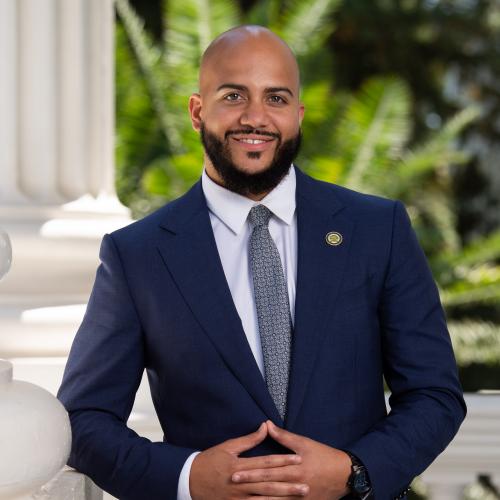
Asm. Isaac Bryan
Sponsored bills
Existing law establishes the California Work Opportunity and Responsibility to Kids (CalWORKs) program, under which each county provides cash assistance and other benefits to qualified low-income families and individuals using federal, state, and county funds. Existing law establishes the CalWORKs Recipients Education Program (program) in the California Community Colleges under which community college districts are required to provide educational services and special services to recipients of aid under CalWORKs who are attending a community college, to the extent funding is provided in the annual Budget Act. Existing law authorizes those special services to include workstudy. Existing law prohibits program payments to an employer for workstudy from exceeding 75% of the wage for the workstudy positions and requires an employer to pay at least 25% of the wage for the workstudy positions. Existing law requires subsidized campus childcare to be provided to students participating in the program only if they are engaged in certain activities, through the completion of their initial education and training plan and for up to 3 months after completion or until the end of the academic year, whichever period of time is greater. This bill would expand who can participate in the program to include students who have exceeded the 60-month limit on CalWORKs cash aid and have one or more dependents who are recipients of aid under CalWORKs. The bill would add direct aid designed to meet ongoing basic needs and services, as described, as a special service for which program funds may be used. The bill would authorize programs to waive the requirement that an employer pay at least 25% of the wage for workstudy positions if the number of workstudy positions will not decrease. The bill would delete the limit on the provision of subsidized campus childcare for program participants. By expanding program eligibility and services, the bill would impose a state-mandated local program. The California Constitution requires the state to reimburse local agencies and school districts for certain costs mandated by the state. Statutory provisions establish procedures for making that reimbursement. This bill would provide that, if the Commission on State Mandates determines that the bill contains costs mandated by the state, reimbursement for those costs shall be made pursuant to the statutory provisions noted above.
Existing law defines persons who are peace officers and the entities authorized to appoint them. Existing law prescribes certain minimum standards for a person to be appointed as a peace officer, including moral character and physical and mental condition, and certain disqualifying factors for a person to be employed as a peace officer, including a felony conviction. This bill would require a law enforcement agency that employs a peace officer to have a policy prohibiting that officer from carrying any firearm when the officer has a blood alcohol concentration greater than 0.00%, whether the officer is on duty or off duty, unless the officer is on duty and engaged in an undercover assignment in the course of their employment as a peace officer. By imposing new duties on local law enforcement, the bill would impose a state-mandated local program. The California Constitution requires the state to reimburse local agencies and school districts for certain costs mandated by the state. Statutory provisions establish procedures for making that reimbursement. This bill would provide that, if the Commission on State Mandates determines that the bill contains costs mandated by the state, reimbursement for those costs shall be made pursuant to the statutory provisions noted above.
Existing law makes it a crime to possess, cultivate, and administer specified controlled substances, including psilocybin and psilocyn. Existing law makes it a crime for a person to rent, lease, or make available for use any building or room for the purpose of storing or distributing any controlled substance. This bill would, until January 1, 2031, request the University of California to establish local pilots in up to 5 counties to allow for the research and development of psilocybin services for veterans and former first responders as part of the Veterans and Former First Responders Research Pilot Program ("Pilot Program") . The bill would require these university partners, overseeing each Pilot Program to be responsible for protocol design, institutional review board approvals, training of psilocybin facilitators, data collection, and reporting. The bill would require each local pilot to partner with licensed health care and licensed community-based providers that provide services and care to the target population. The bill would require psilocybin to be provided by or under the supervision of a practitioner who has experience in providing or overseeing psilocybin or other psychedelic therapy services. The bill would require that each person being considered for the Pilot Program meet specified criteria, including that they are 21 years of age or older and have been given specified assessments. This bill would request the University of California to report specified information about the Pilot Program to the Legislature, the Secretary of California Health and Human Services, and the Governor by January 15, 2030. The bill would establish the Veterans and Former First Responders Research Pilot Special Fund and would continuously appropriate the fund to the University of California for the purposes of these provisions. The bill would request the University of California to apply for and accept grants, donations, and federal funding for the purposes of the Pilot Program, and would require those moneys to be deposited in the fund.
Existing law, added by Proposition 184, approved at the November 8, 1994, statewide general election, and amended by the Three Strikes Reform Act of 2012, approved as Proposition 36 at the November 6, 2012, statewide general election, commonly known as the Three Strikes Law, imposes additional years of imprisonment in state prison on a person who commits a serious or violent felony and has been convicted of, or who has a prior conviction for, a serious or violent felony. A prior juvenile adjudication constitutes a prior serious or violent felony conviction for purposes of this sentence enhancement if the juvenile was 16 years of age at the time and other requirements are met. The Legislature may directly amend these initiatives by a statute passed in each house by a 23 vote, or by a statute that becomes effective only when approved by the voters. This bill would amend those initiative statutes by prohibiting a prior juvenile adjudication from being considered a prior serious or violent felony conviction for purposes of sentence enhancement. The bill would provide a means of vacating a prior juvenile adjudication and resentencing a defendant on any remaining counts, as specified. By requiring the participation of district attorneys and public defenders in the resentencing process, this bill would impose a state-mandated local program. The California Constitution requires the state to reimburse local agencies and school districts for certain costs mandated by the state. Statutory provisions establish procedures for making that reimbursement. This bill would provide that, if the Commission on State Mandates determines that the bill contains costs mandated by the state, reimbursement for those costs shall be made pursuant to the statutory provisions noted above.
The Personal Income Tax Law allows various credits against the taxes imposed by that law, including a young child tax credit to a qualified taxpayer in a specified amount multiplied by the earned income tax credit adjustment factor, as provided. That law also allows a payment from the continuously appropriated Tax Relief and Refund Account for an amount in excess of tax liability. Existing law defines "qualified taxpayer" for this purpose to include an eligible individual, as defined, who has a qualifying child, defined to be a child younger than 6 years of age as of the last day of the taxable year, and who meets other specified criteria. This bill, for taxable years beginning on or after January 1, 2025, would instead define a "qualifying child" to mean a child younger than a specified age as of the last day of the taxable year, as described. By increasing the payments from the Tax Relief and Refund Account, a continuously appropriated fund, the bill would make an appropriation. Existing law requires any bill authorizing a new tax expenditure to contain, among other things, specific goals that the tax expenditure will achieve, detailed performance indicators, and data collection requirements. This bill would include additional information required for any bill authorizing a new tax expenditure.
Existing law establishes the Department of Housing and Community Development (HCD) and sets forth its powers and duties, including updating and revising the California Statewide Housing Plan, as provided. Existing law establishes the Office of Emergency Services (OES) , which is responsible for the state's emergency and disaster response services for natural, technological, or human-induced disasters and emergencies, including responsibility for activities necessary to prevent, respond to, recover from, and mitigate the effects of emergencies and disasters on people and property. This bill would require HCD to convene a state-led County of Los Angeles disaster housing task force, as specified, for the purpose of coordinating and streamlining efforts between HCD, the Federal Emergency Management Agency, OES, and local governments to rebuild housing in communities impacted by the wildfires that began on January 7, 2025, in the County of Los Angeles. The bill would require the task force to appoint a state disaster housing coordinator to accelerate the delivery of resources to communities impacted by the wildfires, and report to the Legislature on the status of rebuilding housing in communities impacted by the wildfires on April 1, 2026, and annually thereafter, as specified. The bill would repeal these provisions on June 30, 2028. This bill would make legislative findings and declarations as to the necessity of a special statute for the Counties of Los Angeles and Ventura. This bill would declare that it is to take effect immediately as an urgency statute.
Existing law, the California Coastal Act of 1976, among other things, requires anyone wishing to perform or undertake any development in the coastal zone, except as specified, in addition to obtaining any other permit required by law from any local government or from any state, regional, or local agency, to obtain a coastal development permit from the California Coastal Commission or local government, as provided. This bill, upon appropriation, would authorize the commission to authorize blue carbon demonstration projects, as defined, in order to demonstrate and quantify the carbon sequestration potential of these projects to help inform the state's natural and working lands and climate resilience strategies. The bill, upon appropriation, would, among other things, authorize the commission to require an applicant with a nonresidential project that impacts coastal wetland, subtidal, intertidal, or marine habitats or ecosystems to build or contribute to a blue carbon demonstration project as mitigation for those impacts.
Existing law establishes, until January 1, 2030, the Racial Equity Commission within the Office of Planning and Research and requires the commission to develop resources, best practices, and tools for advancing racial equity by, among other things, developing a statewide Racial Equity Framework that includes methodologies and tools that can be employed to advance racial equity and address structural racism in California. Existing law, the California Fair Employment and Housing Act, establishes the Civil Rights Department and sets forth its powers and duties, including, among others, receiving, investigating, and prosecuting complaints alleging violations of civil rights, as specified. This bill would require the Civil Rights Department (department) , to, upon appropriation by the Legislature, review, investigate, and make certain determinations regarding applications from persons who claim they are the dispossessed owner, as defined, of property taken as a result of racially motivated eminent domain. The bill would define "racially motivated eminent domain" to mean when the state, county, city, city and county, district, or other political subdivision of the state acquires private property for public use and does not distribute just compensation to the owner at the time of the taking, and the taking, or the failure to provide just compensation, was due, in whole or in part, to the owner's ethnicity or race. Upon a determination that providing property or just compensation is warranted, as provided, the bill would require the department to certify that the dispossessed owner is entitled to the return of the taken property, as specified, or other publicly held property, as defined, of equal value, or financial compensation, as specified. Upon a determination that the dispossessed owner is entitled to other publicly held property of equal value, the bill would require the department to solicit and select, as specified, a list of recommendations of publicly held properties that are suitable as compensation, as provided. Upon a rejection of the determination of the department by the state or local agency that took property by racially motivated eminent domain, the bill would authorize the dispossessed owner, as specified, to bring an action to challenge the taking or the amount of compensation, as provided. Upon a determination that an applicant is not a dispossessed owner or issuing property or just compensation is not warranted, the bill would require the department to notify the applicant of its finding and provide an appeal process, as specified. The bill would require the department to prioritize processing applications for claims made by the individual or individuals who held legal title to the affected property at the time of its taking, as specified. The bill would make every finding, decision, determination, or other official act of the department subject to judicial review. Existing law generally prohibits state agencies from employing in-house counsel to act on behalf of the agency or its employees in specified judicial or administrative adjudicative proceedings, but exempts specified agencies from this provision. This bill would exempt the Civil Rights Department from that provision, as specified. This bill would make related findings and declarations, including those related to a gift of public funds.
Existing law establishes the California Housing Finance Agency in the Department of Housing and Community Development, and authorizes the agency to, among other things, make loans to finance affordable housing, including residential structures, housing developments, multifamily rental housing, special needs housing, and other forms of housing, as specified. Existing law establishes the California Dream for All Program to provide shared appreciation loans to qualified first-time homebuyers, as specified. Existing law establishes in the State Treasury the California Dream for All Fund, which is continuously appropriated for expenditure pursuant to the program, as specified. This bill would require, upon establishment of the certification process for the descendants of American slavery established by the Bureau for Descendants of American Slavery, at least 10% of the moneys in the fund to be reserved for applicants who meet the requirements for a loan under the program and have been certified as descendants of formerly enslaved people, as specified. This bill would become operative only if SB 518 of the 2025–26 Regular Session is enacted and takes effect on or before January 1, 2027, and establishes the Bureau for Descendants for American Slavery.