

The California Constitution prohibits the state from discriminating against, or granting preferential treatment to, any individual or group on the basis of race, sex, color, ethnicity, or national origin in the operation of public employment, public education, or public contracting. The Donahoe Higher Education Act sets forth, among other things, the missions and functions of California's public and independent segments of higher education and their respective institutions of higher education. A provision of the act applies to the University of California only to the extent that the Regents of the University of California, by appropriate resolution, act to make the provision applicable. This bill would state that the California State University, the University of California, independent institutions of higher education, and private postsecondary educational institutions may consider providing a preference in admissions to an applicant who is a descendant of slavery, as defined, to the extent it does not conflict with federal law.
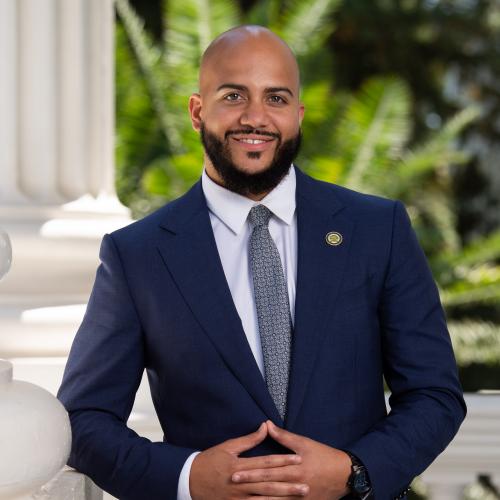
Asm. Isaac Bryan
Sponsored bills
Existing law establishes the Department of Consumer Affairs, which is composed of specified boards that license and regulate various professions. Existing law requires those boards to expedite the licensure process for an applicant who holds a current license in another jurisdiction in the same profession or vocation and supplies evidence that they are married to or in a domestic partnership or other legal union with an active duty member of the Armed Forces of the United States who is assigned to a duty station in this state under official active duty military orders. This bill would require those boards to expedite applications for applicants seeking licensure who are descendants of American slaves once a process to certify descendants of American slaves is implemented, as specified. This bill would make these provisions operative only if SB 518 of the 2025–26 Regular Session is enacted establishing the Bureau for Descendants of American Slavery, and would make these provisions operative when the certification process is implemented pursuant to that measure. The bill would repeal these provisions 4 years from the date on which they become operative or on January 1, 2032, whichever is earlier.
The State Government Strategic Planning and Performance and Review Act requires each agency, department, office, or commission for which strategic planning efforts are recommended, as specified, to develop a strategic plan and to report to the Governor and the Joint Legislative Budget Committee by April 1 each year on the steps being taken to develop and adopt a strategic plan. The act requires the report to include a description of the elements to be included in the strategic plan, the process for developing and adopting the strategic plan, and the timetable for the plan's completion. This bill would instead require each agency, department, office, or commission subject to the Governor's authority to develop and report on the above-described strategic plan. The bill would also require each agency, department, office, or commission subject to the Governor's authority to, for any strategic plans applicable and if feasible, develop or update the strategic plan to reflect the use of data analysis and inclusive practices to more effectively advance racial equity and to respond to identified disparities with changes to the organization's policies, programs, and operations, among other things.
Maddy summaryThis bill establishes January as National Human Trafficking Awareness Month in California to raise public awareness about human trafficking. The resolution recognizes the severity of human trafficking as a felony crime and highlights statistics showing its prevalence across the country and specific challenges with identifying male victims and labor trafficking cases. It aims to educate the public and encourage reporting and support for victims during this designated month.
Existing law prohibits the prosecuting attorney, attorney for the defendant, or investigator for either the prosecution or the defendant from interviewing, questioning, or speaking to a victim or witness whose name has been disclosed pursuant to existing law without first clearly identifying themselves and identifying the full name of the agency by whom they are employed, and identifying whether they represent, or have been retained by, the prosecution or the defendant. Under existing law, if an interview takes place in person, the party is also required to show the victim or witness a business card, official badge, or other form of official identification before commencing the interview or questioning. This bill would require a peace officer, as defined, or a prosecuting attorney, before any initial formal interview of an immediate family member of a person who has been killed or seriously injured by a peace officer, to clearly identify themselves and if the interview takes place in person, to show identification, to inform the person of the status of their family member, to inform the person that they are conducting a formal interview for the purposes of an investigation, as specified, and to inform the person that they have a choice to come to the station for the formal interview if they are asked to go and can have a trusted support person with them. The bill would provide that its provisions do not apply if the immediate family member is under custodial interrogation, as specified, or if the delay would result in the loss or destruction of evidence or pose an imminent threat to public safety. By increasing duties on local law enforcement, this bill would impose a state-mandated local program. The California Constitution requires the state to reimburse local agencies and school districts for certain costs mandated by the state. Statutory provisions establish procedures for making that reimbursement. This bill would provide that, if the Commission on State Mandates determines that the bill contains costs mandated by the state, reimbursement for those costs shall be made pursuant to the statutory provisions noted above.
Existing law establishes the California State University, under the administration of the Trustees of the California State University, as one of the segments of public postsecondary education in the state. Existing law requires the trustees to control and expend all money appropriated for the support and maintenance of the university. Former law, until July 1, 2023, established the Task Force to Study and Develop Reparation Proposals for African Americans, with a Special Consideration for African Americans Who are Descendants of Persons Enslaved in the United States (Task Force) . Former law required the Task Force, among other things, to identify, compile, and synthesize the relevant corpus of evidentiary documentation of the institution of slavery that existed within the United States and the colonies, as specified, and to recommend the form of compensation that should be awarded, the instrumentalities through which it should be awarded, and who should be eligible for this compensation. This bill would authorize the use of up to $6,000,000, as specified, for the purpose of enabling the California State University to conduct research in furtherance of the recommendations of the Task Force, thereby making an appropriation. The bill would authorize the California State University to partner with other universities or nonprofit institutions in furtherance of the bill. The bill would require, before the start of each fiscal year, the California State University to consult with the California Legislative Black Caucus to propose a list of research components to be addressed through the appropriation, as provided. This bill would require the California State University to explore options to determine how to confirm an individual's status as a descendant of an enslaved person, as defined. The bill would also require the California State University to establish a process for conducting or verifying genealogical research for the purpose of confirming an individual's status as a descendant of an enslaved person for eligibility for reparative claims on or before the start of the 2029–30 academic year and to commence the work of establishing the process on or before the start of the 2026–27 academic year. The bill would authorize the funding described above to be used to support student participation in support of this goal. The bill would require the California State University, on or before October 1 of each year and until funding is exhausted, to submit to the Legislature and Governor a report with a status update of pending research projects, and any research projects that have been completed within the prior year. The bill would require the final report to include research findings, recommendations with options, and timelines for statewide implementation, including costs, developed pursuant to these provisions.
Existing law establishes the Civil Rights Department within the Business, Consumer Services, and Housing Agency to enforce civil rights laws with respect to housing and employment and to protect and safeguard the right of all persons to obtain and hold employment without discrimination based on specified characteristics or status. Existing law requires a private employer that has 100 or more employees to submit an annual pay data report to the Civil Rights Department that includes the number of employees by race, ethnicity, and sex in 10 specified job categories, the number of employees by race, ethnicity, and sex whose pay falls within federal pay bands, within each job category the median and mean hourly rate for employees having any combination of those characteristics, and the total number of hours worked by each employee counted in each pay band during the "Reporting Year," as specified. This bill would require an employer to collect and store any demographic information gathered by an employer or labor contractor for the purpose of submitting the pay data report separately from employees' personnel records, and, beginning January 1, 2027, increase the number of job categories, as specified above, to 23. Existing law authorizes the department, if it does not receive the pay data report, to seek an order requiring an employer to comply with these provisions. Existing law provides that upon the request of the department, a court may impose a civil penalty upon any employer for failure to file the required report, which shall be payable to the Civil Rights Enforcement and Litigation Fund. This bill would require a court to impose a civil penalty against an employer that fails to file the report if requested to do so by the department.
Existing law requires every person incarcerated in a state prison to be asked to provide contact information for specific circumstances, including for medical release of information and next of kin authorizing control over body and possessions in case of death. Existing law requires the Department of Corrections and Rehabilitation to notify all persons covered by the medical release of information within 24 hours of a person incarcerated in a state prison being hospitalized for a serious or critical medical condition, as defined. Existing law requires the department to notify all persons covered by the medical release of information and next of kin within 24 hours of the death of a person incarcerated in state prison. Existing law provides that a county jail is kept by the sheriff of the county in which the jail is situated and is to be used for specified purposes, including for the confinement of persons sentenced to imprisonment in a county jail upon a criminal conviction. This bill, Wakiesha's Law, would require the county or city jail to notify all people covered by the medical release of information and next of kin forms within 24 hours of the death of a person incarcerated in the county or city jail. By imposing new duties on county and city jails, this bill would create a state-mandated local program. The California Constitution requires the state to reimburse local agencies and school districts for certain costs mandated by the state. Statutory provisions establish procedures for making that reimbursement. This bill would provide that, if the Commission on State Mandates determines that the bill contains costs mandated by the state, reimbursement for those costs shall be made pursuant to the statutory provisions noted above. This bill would declare that it is to take effect immediately as an urgency statute.
Existing law grants to a depicted individual a cause of action against a person who creates and intentionally discloses sexually explicit material if the person knows, or reasonably should have known, that the depicted individual in that material did not consent to its creation or disclosure or who intentionally discloses sexually explicit material that the person did not create if the person knows the depicted individual in that material did not consent to the creation of the sexually explicit material. Existing law defines "sexually explicit material" for purposes of that provision to mean any portion of an audiovisual work that shows the depicted individual performing in the nude or appearing to engage in, or being subjected to, sexual conduct and defines "depicted individual" to mean an individual who appears, as a result of digitization, to be giving a performance the individual did not actually perform or to be performing in an altered depiction. Existing law authorizes a plaintiff to recover, among other relief, statutory damages of not less than $1,500 but not more than $30,000, or $150,000 for a malicious violation, as prescribed. This bill would revise and recast the provision described above to additionally grant to a depicted individual a cause of action against a person who knows, or reasonably should know, that the depicted individual was a minor when the digitized sexually explicit material was created and would additionally grant a cause of action to that depicted individual against a person who knowingly facilitates or recklessly aids or abets conduct prohibited by that provision. The bill would define "digitized sexually explicit material" to mean any portion of a visual or audiovisual work created or substantially altered through digitization, including an image, that shows the depicted individual in the nude or appearing to engage in, or being subjected to, sexual conduct. This bill would make a person that provides a service that enables the ongoing operation of a deepfake pornography service presumed to be engaged in knowing facilitation or reckless aiding or abetting, as described above, if a depicted individual or public prosecutor provides the person with evidence sufficient to demonstrate that the person is providing services that enable the ongoing operation of a deepfake pornography service that engages in conduct described in the provisions described above, and the person fails to take all necessary steps to stop providing services that enable the ongoing operation of a deepfake pornography service within 30 days of receiving that evidence, as specified. This bill would increase the maximum statutory damages available to a depicted individual to $50,000 if the violation was not malicious and $250,000 for a malicious violation and would authorize certain public attorneys to bring a civil action to enforce these provisions, as specified.
Under existing law, a prisoner can reduce their term of imprisonment by earning credit for, among other things, continuous incarceration, good behavior, and participation in approved rehabilitative programming. Existing law makes an inmate of a county jail or state prison who has completed training for assignment to a conservation camp, state or county facility, or a correctional institution as an inmate firefighter, or who is assigned to a state or county facility or a correctional institution as an inmate firefighter, and who is eligible to earn one day of credit for every one day of incarceration, instead eligible to earn 2 days of credit for every one day served in that assignment or after completing that training. Existing law authorizes a juvenile court to order placement of a ward at the Pine Grove Youth Conservation Camp if specified criteria are met, including if the county has entered into a contract with the Department of Corrections and Rehabilitation and the department has found the ward amenable. Existing law authorizes the department to enter into contracts with counties to operate the Pine Grove Youth Conservation Camp through a state-local partnership, or other management arrangement, to train justice-involved youth, as specified, in wildland firefighting skills. This bill would require an incarcerated individual hand crew member, in addition to receiving credits, and a ward or youth hand crew member placed at the Pine Grove Youth Conservation Camp to be paid an hourly wage equal to $7.25 while assigned to an active fire incident. The bill would require that wage rate to be reviewed annually. The bill would require the Department of Corrections and Rehabilitation and counties to maintain regulations regarding an administrative adjudication and remedy process for any disputes over sums owned pursuant to these provisions. This bill would declare that it is to take effect immediately as an urgency statute.