

Existing law generally regulates the business of renting passenger vehicles to the public. The law prohibits a rental company from taking various actions, including requiring the purchase of a damage waiver, optional insurance, or another optional good or service, and using electronic surveillance technology to track a renter in order to impose fines or surcharges relating to the renter's use of a rental vehicle. This bill would require any privately owned vehicle rented by, or furnished to, any federal, state, or local law enforcement agency for the use of detaining, arresting, or transporting persons who have violated, or are suspected of having violated, any law, to display a temporary decal displaying the agency name and logo, as specified. The bill would authorize certain attorneys, including the Attorney General, to pursue a civil action against the entity renting the vehicle from the private owner for failure to comply with these provisions. The bill would require the rental car contract to include a term that compliance with state law is mandatory. The bill would exempt privately owned vehicles rented or otherwise furnished or loaned to a law enforcement agency for specified purposes and rental car contracts entered into prior to January 1, 2027, from these provisions. The bill would make related findings and declarations.
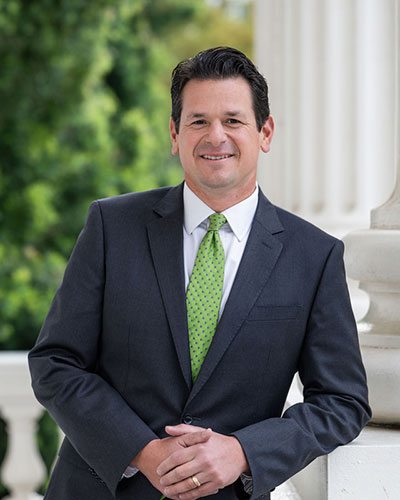
Rep. John Harabedian
Sponsored bills
Existing law, the Elder Abuse and Dependent Adult Civil Protection Act, establishes procedures for the reporting, investigation, and prosecution of elder and dependent adult abuse. Existing law requires a mandated reporter of suspected financial abuse of an elder or dependent adult, as defined, to report financial abuse in a specified manner, including by telephone or through a confidential internet reporting tool, as specified, immediately, or as soon as practicably possible. If reported by telephone, existing law requires a written report to be sent, or an internet report to be made through the internet reporting tool, to the local adult protective services agency or the local law enforcement agency within 2 working days. Existing law deems all officers and employees of a financial institution to be mandated reporters of suspected financial abuse of an elder or dependent adult. A mandated reporter who fails to report financial abuse of an elder or dependent adult is liable for civil penalties, as specified. If a report of financial abuse is made by a mandated reporter, as described above, this bill would also require a report to be made to the Federal Bureau of Investigation Internet Crime Complaint Center within 2 working days. Within 48 hours of filing a report, the bill would require a financial institution to notify the elder or dependent adult identified in the report, as specified, and provide additional required information. The bill would require a financial institution to provide annual training to its mandated reporters on how to escalate internally and report suspected financial abuse of an elder or a dependent adult to both local and federal authorities, as specified. The bill would specify that violations of these provisions would not incur the above-described liability for civil penalties. The bill would make its provisions operative on January 1, 2028.
Existing law requires law enforcement agencies to report to the Department of Justice, as specified, any incident in which a peace officer is involved in a shooting or use of force that results in death or serious bodily injury. Existing law requires the state prosecutor to investigate incidents involving a shooting by a peace officer resulting in the death of an unarmed civilian. Existing law authorizes the state prosecutor to criminally prosecute any officer that, pursuant to an investigation, is found to have violated state law. Existing law provides that the Attorney General is the state prosecutor unless otherwise specified or named. This bill would require the state prosecutor to conduct an independent, transparent, and thorough investigation into incidents of an immigration enforcement officer-involved shooting resulting in the death of an unarmed civilian. The bill would authorize the state prosecutor to criminally prosecute an immigration enforcement officer that, pursuant to an investigation, is found to have violated state law. The bill would require the state prosecutor to post and maintain on a public internet website each written report, as specified. The bill provides that the Attorney General is the state prosecutor unless otherwise specified or named. This bill would provide that the provisions of this bill are severable.
Existing law appropriates $10,000,000 from the General Fund for the 2021–22 fiscal year to the Superintendent of Public Instruction to administer the Dual Language Immersion Grant Program for the purpose of expanding access to quality dual language learning and fostering languages that English learners bring to California's education system. Under that program, the State Department of Education is required to award a minimum of 25 one-time Dual Language Immersion Grants over a period of 3 fiscal years of up to $380,000 per grant to an eligible entity to expand or establish dual language immersion programs. This bill would require, upon appropriation by the Legislature, the department, on or before July 1, 2027, to establish a Dual Language Immersion Coordinator to provide coordination between local educational agencies, as defined, to share resources and knowledge on dual language immersion programs, as defined. The bill would require the Dual Language Immersion Coordinator to (1) act as the point of contact within the department for local educational agencies seeking to, among other things, establish new or expand existing dual language immersion programs, and (2) establish, publish, and maintain on the department's internet website, on or before January 1, 2028, a directory of operative dual language immersion programs, as specified. To the extent the bill would impose additional duties on local educational agencies relating to the establishment and maintenance of the directory, the bill would impose a state-mandated local program. The California Constitution requires the state to reimburse local agencies and school districts for certain costs mandated by the state. Statutory provisions establish procedures for making that reimbursement. This bill would provide that, if the Commission on State Mandates determines that the bill contains costs mandated by the state, reimbursement for those costs shall be made pursuant to the statutory provisions noted above.
Existing law includes various provisions limiting how state and local entities may use their resources for immigration enforcement purposes. This bill would prohibit the use of state-owned property for purposes of immigration enforcement, as specified. In this regard, the bill would prohibit, among other uses, staging, assembling, mobilizing, or deploying vehicles, equipment, or personnel for immigration enforcement purposes. The bill would require the Department of General Services and state agencies to work together to identify state-owned property previously or likely to be used for immigration enforcement purposes. The bill would require state agencies to post signage at those properties regarding the prohibition and to use physical barriers limiting access, as provided. The bill would require state agencies to develop procedures to ensure that an attempted or actual use of state-owned property for immigration enforcement purposes is documented in writing, that the documentation includes any photographic or video evidence, and that the Attorney General's office or the Attorney General's designee is notified. The bill would direct state agencies to make educational materials available regarding the rights of employees, tenants, and security staff if federal agents enter state-owned property. The bill would further require the Attorney General's office to design standardized signage and to make the signage available to download free of charge on the Attorney General's internet website.
Existing law provides that the State of California recognizes and accepts responsibility for the harms and atrocities committed by the state in promoting, facilitating, enforcing, and permitting chattel slavery and apologizes for perpetuating the harms African Americans have faced, as specified. Existing law requires a plaque memorializing this apology to be publicly and conspicuously installed and maintained in the State Capitol Building. This bill, the Rowena Mae Ramos Act, would provide that the State of California recognizes and accepts responsibility for all of the harms and atrocities committed by its representatives who promoted, permitted, facilitated, and enforced policies of violence against California Native Americans. The bill would further provide that the State of California apologizes for perpetuating the harms experienced by California Native Americans as a result of policies enacted, sanctioned, or tolerated by the Legislature. The bill would require a plaque memorializing this apology to be publicly and conspicuously installed and maintained in the State Capitol Building. The bill would impose specified duties on the Department of General Services and the Joint Rules Committee relating to the installation and maintenance of the plaque. The bill would authorize the Department of General Services and the Joint Rules Committee to receive money from grants and private donations and would continuously appropriate those funds for this purpose, as specified. The bill would require the Legislature to prepare the formal apology and would request it be signed by specified state leaders. The bill would require the Secretary of State to submit a final copy of this formal apology to the State Archives, where it would be available for viewing by the general public in perpetuity. The bill would include related legislative findings.
Existing law vests the Public Utilities Commission with regulatory authority over public utilities. Existing law authorizes the commission to fix the rates and charges for every public utility and requires that those rates and charges be just and reasonable. Existing law requires the commission to evaluate the full effect of the enactment of federal House Resolution 1 (Public Law 115-97) on the expenses and tax liabilities incurred by certain public utilities for the payment of federal taxes, and, if the commission determines that the projected expenses and tax liabilities for federal taxes that the commission has authorized in the rates for a public utility are materially affected by its enactment, to adjust the rates of the public utility to reflect the changes in projected expenses and tax liabilities in light of the changes in federal law. This bill would require the commission to evaluate the full effect of all federal legislation that becomes law, including the recent federal House Resolution 1 (Public Law 119-21) , on the expenses and tax liabilities incurred by those public utilities for the payment of federal taxes and, if the commission determines that the projected expenses and tax liabilities for federal taxes that the commission has authorized in the rates for a public utility are materially affected by the enactment, to adjust the rates of the public utility to reflect the changes in projected expenses and tax liabilities in light of the changes in federal law, as specified.
Existing law establishes the California Interagency Council on Homelessness (council) , which has various goals, including, among other things, to serve as a statewide facilitator, coordinator, and policy development resource on ending homelessness in California. This bill would require the council to, by July 1, 2028, complete a comprehensive statewide study of the coordinated entry system and its role in connecting individuals and families experiencing homelessness to affordable housing, as specified. The bill would require the council, in conducting the study, to meaningfully consult with a geographically representative group of stakeholders, as described, and would require the council, by July 1, 2028, to post the report on its internet website and submit the report to the Legislature and any relevant policy committees.
Existing law establishes the California State University, under the administration of the Trustees of the California State University, the University of California, under the administration of the Regents of the University of California, the California Community Colleges, under the administration of the Board of Governors of the California Community Colleges, and independent institutions of higher education, as defined, as 4 segments of postsecondary education in the state. This bill would establish the Designation of California Asian American- and Native Hawaiian Pacific Islander-Serving Institutions to recognize campuses of those segments of postsecondary education that excel at providing academic resources to Asian American, Native Hawaiian, and Pacific Islander students. The bill would establish a California Asian American- and Native Hawaiian Pacific Islander-Serving Institutions governing board to designate colleges and universities as California Asian American- and Native Hawaiian Pacific Islander-Serving Institutions and would require the office of the Chancellor of the California Community Colleges to, among other duties, develop the application processes and to process and present initial and renewal applications to receive this designation to the governing board, as specified. The bill would make an initial and renewal designation valid for 5 years.
Existing law authorizes a borrower who is experiencing financial hardship that prevents the borrower from making timely payments on a specified residential mortgage loan due directly to a specified state of emergency proclaimed by the Governor, or a specified federally declared disaster, to request forbearance on their residential mortgage loan, as prescribed. Existing law requires a mortgage servicer, except as specified, to offer mortgage payment forbearance for an initial 90-day period that may be extended up to a maximum forbearance period of 12 months and prohibits a mortgage servicer from assessing any late fees to the borrower's account or charging a default rate of interest during the forbearance period. This bill would, among other things, similarly authorize a borrower to request forbearance on a residential mortgage loan, as defined, secured by residential real property that has become uninhabitable as a direct result of a disaster, which the bill would define to mean the conditions described in a declaration of a disaster issued by the federal government. The bill would require the borrower to affirm that as a direct result of a disaster, a residential unit is uninhabitable. Because the bill would expand the crime of perjury, the bill would impose a state-mandated local program. This bill would, except as specified, require a mortgage servicer to offer mortgage payment forbearance of a period of up to an initial 180 days, to be extended at the request of the borrower in 90-day increments, up to a maximum forbearance period of 12 months. The bill would provide that the forbearance period includes any period of forbearance related to the disaster that a mortgage servicer has provided to a borrower before the date upon which a declaration of a disaster was issued. The bill would also prohibit a mortgage servicer from assessing any late fees to the borrower's account or charging a default rate of interest during the forbearance period. This bill would require a mortgage servicer to report the credit obligations of borrowers under a disaster-related forbearance plan in compliance with the federal Fair Credit Reporting Act. For an account granted disaster-related mortgage payment relief, the bill would prohibit a mortgage servicer from furnishing information during the forbearance period indicating that the payments are in forbearance and would require the mortgage servicer to report the credit obligation or account as current. This bill would authorize a civil action to enforce these provisions to be brought by the Attorney General, a district attorney, or a county counsel. The California Constitution requires the state to reimburse local agencies and school districts for certain costs mandated by the state. Statutory provisions establish procedures for making that reimbursement. This bill would provide that no reimbursement is required by this act for a specified reason.