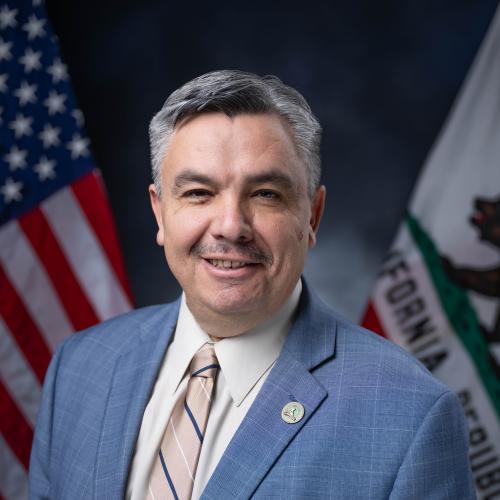
Photo of Juan Carrillo
D California Assembly · District 39 On the 2026 ballot

Asm. Juan Carrillo

Compare
Total votes
10,001
all sessions
Attendance
96%
345 missed
Near the chamber average
With party
99%
of cast votes
Near the chamber average
Bipartisan score
0%
crosses aisle rarely
Near the chamber average
Sponsored
862
bills & resolutions
Near the chamber average
Committees
13
assignments
862 bills and resolutions

Sponsored bills

Total
862
Primary
84
Co-sponsor
778
This page
862
matching current filters
Primary AB 1736
Signed into law · California Assembly · Lead sponsor
Water replenishment districts: competitive bidding.

Existing law, the Water Replenishment District Act, provides for the formation of a water replenishment district, governed by a board, with prescribed powers for the purposes of replenishing the groundwater supplies within the district. Existing law requires a district to provide notice of a contract for any improvement or work, as specified. Existing law authorizes a board to let the work to the lowest responsible bidder, reject the bids and readvertise for proposals, or proceed to construct the work under its own superintendence. This bill would also authorize a board to negotiate a contract for the work if no bids are received.

Signed into law Oct 8, 2023 0 co-sponsors
Co-sponsor SB 348
Signed into law · California Senate · Co-sponsor
Pupil meals.

(1) Existing law establishes a system of public elementary and secondary schools in this state. This system is composed of local educational agencies throughout the state that provide instruction to pupils in kindergarten and grades 1 to 12, inclusive, at schoolsites operated by these agencies. Existing law, commencing with the 2022–23 school year, requires each school district and county superintendent of schools maintaining kindergarten or any of grades 1 to 12, inclusive, and each charter school to provide 2 nutritiously adequate school meals free of charge during each schoolday, regardless of the length of the schoolday, to any pupil who requests a meal without consideration of the pupil's eligibility for a federally funded free or reduced-price meal, as specified, with a maximum of one free meal for each meal service period. Existing law requires the department to develop and maintain nutrition guidelines for school lunches and breakfasts, and for all food and beverages sold on public school campuses. Existing law requires a school district, county superintendent of schools, or charter school to provide each needy pupil with one nutritionally adequate free or reduced-price meal during each schoolday, except as provided. This bill would revise and recast provisions regarding school meals for needy pupils by, among other things, instead requiring each school district, county superintendent of schools, and charter school to make available a nutritionally adequate breakfast, as defined, and a nutritionally adequate lunch, as defined, free of charge during each schoolday, as defined, to any pupil who requests a meal, without consideration of the pupil's eligibility for a federally funded free or reduced-price meal, as provided. The bill would require each school district, county office of education, or charter school that offers independent study to meet the above meal requirements for any pupil on any schoolday that the pupil is scheduled for educational activities, as provided. The bill would require the State Department of Education to submit a waiver request to the United States Department of Agriculture to allow for one meal to be provided during a schoolday lasting 4 hours or less to be served in a noncongregate manner. The bill would authorize each school district, county superintendent of schools, and charter school to make available either a nutritionally adequate breakfast or a nutritionally adequate lunch, as defined, in a noncongregate manner, as provided, if the State Department of Education receives approval for the federal noncongregate waiver. The bill would require each school district, county superintendent of schools, and charter school to provide pupils with adequate time to eat, as determined by that school district, county superintendent of schools, or charter school in consideration of the recommendations provided by the department. The bill would require a chartering authority, among other things, to provide technical assistance to a charter school to meet these meal requirements, as provided. If the federal School Breakfast Program and federal National School Lunch Program allow more added sugar or sodium than is recommended by the most recent Dietary Guidelines for Americans, as described, the bill would require the department to convene representatives from specified entities to work in partnership to provide maximum daily added sugar and sodium intake recommendations for each grade level, as provided. The bill also would make conforming changes to related provisions of law. By imposing additional duties on local educational agencies and officials, the bill would impose a state-mandated local program. (2) Existing law authorizes the governing board of a school district to establish rules to determine which pupils are needy and authorizes a nominal cash payment for school meals to be collected from pupils that are not eligible for free meals and requires the State Department of Education to determine the amount of cash payment that may be required of those pupils. Existing law requires the Superintendent of Public Instruction to reimburse school districts for free and reduced-price meals served or sold based on the median statewide meal costs. This bill would delete those provisions. (3) Existing federal law provides for the permanent and nationwide Summer Electronic Benefit Transfer for Children (Summer EBT) program, under which pupils who are eligible for free and reduced-price school meals receive $40 per month during summer months for grocery benefits. This bill would require the State Department of Education to work in partnership with the State Department of Social Services to maximize participation in the federal Summer EBT program, as provided. (4) The California Constitution requires the state to reimburse local agencies and school districts for certain costs mandated by the state. Statutory provisions establish procedures for making that reimbursement. This bill would provide that, if the Commission on State Mandates determines that the bill contains costs mandated by the state, reimbursement for those costs shall be made pursuant to the statutory provisions noted above.


Signed into law Oct 8, 2023 1 co-sponsor
Co-sponsor AB 417
Signed into law · California Assembly · Co-sponsor
County boards of education: pupil members.

Existing law authorizes governing boards of county boards of education to appoint one or more high school pupils enrolled in a school that is under the jurisdiction of the county board of education as members in response to a petition from high school pupils of the county board requesting the governing board to appoint one or more pupil members. Existing law authorizes a pupil who is enrolled in a high school that is under the jurisdiction of a school district, and who may be less than 18 years of age, to be selected to serve as a pupil member of the county board of education, if no petition is submitted to select a pupil who is enrolled in a high school that is under the jurisdiction of the county board of education. This bill would additionally authorize a pupil who is enrolled in a high school that is under the jurisdiction of the county board of education, and who may be less than 18 years of age, to be selected to serve as a pupil member of the county board of education, if no petition is submitted to select a pupil who is enrolled in a high school that is under the jurisdiction of the county board of education. This bill would incorporate additional changes to Section 1000 of the Education Code proposed by AB 275 to be operative only if this bill and AB 275 are enacted and this bill is enacted last.

Signed into law Oct 8, 2023 1 co-sponsor
Primary AB 744
Signed into law · California Assembly · Lead sponsor
California Transportation Commission: data, modeling, and analytic software tools procurement.

Existing law establishes the California Transportation Commission in the Transportation Agency. Existing law vests the California Transportation Commission with various powers and duties relative to the programming of transportation capital projects and allocation of funds to those projects pursuant to the state transportation improvement program and various other transportation funding programs. This bill would require the commission to convene relevant state agencies to assess the procurement and implementation of data, modeling, and analytic software tools to support the state's sustainable transportation, congestion management, affordable housing, efficient land use, air quality, economic, and climate change strategies and goals, as provided. On or before July 1, 2025, the bill would require the commission to develop a proposal to procure data, modeling, and analytic software tools and a process to grant access to the data it procures directly, or provide a process for direct allocation of funding to agencies for data procurement, or both of those, as provided.

Signed into law Oct 8, 2023 0 co-sponsors
Co-sponsor AB 278
Signed into law · California Assembly · Co-sponsor
High Schools: Dream Resource Center Grant Program.

Existing law authorizes the governing board of a school district to provide a comprehensive educational counseling program for all pupils enrolled in the school district. Existing law provides that educational counseling may include counseling in developing pupil knowledge of financial aid planning for postsecondary education, including, among others, financial aid programs and resources for foster and homeless youth. This bill would establish the Dream Resource Center Grant Program for the purpose of providing pupils, including undocumented pupils, in grades 9 to 12, inclusive, with specified resources. The bill would require the State Department of Education, in administering the program, to review applications and award grants based off of a tiered point system that prioritizes applications for funding, as provided. The bill would authorize a school district, county office of education, or charter school, including those that have already established a Dream Resource Center at one or more schoolsites, to apply to the department to be eligible to receive a grant, as provided. The bill would require a local educational agency that receives a grant under the program to use it for creating a Dream Resource Center or for supplementing, but not supplanting, an existing Dream Resource Center, as provided. The bill would require the department, on or before June 1, 2026, to submit a report to the appropriate policy committees of the Legislature detailing the successes, best practices, barriers or constraints, and outcomes of Dream Resource Centers funded with these grants. The bill would condition the implementation of these provisions on an appropriation by the Legislature for these purposes in the annual Budget Act or other statute.

Signed into law Oct 8, 2023 1 co-sponsor
Co-sponsor AB 897
Signed into law · California Assembly · Co-sponsor
Certificated school employees: probationary employees: service credit.

(1) Existing law requires a probationary employee who, in any one school year, has served for at least 75% of the number of days the regular schools of the school district in which the employee is employed are maintained to be deemed to have served a complete school year. Existing law also requires a probationary employee of an evening school who, in any one school year, has served for at least 75% of the number of days the evening schools of the school district in which the employee is employed are in session to be deemed to have served a complete school year. This bill would, commencing July 1, 2024, remove that requirement for a probationary employee of an evening school and instead require a probationary employee of an adult education program to be deemed to have served a complete school year if the employee serves for at least 75% of the hours constituting a full-time equivalent position for adult education programs in the school district. The bill would specify that, to the extent the provisions of the bill conflict with any provision of a collective bargaining agreement entered into before July 1, 2024, by a public school employer and an exclusive bargaining representative, the provisions of the bill would not apply to the school district until the expiration or renewal of that collective bargaining agreement. (2) Existing law authorizes the governing board of a school district to employ certificated employees in programs and projects to perform services conducted under contract with public or private agencies, or categorically funded projects that are not required by federal or state law. Existing law requires the employee and the governing board of the school to mutually agree, in writing, on the terms and conditions of that employment. This bill would, commencing July 1, 2024, require certain information to be included in that employment agreement. Existing law prohibits service pursuant to that employment authorization from being included in computing the service required as a prerequisite to attainment of, or eligibility to, classification as a permanent employee unless the person served at least 75% of the number of days the regular schools of the school district are maintained, and the person is subsequently employed as a probationary employee in a position requiring certification qualifications. This bill would, commencing July 1, 2024, specify that these provisions do not apply to a teacher of classes for adults.

Signed into law Oct 8, 2023 1 co-sponsor
Primary AB 965
Signed into law · California Assembly · Lead sponsor
Local government: broadband permit applications.

(1) Existing law, the Permit Streamlining Act, governs the approval process that a city or county is required to follow when approving, among other things, a permit for construction or reconstruction for a development project for a wireless telecommunications facility and a collocation or siting application for a wireless telecommunications facility. This bill, except as specified, would require a local agency to undertake batch broadband permit processing, as defined, upon receiving 2 or more broadband permit applications for substantially similar broadband project sites submitted at the same time by the same applicant, within a presumptively reasonable time, as defined. The bill would define "local agency" for these purposes to mean a city, county, city and county, charter city, special district, or publicly owned utility, other than certain publicly owned electric utilities. If a local agency does not approve those broadband permit applications for substantially similar broadband project sites and issue permits, or reject the applications and notify the applicants, within the presumptively reasonable time or longer period permitted under applicable law, the bill would require that all of those permits be deemed approved. The bill would authorize a local agency to place reasonable limits on the number of broadband project sites that are grouped into a single permit while undertaking batch broadband permit processing, as specified. The bill would provide that a local agency may only remove a broadband project site from grouping under a single permit under mutual agreement with the applicant or to expedite the approval of other substantially similar broadband project sites. The bill, if a local agency denies a broadband permit application, would require the local agency to notify the applicant in writing of the reasons for the denial. The bill would specify that these provisions do not apply to eligible facility requests, as defined. (2) The bill would include findings that changes proposed by this bill address a matter of statewide concern rather than a municipal affair and, therefore, apply to all cities, including charter cities. (3) By imposing new duties on local agencies with regard to the processing of broadband permit applications, this bill would impose a state-mandated local program. The California Constitution requires the state to reimburse local agencies and school districts for certain costs mandated by the state. Statutory provisions establish procedures for making that reimbursement. This bill would provide that no reimbursement is required by this act for a specified reason.

Signed into law Oct 8, 2023 0 co-sponsors
Co-sponsor AB 1340
Signed into law · California Assembly · Co-sponsor
School accountability: pupils with exceptional needs.

Existing law requires the Department of Education to report annually, on its internet website, enrollment data by disability, as specified. This bill would, contingent upon an appropriation for these purposes, require the department to, on or before January 1, 2025, include a report on its internet website that allows the public to view statewide-level four- and five-year cohort graduation rates for pupils who are individuals with exceptional needs, disaggregated by certain identified disabilities, as provided.

Signed into law Oct 8, 2023 1 co-sponsor
Primary AB 542
Signed into law · California Assembly · Lead sponsor
Self-service storage facilities: lien sales.

Existing law, the California Self-Service Storage Facility Act, specifies remedies and procedures for self-service storage facility owners when occupants are delinquent in paying rent or other charges, including through enforcement of a lien by the sale of the stored property. These procedures require an advertisement of the sale to be published once per week for 2 consecutive weeks in a newspaper of general circulation in the public notice district where the sale is to be held. Existing law requires the advertisement to include, among other things, a general description of the goods. Existing law requires, if there is no newspaper of general circulation published in the public notice district where the sale is to be held, the advertisement to be posted at least 10 days before the sale in at least 6 conspicuous places in the neighborhood of the proposed sale. This bill would instead require publication once per week for 2 consecutive weeks in a newspaper of general circulation in the public notice district where the sale is to be held or in the county where the self-service storage facility is located, or publication once in a newspaper of general circulation in the public notice district where the sale is to be held or in the county where the self-service storage facility is located and once on an internet website that customarily conducts or advertises online auctions or sales for at least 7 days before the sale, as specified. The bill would require that, in either case, if there is no newspaper of general circulation published in the public notice district where the sale is to be held or in the county where the self-service storage facility is located, the advertisement shall be posted at least 10 days before the sale in not less than 6 conspicuous places in the neighborhood of the proposed sale. The bill would remove the requirement that the advertisement include a general description of the goods.

Signed into law Oct 8, 2023 0 co-sponsors
Co-sponsor AB 393
Signed into law · California Assembly · Co-sponsor
Childcare: dual language learners.

Existing law, the Early Education Act, requires the Superintendent of Public Instruction to provide an inclusive and cost-effective preschool program. Existing law requires the Superintendent to develop procedures for state preschool contractors to identify and report data on dual language learners enrolled in a preschool program. Existing law requires these procedures, at minimum, to include a distribution and collection of a family language instrument, as specified, and a family language and interest interview. Existing law requires the reported data to include, among other things, a child's home language and the language composition of the program staff. Existing law, the Child Care and Development Services Act, administered by the State Department of Social Services, establishes a system of childcare and development services for children up to 13 years of age, which includes various programs and services, including, among others, general childcare and development programs and migrant childcare and development programs. This bill would similarly require the Director of Social Services to develop procedures for general or migrant childcare and development contractors to identify and report data on dual language learners enrolled in a general childcare and development program or migrant childcare and development program, as specified, and requires the director to develop informal directives and adopt regulations to implement these provisions. The bill would require the Superintendent and the director to coordinate efforts to implement these provisions. The bill would prohibit the use of these provisions to compel a parent or guardian to participate in the data collection procedures described above. The bill would further clarify that a family's decision to decline to complete the family language instrument or family language and interest interview shall not affect the contract of a state preschool contractor or general or migrant childcare and development contractor. The bill would also specify that these provisions shall not affect the eligibility of a child to enroll in a state preschool program or a general or migrant childcare and development program.

Signed into law Oct 8, 2023 1 co-sponsor
Showing 641 to 650 of 862 bills
Previous 1 … 64 65 66 … 87 Next