

The Emergency Medical Services System and the Prehospital Emergency Medical Care Personnel Act governs local emergency medical services systems. Existing law makes it a crime to violate any of the provisions of the act, and any rules, regulations, or county ordinances adopted pursuant to the act, that govern patient transfers. Existing law provides specified liability limitations to, among others, physicians, nurses, and other authorized individuals who provide assistance in emergency situations. This bill would provide that a private provider of ambulance services, and employees of that provider, when operating in accordance with the standards, regulations, policies, and protocols of local emergency medical services agencies, shall not be criminally or civilly liable for the continued detainment of a person when that detainment is requested by a peace officer, facility staff, or other professionals authorized to detain persons in specified circumstances involving the transport and continued containment of a person who requires mental health evaluation and treatment, as specified. The bill would require a private provider of ambulance services subject to these provisions to provide care according to the policies and procedures established by the local emergency medical services agency, as specified, and the policies of the California Emergency Medical Services Authority. The bill would also prohibit a private provider of ambulance services that provides transportation to a designated facility, as defined, from requiring a person who is voluntarily agreeing to transport to be placed on an involuntary hold as a precondition to that transport. By creating a new crime under the act, this bill would impose a state-mandated local program. The California Constitution requires the state to reimburse local agencies and school districts for certain costs mandated by the state. Statutory provisions establish procedures for making that reimbursement. This bill would provide that no reimbursement is required by this act for a specified reason.
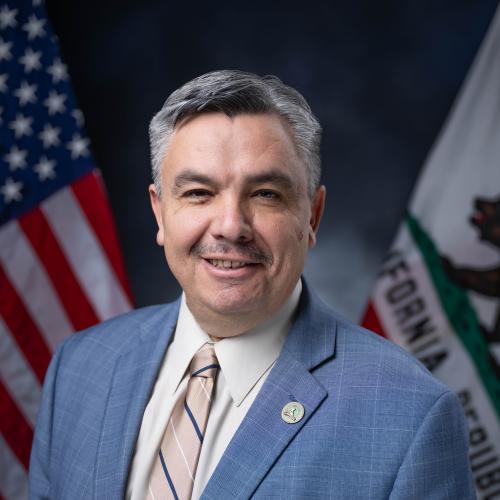
Asm. Juan Carrillo
Sponsored bills
Existing law classifies controlled substances into 5 schedules and places the greatest restrictions and penalties on the use of those substances placed in Schedule I. Existing law classifies the drug fentanyl in Schedule II. Existing law prohibits a person from possessing for sale or purchasing for purposes of sale specified controlled substances, including fentanyl, and provides for imprisonment in a county jail for 2, 3, or 4 years for a violation of this provision. Existing law also imposes an additional term, and authorizes a trial court to impose a specified fine, upon a person who is convicted of a violation of, or of a conspiracy to violate, specified provisions of law with respect to a substance containing heroin, cocaine base, and cocaine, if the substance exceeds a specified weight. This bill would add fentanyl to the substances for which additional terms or fines can be imposed and would require a defendant who violates those laws with respect to a substance containing heroin, fentanyl, or cocaine, as specified, to know of the substance's nature or character as a controlled substance to be subjected to an additional term and authorized fine. By increasing the penalty for, and by changing the definition of, a crime, the bill would impose a state-mandated local program. The California Constitution requires the state to reimburse local agencies and school districts for certain costs mandated by the state. Statutory provisions establish procedures for making that reimbursement. This bill would provide that no reimbursement is required by this act for a specified reason.
Existing law establishes the California DREAM Loan Program, which provides a student attending a participating campus of the University of California or California State University with a loan, referred to as a DREAM loan, if the student satisfies specified requirements, including a requirement that the student be exempt from paying nonresident tuition or meets equivalent requirements adopted by the Regents of the University of California, and that the student be enrolled in an instructional program, as defined, or, commencing with the 2020–21 academic year, a graduate program. This bill would, commencing with the 2024–25 academic year, authorize participating institutions to award DREAM grants to grant-eligible students, as defined, if the institution has unawarded funds in the institution's DREAM revolving fund, as specified. The bill would require the amount of the DREAM grant offered to an individual student to be determined by the institution, not to exceed the student's financial need, and would prohibit a DREAM grant awarded pursuant to these provisions from counting towards the annual or aggregate borrowing limits established for the California DREAM Loan Program.
Existing law, the Medical Practice Act, establishes the Medical Board of California within the Department of Consumer Affairs and sets forth its powers and duties relating to the licensure and regulation of physicians and surgeons. Existing law requires the board to adopt and administer standards for the continuing education of physicians and surgeons. Existing law provides that these standards may be met by educational activities that serve to maintain, develop, or increase the knowledge, skills, and professional performance that a physician and surgeon uses to provide care, or to improve the quality of care to patients, which may include educational activities that are designed to improve the physician-patient relationship. This bill would specify that these educational activities may also include activities that are designed to improve the quality of physician-patient communication. Existing law requires continuing education courses to contain curriculum that includes cultural and linguistic competency in the practice of medicine. Under existing law, associations that accredit continuing medical education courses are required to develop standards. Existing law authorizes the associations to update the standards, as needed, in conjunction with an advisory group that has expertise in cultural and linguistic competency issues. This bill would require the advisory group to be informed of federal and state threshold language requirements, as specified, and would require the authorized updates to be for the purpose of meeting the needs of California's changing demographics and properly addressing language disparities, as they emerge.
Existing law establishes the New Motor Vehicle Board in the Department of Motor Vehicles, and requires the board to hear and decide certain protests presented by a motor vehicle franchisee in regard to a dispute with the vehicle manufacturer. Existing law prohibits a franchisor from engaging in specified proscribed business practices. A violation of the Vehicle Code is punishable as an infraction. This bill would prohibit additional acts, including allocating vehicles and parts inconsistent with specified standards. Existing law prohibits a licensed manufacturer, manufacturer branch, distributor, distributor branch, or affiliate from engaging in specified proscribed business practices, including establishing or maintaining a performance standard, sales objective, or program for measuring a dealer's sales, service, or customer service performance, unless specified requirements are satisfied. A violation of the Vehicle Code is punishable as an infraction. This bill would prohibit additional acts, including exercising a right of first refusal in bad faith and implementing or modifying a vehicle reservation system for the sale or lease of motor vehicles that does not comply with specified requirements. This bill would additionally provide that a licensed manufacturer, manufacturer branch, distributor, distributor branch, or affiliate is not unlawfully competing with a franchise by providing an update or repair of motor vehicle software over-the-air at no cost or by creating a new line of motor vehicles and using new or existing franchisees to sell and service those vehicles. The bill would also declare the severability of its provisions. Because a violation of these new provisions would be punishable as a crime, the bill would impose a state-mandated local program. The bill includes legislative findings and declarations and would make other conforming changes. The California Constitution requires the state to reimburse local agencies and school districts for certain costs mandated by the state. Statutory provisions establish procedures for making that reimbursement. This bill would provide that no reimbursement is required by this act for a specified reason.
Existing law establishes a system of public elementary and secondary schools in this state, and provides for their governance. Existing law establishes county boards of education and school districts throughout the state to administer the public elementary and secondary schools within their respective jurisdictions. Existing law requires county boards of education and the governing board of each school district to prescribe and enforce rules not inconsistent with state law for their own government. Existing law requires a petition to establish a charter school to include, among other things, a reasonably comprehensive description of the governance structure of the charter school. Existing law requires county boards of education, school district governing boards, and, commencing July 1, 2023, the governing body of a charter school or of an entity managing multiple charter schools to appoint at least one high school pupil as a pupil member of the board or body, as applicable, in response to a petition from high school pupils requesting the appointment of one or more pupil members. Existing law authorizes the members of city or county boards of education or the governing boards of school districts to receive compensation, as provided. Existing law, on an annual basis, authorizes the county board of education or school district governing board to increase the compensation of individual board members beyond these limits in an amount not to exceed 5% based on the present monthly rate of compensation. Existing law authorizes any member who does not attend all meetings held in any month to receive, as compensation for their services, an amount not greater than the maximum amount allowed by law divided by the number of meetings held, and multiplied by the number of meetings actually attended. Existing law also authorizes an absent member to be paid for any meeting if the county board of education or school district governing board, by resolution, makes specified findings. Existing law does not entitle a pupil member of a county board of education, school district governing board, or governing body of a charter school or of an entity managing multiple charter schools to compensation pursuant to these provisions, except that the county board of education, the school district governing board, or the governing body of a charter school or of an entity managing multiple charter schools may award a pupil member elective course credit, as provided. This bill would revise and recast provisions related to the compensation of regular members and pupil members, as defined, of county boards of education, school district governing boards, and governing bodies of charter schools and of entities managing multiple charter schools. The bill would authorize the county board of education, the governing board of a school district, and the governing body of a charter school or of an entity managing multiple charter schools to award a pupil member elective course credit or monthly financial compensation, or both, as provided. For county boards of education and school district governing boards, the bill would authorize a pupil member to also receive partial monthly compensation, as described above, and would authorize an absent pupil member or an absent regular member to be paid for any meeting if the county board of education or school district governing board, by resolution, makes specified findings. This bill would incorporate additional changes to Section 1000 of the Education Code proposed by AB 417 to be operative only if this bill and AB 417 are enacted and this bill is enacted last.
Existing law states the intent of the Legislature to ensure that all pupils in foster care and those who are homeless, as defined, have a meaningful opportunity to meet the challenging state pupil academic achievement standards to which all pupils are held. Existing law requires educators, county placing agencies, care providers, advocates, and the juvenile courts to work together to maintain stable school placements and to ensure that each pupil is placed in the least restrictive educational programs, and has access to the academic resources, services, and extracurricular and enrichment activities that are available to all pupils, as provided. Existing law authorizes the governing board of any school district to initiate and carry on any program, activity, or to otherwise act in any manner that is not in conflict with or inconsistent with, or preempted by, any law and that is not in conflict with the purposes for which school districts are established. This bill would require a school district, county office of education, or charter school, if the local educational agency operates an intersession program, as defined, to grant priority access to foster children and homeless youth, as provided. The bill would, notwithstanding any other law, provide that if a foster child or homeless youth will be moving during an intersession period, the pupil's parent, guardian, educational rights holder, or Indian custodian, as defined, in the case of an Indian child, or, if there is no parent, guardian, educational rights holder, or Indian custodian, the unaccompanied homeless youth, as applicable, shall determine which school the pupil attends for the intersession period, if applicable. This bill would incorporate additional changes to Section 48853.5 of the Education Code proposed by AB 723 to be operative only if this bill and AB 723 are enacted and this bill is enacted last.
Existing law, until January 1, 2024, increases the smog abatement fee on certain vehicles by a specified amount and requires the revenues generated by the increase to be deposited in the Air Quality Improvement Fund and the Alternative and Renewable Fuel and Vehicle Technology Fund. Existing law, until January 1, 2024, increases vehicle registration fees and certain service fees for identification plates by specified amounts. Existing law requires the revenue generated by the increase in those fees to be deposited in the Alternative and Renewable Fuel and Vehicle Technology Fund and either the Air Quality Improvement Fund or the Enhanced Fleet Modernization Subaccount, as provided. This bill would extend the increases in those charges to July 1, 2035. Existing law, until January 1, 2024, prohibits the State Air Resources Board from enforcing any element of its clean fuels outlet regulations or other regulation that requires or has the effect of requiring suppliers, as defined, to construct, operate, or provide funding for the construction or operation of publicly available hydrogen-fueling stations. Existing law, until January 1, 2024, requires the state board to aggregate and make available certain information regarding projected leases and sales of, and the registration of, hydrogen-fueled vehicles, to evaluate, based on that information, the need for additional publicly available hydrogen-fueling stations for the actual and projected number of hydrogen-fueled vehicles, the geographic areas where fuel will be needed, and station coverage, and to report the finding of the evaluation to the State Energy Resources Conservation and Development Commission (Energy Commission) . Existing law, until January 1, 2024, requires the Energy Commission to annually allocate $20,000,000 to fund the number of publicly available hydrogen-fueling stations identified by the state board, not to exceed 20% of the moneys appropriated by the Legislature from the Alternative and Renewable Fuel and Vehicle Technology Fund, until at least 100 publicly available hydrogen-fueling stations are operating in the state. This bill would extend the above-described provisions to July 1, 2035, and would repeal them as of January 1, 2036. The bill would require the annual allocation described above to instead be no less than 15% of the moneys appropriated by the Legislature from the Alternative and Renewable Fuel and Vehicle Technology Fund from revenues attributable to specified sources, would require the commission to make that allocation only until July 1, 2030, and would impose other specified requirements. The bill would also delete the requirements that the hydrogen-fueling stations be publicly available and that there be at least 100 hydrogen-fueling stations operating in the state. Existing law creates the Enhanced Fleet Modernization Program to provide compensation for the retirement and replacement of passenger vehicles and light-duty and medium-duty trucks that are high polluters. Existing law requires the Bureau of Automotive Repair to administer the program and the state board to adopt the guidelines for the program. Existing law requires the guidelines to ensure vehicle replacement or a mobility option be an option for all motor vehicle owners and may be in addition to compensation for vehicles retired. This bill would require the guidelines to ensure each replacement vehicle in the program be either a plug-in hybrid or zero-emission vehicle unless the state board makes a specified determination regarding either the availability of vehicles or the availability of charging and refueling capabilities in consultation with the Energy Commission, as specified. Existing law establishes the Air Quality Improvement Program under the administration of the State Air Resources Board for the purpose of funding air quality improvement projects relating to fuel and vehicle technologies. The primary purpose of the program is to fund projects to reduce criteria air pollutants, improve air quality, and provide funding for research to determine and improve the air quality impacts of alternative transportation fuels and vehicles, vessels, and equipment technologies. This bill would instead provide that the purpose of the program is to fund air quality improvement projects relating to zero-emission fuel and vehicle technologies and that the primary purpose of the program is to fund projects to reduce criteria air pollutants in the logistics, goods movement, off-road, warehouse, and port sectors, improve air quality in nonattainment basins, with a priority for projects located in the areas of extreme nonattainment, and improve the air quality impacts of zero-emission transportation fuels and vehicles, vessels, and equipment technologies. The bill would also revise the list of the types of projects eligible for funding under the program. Existing law establishes the Clean Transportation Program that is administered by the Energy Commission to provide financial assistance to develop and deploy innovative technologies that transform California's fuel and vehicle types to help attain the state's climate change policies with an emphasis on the development and deployment of technology and alternative and renewable fuels in the marketplace. Existing law authorizes the Energy Commission to make a single source or sole source award for applied research. This bill would revise and recast the Clean Transportation Program to, among other things, change the emphasis of the program to the development and deployment of zero-emission technology and fuels in the marketplace where feasible and near-zero-emission technology and fuels elsewhere. The bill would require certain information regarding electric vehicle charging infrastructure and hydrogen-fueling infrastructure funded by the program to be reported to the Energy Commission. The bill would additionally authorize the Energy Commission to make a single source or sole source award to public or nonpublic entities that manage a United States Department of Energy national laboratory. The bill would require the Energy Commission, on and after January 1, 2025, to expend at least 50% of the moneys appropriated to the program on programs and projects that directly benefit or serve residents of disadvantaged and low-income communities and low-income Californians. The bill would require the Energy Commission, for any hydrogen application scoring under the program, to provide preference to applicants with the least carbon-intensive proposed fuel, as specified. The bill would also require the Energy Commission, by January 1, 2026, in consultation with the State Air Resources Board and the Department of Motor Vehicles, to propose to the Legislature alternative funding methodologies or fee structures for funding zero-emission vehicle infrastructure for light-, medium-, and heavy-duty vehicles. The bill would require the proposal to include an assessment of the economic equity of the alternatives. Existing law requires the Energy Commission, in consultation with the Public Utilities Commission, to develop uptime recordkeeping and reporting standards for electric vehicle chargers and charging stations by January 1, 2024, that only apply to electric vehicle chargers and charging stations installed on or after January 1, 2024, and that received an incentive from a state agency or through a charge on ratepayers. Existing law authorizes the Energy Commission, in consultation with the Public Utilities Commission, to adopt tools to increase charging station uptime and to include incentives, as specified. Existing law repeals these provisions on January 1, 2035. This bill would require the Energy Commission, by January 1, 2025, to set standards for how these stations shall notify customers about the availability and accessibility of publicly available charging infrastructure. This bill also would require, rather than authorize, the Energy Commission to adopt tools to increase charging station uptime. This bill would declare that it is to take effect immediately as an urgency statute.
Existing law provides for various memorials and monuments within the State Capitol Building and on the State Capitol grounds. Existing law prescribes various duties of the Department of General Services in connection with the development and maintenance of the State Capitol Building and grounds. This bill would authorize a nonprofit organization that represents blind veterans, in consultation with the Department of General Services, to plan, construct, and maintain a braille American flag to serve as a monument to the blind veterans of California and the United States in the State Capitol Building. The bill would specify duties for the Department of General Services in connection with the planning, construction, and maintenance of the monument. The bill would prohibit the construction of the monument until the Joint Rules Committee of the California Legislature approves and adopts a plan for the monument and the committee and the Department of Finance determine that sufficient private funding is available to construct and maintain the monument.
Existing law deems the month of May to be Labor History Month throughout the public schools, and encourages school districts to commemorate that month with appropriate educational exercises that make pupils aware of the role the labor movement has played in shaping California and the United States. This bill would require the week of each year that includes April 28 to be known as "Workplace Readiness Week." The bill would require all public high schools, including charter schools, to annually observe that week by providing information to pupils on their rights as workers, and would specify the topics to be covered. The bill would require the observances to be integrated into the regular school program in grades 11 and 12, consistent with the history-social science framework. By imposing additional duties on public school officials, the bill would impose a state-mandated local program. The bill would require the Superintendent of Public Instruction to annually send a written notice to every public high school, including charter schools, with certain information relating to Workplace Readiness Week, as provided. Existing law authorizes specific school administrators to issue a work permit to pupils subject to specific requirements, including requiring certain information to be included on the work permit. This bill would require, beginning August 1, 2024, any minor seeking the signature of a verifying authority on a Statement of Intent to Employ a Minor and Request for a Work Permit-Certificate of Age to be issued, before or at the time of receiving the signature of the verifying authority, a document clearly explaining basic labor rights extended to workers, as provided. The bill would encourage the University of California Berkeley Center for Labor Research and Education to produce, with input from bona fide labor organizations, a draft template for the document to be provided to minors, including translations into languages other than English, as specified. The bill would require the document to express those labor rights in plain, natural terminology easily understood by the pupil. The bill would require the document, in English, to be in a physical form and include a Uniform Resource Locator for, and a quick response code linked to, an internet website with electronic versions of the document, including any translated versions of the document, produced by the University of California Berkeley Center for Labor Research and Education. To the extent these requirements would impose additional duties on public school officials, the bill would impose a state-mandated local program. The California Constitution requires the state to reimburse local agencies and school districts for certain costs mandated by the state. Statutory provisions establish procedures for making that reimbursement. This bill would provide that, if the Commission on State Mandates determines that the bill contains costs mandated by the state, reimbursement for those costs shall be made pursuant to the statutory provisions noted above.