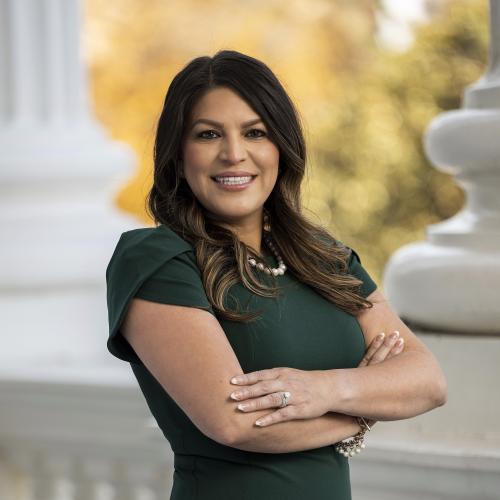
Photo of Esmeralda Soria
D California Assembly · District 27

Asm. Esmeralda Soria

Compare
Total votes
9,034
all sessions
Attendance
93%
572 missed
Near the chamber average
With party
99%
of cast votes
Near the chamber average
Bipartisan score
0%
crosses aisle rarely
Near the chamber average
Sponsored
783
bills & resolutions
Near the chamber average
Committees
12
assignments
783 bills and resolutions

Sponsored bills

Total
783
Primary
78
Co-sponsor
705
This page
783
matching current filters
Co-sponsor SCR 103
Passed · California Senate · Co-sponsor
Probation Services Week.

Maddy summarySCR 103 designates the week of July 20-26, 2025, as "Probation Services Week" in California. This concurrent resolution recognizes the work of probation services professionals across the state. It is a symbolic observance with no new laws, regulations, or direct impact on individuals or policies. The bill does not alter existing statutes or create obligations for any entity.

Passed Jan 26, 2026 1 co-sponsor
Co-sponsor AB 524
Vetoed · California Assembly · Co-sponsor
Farmland Access and Conservation for Thriving Communities Act.

Existing law, the California Farmland Conservancy Program Act, establishes within the Department of Conservation the California Farmland Conservancy Program. Existing law authorizes the program to offer financial assistance, including grants or contracts, for projects and activities on agricultural lands, as defined, that support agricultural conservation and sustainable land management. This bill would require the department, in collaboration with the California Agricultural Land Equity Task Force, to establish the Farmland Access and Conservation for Thriving Communities Program in the department to provide financial and technical assistance to support agricultural land acquisition and protection. The bill would require the department, subject to specified requirements, to provide financial assistance under the program to qualified entities for the purpose of acquiring agricultural lands to transfer or provide long-term leases to qualified farmer participants, as specified. The bill would establish the Farmland Access Fund in the State Treasury and would make moneys in the fund available, upon appropriation by the Legislature, to the department for program expenditures. The bill would authorize the department to contract with one or more nonprofit organizations to administer the program. The bill would make the operation of the program contingent upon the Legislature making an appropriation for purposes of the program.

Vetoed Jan 22, 2026 1 co-sponsor
Primary AB 1400
Vetoed · California Assembly · Lead sponsor
Community colleges: Baccalaureate Degree in Nursing Pilot Program.

Existing law establishes the California Community Colleges, under the administration of the Board of Governors of the California Community Colleges. Existing law establishes community college districts throughout the state, under the administration of community college district governing boards, and authorizes these districts to provide instruction at the community college campuses they operate. Existing law establishes a statewide baccalaureate degree program that authorizes up to a total of 30 baccalaureate degree programs at community college districts to be approved per academic year, as provided. This bill would require the office of the Chancellor of the California Community Colleges to develop a Baccalaureate Degree in Nursing Pilot Program that authorizes select community college districts to offer a Bachelor of Science in Nursing degree. The bill would limit the pilot program to 10 community college districts statewide and would require the chancellor's office to identify and select eligible community college districts based on specified criteria. The bill would require the chancellor's office to develop a process designed to assist community college districts with nursing programs that are applying for national accreditation for the purpose of qualifying for the pilot program, as provided. The bill would require each participating community college district to give priority registration for enrollment in the pilot program to students with an associate degree in nursing from that community college district. The bill would require the Legislative Analyst's Office to conduct an evaluation of the pilot program to determine the effectiveness of the program and the need to continue or expand the program, as specified, to be submitted to the Legislature on or before July 1, 2033. The bill would repeal these provisions as of January 1, 2035.

Vetoed Jan 22, 2026 0 co-sponsors
Primary AB 1373
Vetoed · California Assembly · Lead sponsor
Water quality: state certification.

Under existing law, the State Water Resources Control Board and the California regional water quality control boards prescribe waste discharge requirements in accordance with the Federal Water Pollution Control Act and the Porter-Cologne Water Quality Control Act. Under federal law, any applicant seeking a federal license or permit for an activity that may result in any discharge into the navigable waters of the United States is required to first seek a state water quality certification, as specified. The Porter-Cologne Water Quality Control Act authorizes the state board to certify or provide a statement to a federal agency, as required pursuant to federal law, that there is reasonable assurance that an activity of any person subject to the jurisdiction of the state board will not reduce water quality below applicable standards. The federal act provides that if a state fails or refuses to act on a request for this certification within a reasonable period of time, which shall not exceed one year after receipt of the request, then the state certification requirements are waived with respect to the federal application. This bill would require the state board, if requested by the applicant within 14 days of an initial draft certification being issued, to hold a public hearing at least 21 days before taking action on an application for certification for a license to operate a hydroelectric facility, as provided. The bill would, if a public hearing is requested on the draft certification, prohibit the authority to issue a certification for a license to operate a hydroelectric facility from being delegated. The bill would authorize the state board to include in its fee schedule for hydroelectric facility applicants an amount up to the reasonable costs incurred by the state board in implementing these provisions.

Vetoed Jan 22, 2026 0 co-sponsors
Co-sponsor HR 75
Passed · California Assembly · Co-sponsor
Relative to National Human Trafficking Awareness Month.

Maddy summaryThis bill establishes January as National Human Trafficking Awareness Month in California to raise public awareness about human trafficking. The resolution recognizes the severity of human trafficking as a felony crime and highlights statistics showing its prevalence across the country and specific challenges with identifying male victims and labor trafficking cases. It aims to educate the public and encourage reporting and support for victims during this designated month.

Passed Jan 20, 2026 1 co-sponsor
Co-sponsor AB 366
Signed into law · California Assembly · Co-sponsor
Ignition interlock devices.

Existing law, commencing January 1, 2019, made various changes to the law governing ignition interlock devices (IID) , including, among other things, requiring a person who has been convicted of driving a motor vehicle under the influence of an alcoholic beverage, as specified, to install for a specified period of time as ordered by the court, an IID on the vehicle they operate, provided however that installation of an IID is discretionary for a first offender, as specified; authorizing a person convicted of driving a motor vehicle under the influence, if all other requirements are satisfied, including the installation of an IID, to apply for a restricted driver's license without completing a period of license suspension or revocation; and requiring ignition interlock device manufacturers to be in compliance with specified provisions relating to payment for the costs of an ignition interlock device. Existing law makes these changes operative until January 1, 2026. On January 1, 2026, existing law, as it relates to these provisions, is generally reinstated to read as it read prior to January 1, 2019. Existing law makes it a crime to violate certain provisions relating to IIDs and motor vehicles equipped with IIDs. This bill would extend the operation of these provisions until January 1, 2033, and would instead reinstate the law to how it read prior to January 1, 2019, on January 1, 2033. By extending the application of a crime, the bill would impose a state-mandated local program. The California Constitution requires the state to reimburse local agencies and school districts for certain costs mandated by the state. Statutory provisions establish procedures for making that reimbursement. This bill would provide that no reimbursement is required by this act for a specified reason.

Signed into law Oct 13, 2025 1 co-sponsor
Primary AB 1441
Signed into law · California Assembly · Lead sponsor
County of Merced Citizens Redistricting Commission.

Existing law requires the board of supervisors, following a county's decision to elect its board using district-based elections or following each decennial federal census for a county whose board is already elected using district-based elections, by ordinance or resolution, to adjust the boundaries of all of the supervisorial districts of the county so that the districts are as nearly equal in population as possible and comply with applicable federal law, and specifies the procedures the board of supervisors must follow in adjusting those boundaries. Existing law establishes independent redistricting commissions in the Counties of Los Angeles, San Diego, Orange, Riverside, San Luis Obispo, Kern, Fresno, and Sacramento, which are charged with adjusting the supervisorial district boundaries for their respective counties. This bill would similarly establish the Citizens Redistricting Commission in the County of Merced, which would be charged with adjusting the boundary lines of the districts of the Board of Supervisors of the County of Merced in accordance with specified criteria. The commission would consist of 11 members who meet specified qualifications. By increasing the duties of local officials, the bill would impose a state-mandated local program. This bill would make legislative findings and declarations as to the necessity of a special statute for the County of Merced. The California Constitution requires the state to reimburse local agencies and school districts for certain costs mandated by the state. Statutory provisions establish procedures for making that reimbursement. This bill would provide that, if the Commission on State Mandates determines that the bill contains costs mandated by the state, reimbursement for those costs shall be made pursuant to the statutory provisions noted above.


Signed into law Oct 13, 2025 0 co-sponsors
Co-sponsor AB 64
Signed into law · California Assembly · Co-sponsor
Vital records.

(1) Existing law prescribes the duties of the State Registrar of Vital Statistics (State Registrar) and local registrars of births and deaths with respect to the registration of certificates of live birth, fetal death, or death, and marriage licenses. Existing law requires the State Registrar to prescribe and furnish all record forms for use in carrying out the provisions governing vital records and prohibits the use of any record form or format other than those prescribed by the State Registrar. Existing law requires every live birth, fetal death, death, and marriage that occurs in the state to be registered with the local registrar. Existing law requires certificates of live birth, fetal death, or death, and a marriage license to include specified information, such as the full name of the child on a certificate of live birth and the full names of the parties to be married on a marriage license. Existing law also requires the county clerk to issue a confidential marriage license, as specified, on a form prescribed by the State Registrar. This bill would require, commencing no earlier than 2 years after an appropriation of funds by the Legislature, the State Registrar to require the use of a diacritical mark on an English letter within a name field to be properly recorded, when applicable, on a certificate of live birth, fetal death, death, marriage license and certificate, or confidential marriage license and certificate, and would require the use of a diacritical mark to be deemed an acceptable entry by the State Registrar. The bill would provide that the absence or presence of a diacritical mark on a certificate of live birth, fetal death, or death, or a marriage license and certificate or confidential marriage license and certificate does not render the document invalid nor affect any constructive notice imparted by proper recordation of the document. The bill would authorize the State Registrar to develop a list of acceptable diacritical marks for use on a certificate of live birth, fetal death, or death, or a marriage license and certificate or confidential marriage license and certificate through all-county letters or similar instructions from the State Registrar without taking further regulatory actions. The bill would authorize the State Registrar to remove any diacritical marks on the birth, fetal death, death, and marriage license and certificate data before furnishing the vital statistics to a federal, state, or local government agency. The bill would authorize, beginning July 1, 2026, if a name is not accurately recorded because of the absence of a diacritical mark on an English letter in any certificate of live birth, fetal death, death, or marriage already registered, the person asserting the omission, or the person's conservator, or if a minor, the person's parent or guardian, to make an affidavit under oath, as specified, stating the changes necessary to make the record correct. The bill would require the affidavit to be supported by the affidavit of one other person having knowledge of the facts and be filed with the State Registrar. The bill would require the State Registrar to, review the request and, if the request is accompanied with the payment of a specified fee, to issue an amendment to any certificate of live birth, fetal death, death, or marriage with the accurate name identified in the request. The bill would also authorize, if a name field of either of the parties married or their parents is not accurately recorded because of the absence of a diacritical mark on an English letter on any confidential license and certificate of marriage already registered, the party asserting the omission to make an affidavit, under oath, stating the changes necessary to make the record correct and file it with the county clerk. The bill would authorize the county clerk to charge a fee, not to exceed the amount of the fee for any other amended confidential marriage license and certificate issued by the county clerk and not to exceed the reasonable cost to provide the amended marriage license and certificate. The bill would require the county clerk to review the amendment for acceptance for filing, and if accepted, file the amendment and note the fact of the amendment, with its date, on the otherwise unaltered original confidential license and certificate of marriage. By requiring the affidavit to be under oath, the bill would expand the crime of perjury, thereby imposing a state-mandated local program. By increasing duties on county clerks, the bill would impose a state-mandated local program. (2) Existing law requires the collection of specified fees for certified copies of a fetal death record, death record, a birth certificate, marriage record, or marriage dissolution record. Existing law requires all applicants for certified copies of the above-described records to pay an additional fee of $3 to be collected by the State Registrar, the local registrar, county recorder, or county clerk, as appropriate. This bill would increase the additional fee charged for certified copies of the above-described records to $5. (3) The California Constitution requires the state to reimburse local agencies and school districts for certain costs mandated by the state. Statutory provisions establish procedures for making that reimbursement. This bill would provide that with regard to certain mandates no reimbursement is required by this act for a specified reason. With regard to any other mandates, this bill would provide that, if the Commission on State Mandates determines that the bill contains costs so mandated by the state, reimbursement for those costs shall be made pursuant to the statutory provisions noted above.
Signed into law Oct 12, 2025 1 co-sponsor
Primary AB 848
Signed into law · California Assembly · Lead sponsor
Sexual battery.

Existing law prohibits the touching of any intimate part of another person for the purpose of sexual arousal, gratification, or abuse, under specified circumstances, including if the victim is unconscious of the nature of the act because the perpetrator fraudulently represented that the touching served a professional purpose. A violation of these provisions is punishable as a misdemeanor or as a felony by imprisonment in the state prison for 2, 3, or 4 years, and by a fine not exceeding $10,000. Existing law requires, in the case of a felony conviction for a violation of these provisions, the fact that the defendant was an employer and the victim was an employee of the defendant to be a factor in aggravation in sentencing. This bill would require, in the case of a felony conviction for a violation of these provisions, the fact that the defendant was employed at a hospital where the offense occurred and the victim was in the defendant's care or seeking medical care at the hospital to be a factor in aggravation in sentencing. By increasing the punishment for a crime, this bill would impose a state-mandated local program. The California Constitution requires the state to reimburse local agencies and school districts for certain costs mandated by the state. Statutory provisions establish procedures for making that reimbursement. This bill would provide that no reimbursement is required by this act for a specified reason.

Signed into law Oct 11, 2025 0 co-sponsors
Primary AB 639
Signed into law · California Assembly · Lead sponsor
Dams: exceptions.

Existing law defines a dam to mean any artificial barrier, together with appurtenant works, that does or may impound or divert water, and meets other specified criteria. Existing law excludes from the definition a barrier that is or will be not in excess of 6 feet in height, regardless of storage capacity, or that has or will have a storage capacity not in excess of 15 acre-feet, regardless of height. Existing law requires the Department of Water Resources to supervise the construction, enlargement, alteration, repair, maintenance, operation, and removal of dams and reservoirs for the protection of life and property. This bill would additionally exclude from the definition of a dam a barrier that does not impound water above the top of a levee where maximum storage behind the barrier has a minimum of 3 feet of freeboard on the levee and is a weir, as defined, but would apply only to specified weirs named in the bill.

Signed into law Oct 11, 2025 0 co-sponsors
Showing 191 to 200 of 783 bills
Previous 1 … 19 20 21 … 79 Next