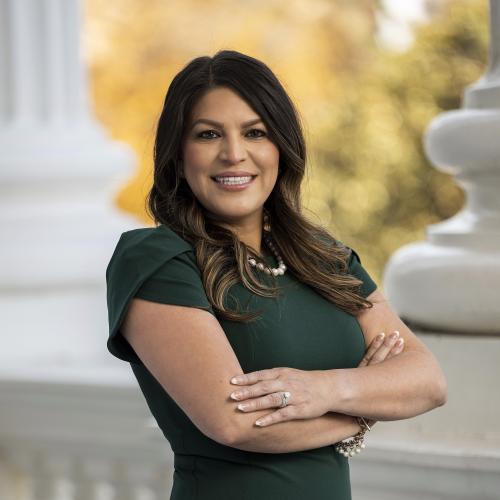
Photo of Esmeralda Soria
D California House · District 27

Rep. Esmeralda Soria

Compare
Total votes
9,034
all sessions
Attendance
93%
572 missed
Near the chamber average
With party
99%
of cast votes
Near the chamber average
Bipartisan score
0%
crosses aisle rarely
Near the chamber average
Sponsored
783
bills & resolutions
Near the chamber average
Committees
12
assignments
783 bills and resolutions

Sponsored bills

Total
783
Primary
78
Co-sponsor
705
This page
783
matching current filters
Co-sponsor AB 2017
Passed · California House · Co-sponsor
State holidays: Eid.

Existing law designates specific days as holidays in this state. Existing law adopts state holidays as judicial holidays, with certain exceptions, including Admission Day and Columbus Day. Existing law designates holidays on which community colleges and public schools are authorized to close pursuant to a memorandum of understanding between the governing board and represented employees, including "Native American Day" on the 4th Friday in September. This bill would add "Eid al-Fitr" and "Eid al-Adha" to the list of state holidays. The bill would exclude "Eid al-Fitr" and "Eid al-Adha" from designation as judicial holidays. The bill would authorize community colleges and public schools to close on "Eid al-Fitr" and "Eid al-Adha," as specified. Existing law entitles state employees, with specified exceptions, to be given time off with pay for specified holidays. Existing law, in addition, authorizes state employees to elect to use 8 hours of vacation, annual leave, compensating time off, or personal holiday credit corresponding with specified dates. This bill would, similarly, permit the employee to elect to receive the holiday credit for the holidays of "Eid al-Fitr" or "Eid al-Adha," as specified. The bill would, for those holidays whose dates vary annually, instead authorize the above-described election to be made on the date designated by their group. The bill would make findings and declarations related to the purpose of the Eid holidays. The bill would make its provisions severable. This bill would incorporate additional changes to Section 135 of the Code of Civil Procedure proposed by AB 2294 to be operative only if this bill and AB 2294 are enacted and this bill is enacted last. The bill also would incorporate additional changes to Sections 45203, 79020, and 88203 of the Education Code proposed by SB 1394 to be operative only if this bill and SB 1394 are enacted and this bill is enacted last. The bill further would incorporate additional changes to Section 6700 of the Government Code proposed by AB 2294 and SB 1394 to be operative only if this bill and either or both of those bills are enacted and this bill is enacted last. The bill further would incorporate additional changes to Sections 19853 and 19853.1 of the Government Code proposed by SB 1394 and AB 1841 to be operative only if this bill and either or both of those bills are enacted and this bill is enacted last.

Passed Aug 30, 2026 1 co-sponsor
Co-sponsor AB 2727
Passed · California House · Co-sponsor
Corrections: parole and prerelease treatment.

Existing law requires the Board of Parole Hearings, among other responsibilities, to conduct parole suitability hearings and determine whether an individual is suitable for parole. Existing law establishes the Elderly Parole Program for the purpose of reviewing parole suitability of inmates who are 50 years of age or older and who have served a minimum of 20 years of continuous incarceration on their sentence. Existing law requires the Board of Parole Hearings, when considering the release of qualifying inmates, to give special consideration to whether certain criteria have reduced the elderly inmate's risk for future violence. Existing law excludes various persons from these provisions, including persons sentenced pursuant to existing sentencing provisions commonly known as the 3 strikes law. Under an existing court order, although statutorily excluded, an individual may be eligible for parole under the Elderly Parole Program when they are 60 years of age or older and have been continuously incarcerated for at least 25 years. This bill would instead specify that persons convicted of various sexual offenses, including rape, sodomy, or aggravated sexual assault of a child, or sentenced pursuant to a provision applicable where the crimes involved had multiple victims, as specified, are not eligible for parole under the Elderly Parole Program, unless the person is 65 years of age or older and has served a minimum of 25 years of continuous incarceration on their current sentence. The bill would require the board to review a sexual dangerousness screening of an individual sentenced to an indeterminate sentence for a sexually violent offense, as defined, and would require the board to refer a person whose sexual dangerousness screening indicates that they may qualify as a sexually violent predator to the State Department of State Hospitals for further evaluation, as described. The bill would require commissioners who conduct hearings to undergo training in sex offender behaviors and risks. Existing law defines a sexually violent predator to mean a person who has been convicted of a sexually violent offense against one or more victims and who has a diagnosed mental disorder that makes the person a danger to the health and safety of others in that it is likely that the person will engage in sexually violent criminal behavior. For purposes of this definition, a conviction for a sexually violent offense includes convictions that resulted in either a determinate or an indeterminate prison sentence, as specified. Existing law requires the Secretary of the Department of Corrections and Rehabilitation to refer a person who is in custody under that department's jurisdiction, and who is serving a determinate sentence or whose parole has been revoked, for evaluation by the State Department of State Hospitals at least 6 months prior to that individual's scheduled date for release from prison if the secretary determines that the person may be a sexually violent predator. Existing law requires a petition for commitment as a sexually violent predator to be filed in the county in which the person was convicted of the sexual offense for which the person was committed to the jurisdiction of the Department of Corrections and Rehabilitation. This bill would also require the Executive Officer of the Board of Parole Hearings to make that referral and revise the criteria for referral to additionally apply to a person who is serving an indeterminate prison sentence. The bill would also authorize the secretary, or the Executive Officer of the Board of Parole Hearings, to refer the person for evaluation if the person's scheduled release date is less than 4 months after the date of the decision to grant parole, or if the person will be scheduled for a parole hearing in the next 6 months. By imposing additional duties on counties regarding commitment of persons as sexually violent predators, this bill would impose a state-mandated local program. The California Constitution requires the state to reimburse local agencies and school districts for certain costs mandated by the state. Statutory provisions establish procedures for making that reimbursement. This bill would provide that, if the Commission on State Mandates determines that the bill contains costs mandated by the state, reimbursement for those costs shall be made pursuant to the statutory provisions noted above.

Passed Aug 30, 2026 1 co-sponsor
Primary AB 2739
Passed · California House · Lead sponsor
Water: affordability and system stabilization.

Existing law establishes in the Natural Resources Agency the Department of Water Resources. Existing law vests in the department powers, duties, purposes, responsibilities, and jurisdiction in matters pertaining to water or dams. Existing law declares the responsibility of the state to assist local governments in providing certain essential services and facilities where water resource construction projects financed, in whole or in part, by the state or by the state jointly with the federal government create an undue burden on a local area's ability to provide these services and facilities. Existing law, the California Safe Drinking Water Act, requires the State Water Resources Control Board to administer provisions relating to the regulation of drinking water to protect public health. Existing law declares it to be the established policy of the state that every human being has the right to safe, clean, affordable, and accessible water adequate for human consumption, cooking, and sanitary purposes. This bill would establish in the State Treasury the Water Affordability and System Stabilization Fund for holding the principal and income of the Water Affordability and System Stabilization Trust, which the bill would create. The bill would designate the Treasurer as trustee of the trust, as specified, and would require the trustee, among other things, to hold, manage, and invest the principal of the trust with the obligation of providing a growing perpetual source of annual funding to the Water Rate Assistance Fund, administered by the state board, and the Community Water Affordability Assistance Fund, administered by the department, beginning 25 years after the Legislature transfers funding from the General Fund to the Water Affordability and System Stabilization Fund. This bill would require, during the first 25 years following the Legislature's transfer, 45% of the income of the trust to be transferred from the Water Affordability and System Stabilization Fund to each of the Water Rate Assistance Fund and the Community Water Affordability Assistance Fund, and would continuously appropriate the remaining 10% of the income of the trust to be invested as part of the principal of the trust. After the first 25 years, the bill would require 50% of the income of the trust to be transferred from the Water Affordability and System Stabilization Fund to each of the Water Rate Assistance Fund and the Community Water Affordability Assistance Fund. The bill would continuously appropriate no more than 1% of the annual income of the trust to pay for administration of the trust. By making continuous appropriations and by transferring moneys into a continuously appropriated fund, the bill would make an appropriation. Existing law requires the Controller to transfer surplus money in any special fund from that fund to the Surplus Money Investment Fund in the State Treasury, a continuously appropriated fund. The bill would authorize the trustee to enter into a trust agreement with a fiscal intermediary to support its duties, as provided, and would authorize the fund to be invested in the Surplus Money Investment Fund, thereby making an appropriation. This bill would require the department, subject to a transfer of moneys by the Legislature, to develop and administer the Community Water Affordability Program to provide funding in the form of grants to community water systems for local water system infrastructure projects, as specified, for the purpose of reducing the amount of local ratepayer funding required for those projects and for avoiding costs that would otherwise be paid for by ratepayers. The bill would require the department to develop and adopt program guidelines and project solicitation documents before disbursing grant funds, and would exempt those guidelines and documents from the rulemaking procedures of the Administrative Procedure Act. The bill would require the program guidelines to, among other things, require an applicant for a grant to provide at least 25% of the total funding required for the project, as provided. The bill would authorize the department to waive or reduce that minimum amount if that requirement would cause extreme financial hardship to the applicant. The bill would also establish the Community Water Affordability Assistance Fund in the State Treasury and would provide for deposit into the fund of contributions from private and public entities, as specified. The bill would make moneys in the fund available to the department for purposes of the program, including up to 5% annually for administration of the fund, upon appropriation by the Legislature, as provided.


Passed Aug 30, 2026 0 co-sponsors
Co-sponsor AB 1709
Passed · California House · Co-sponsor
Covered platforms: age restriction: e-Safety Advisory Commission.

Existing law, the Protecting Our Kids from Social Media Addiction Act, prohibits an operator of an addictive internet-based service or application from providing an addictive feed, as defined, to a user unless the operator does not have actual knowledge that the user is a minor, as specified, or the operator has obtained verifiable parental consent to provide an addictive feed to the user who is a minor. Existing law, the Digital Age Assurance Act, beginning January 1, 2027, requires a person who owns, maintains, or controls a software application, as defined, to request age bracket data sent by a real-time secure application programming interface or operating system with respect to a particular user from an operating system provider or a covered application store when the application is downloaded and launched. This bill would prohibit a covered platform, as defined, from providing an addictive feature, as defined, to a user who is under 16 years of age and would require a covered platform to implement reasonable measures to ensure that users under 16 years of age are not offered or provided any addictive feature on the covered platform. The bill would also authorize the Attorney General to adopt regulations to implement and enforce the bill in order to further the purpose of protecting minors online, including by altering the scope of "covered platform" if the Attorney General determines that doing so is necessary to ensure that "covered platform" applies to internet websites, online services, online applications, or mobile applications that make addictive features, as defined, available to users under 16 years of age. This bill would impose a civil penalty upon a noncompliant platform and would require its provisions to be enforced by a civil action brought only by the Attorney General or a local public prosecutor, as specified. This bill would also establish the e-Safety Advisory Commission within the Department of Justice as an independent advisory body that is only for administrative purposes to advise state government on certain matters related to online safety and would require the commission to, on or before January 1 of each year, report to the Legislature and the Governor on, among other things, its activities under the bill.

Passed Aug 30, 2026 1 co-sponsor
Co-sponsor AB 1981
Passed · California House · Co-sponsor
Subsidized childcare: reimbursement rates: reporting.

Existing law requires the State Department of Social Services, in collaboration with the State Department of Education, to implement a reimbursement system plan that establishes reasonable standards and assigned reimbursement rates for subsidized childcare and development services, and to develop and conduct an alternative methodology for ratesetting, as specified. Existing law requires the Governor and the Legislature to, by no later than July 1, 2025, establish reimbursement rates based on the alternative methodology, as specified. Existing law requires the department to provide quarterly updates from October 1, 2024, to July 1, 2027, inclusive, on the implementation of the new reimbursement rates set under the alternative methodology. If the new reimbursement rates do not take effect on July 1, 2025, existing law also requires the department to provide the Legislature with a timeline for transitioning from the rates that are in effect on July 1, 2025, to the new established rates. This bill would instead, under those circumstances, require the department to provide the Chairperson of the Joint Legislative Budget Committee with the department's anticipated timeline for the above-described rate transition. The bill would also require the quarterly reports described above to continue until July 1, 2028. Existing law states the intent of the Legislature that the reimbursement rates established under the alternative methodology satisfy certain parameters, including, among others, that the rates vary based on geography, type of care setting, regulatory requirements applicable to each type of care setting, time categories, and child age. This bill would impose various requirements on the department, in consultation with the State Department of Education, when establishing new reimbursement rates using a single-rate structure informed by the alternative methodology, to the extent those requirements are consistent with the approved Child Care and Development Fund state plan. Among other things, the bill would require the department to vary rates based on geographic regions and specific age groupings and to include in the rates an enhanced rate for nonstandard hours of care and enhanced inclusion rates for children with special needs. The bill would authorize the department to implement these provisions by means of all-county letters, childcare bulletins, or similar written instructions. This bill would incorporate additional changes to Section 10227.6 of the Welfare and Institutions Code proposed by AB 190 or SB 190 to be operative only if this bill and AB 190 or SB 190 are enacted and this bill is enacted last. This bill would declare that it is to take effect immediately as an urgency statute.

Passed Aug 30, 2026 1 co-sponsor
Co-sponsor SB 931
Passed · California Senate · Co-sponsor
Dolly Parton Day.

Existing law requires the Governor to proclaim various days as days of remembrance or recognition. This bill would require the Governor to annually proclaim September 25 as Dolly Parton Day. This bill would declare that it is to take effect immediately as an urgency statute.

Passed Aug 30, 2026 1 co-sponsor
Co-sponsor AB 1039
Passed · California House · Co-sponsor
State-funded assistance grants and contracts: advance payments.

Existing law authorizes a state agency administering a grant program or contract to advance a payment to a recipient entity, subject to specified requirements. Existing law defines "recipient entity" for these purposes to mean a private, nonprofit organization qualified under federal law, or a federally recognized Indian tribe whose territorial boundaries lie wholly or partially within the State of California, as specified. Existing law requires the administering state agency, among other things, to prioritize recipient entities and projects serving disadvantaged, low-income, and underresourced communities, to stipulate an advance payment structure and request process within the grant agreement or contract, and to ensure an advance payment to the recipient entity does not exceed 25% of the total grant or contract amount, except as specified. Existing law requires recipient entities to satisfy specified minimum requirements, including submitting prescribed documentation, providing progress reports on the expenditure of advanced funds no less than on a quarterly basis, and depositing any funds received as an advance payment into a federally insured account, as specified. This bill would expand the definition of "recipient entity" to include a private, nonprofit organization qualified under state law and would limit the requirement to prioritize recipient entities and projects to grants and contracts advertised before January 1, 2026. The bill would eliminate the requirement to stipulate an advance payment structure and request process. The bill would limit the above-described documentation and federally insured account requirements to apply only to grants and contracts in excess of $10,000 and, for grants or contracts less than $10,000, would instead require recipient entities to provide the above-described progress reports no less than annually. The bill would revise and recast the above-described authorization for an administering state agency to instead require the agency to advance a payment to an eligible recipient entity in accordance with the above requirements for any grants and contracts advertised on or after January 1, 2027, with a total award value of $150,000 or less, receiving an initial disbursement of 25 percent of the total award that meets one or more of specified criteria. The bill would authorize an administering state agency to distribute advance payments in multiple installments over the course of the grant or contract term and would authorize a recipient entity to request subsequent advance payment installments, as provided. This bill would authorize an administering state agency to opt out of the default advance payment requirement for a specific funding opportunity if the agency determines it would create an irreconcilable conflict with federal law, bond requirements, or a documented high-risk profile of the specific program. To exercise the opt-out, the bill would require the agency to follow prescribed procedures, including clearly stating in the grant solicitation or request for proposal that advance payment is not available for that specific opportunity. Existing law requires each state agency to register every grant the state agency administers with the California State Library prior to commencing a solicitation or award process for distribution of the grant, and to provide specified information that assists the California State Library with cataloging the distribution of grants and provides potential applicants with understandable and consistent information about available funding opportunities. This bill would require a state agency to include within the information submitted to the California State Library, the percentage of the grant funds that may be distributed as an advance payment. This bill would require, on or before July 1, 2027, the Strategic Growth Council, in consultation with the Department of Finance and the Department of General Services, to develop a Statewide Advance Funds and Reconciliation Guide (Master Guide) , as specified. The bill would require the Department of General Services to actively promote the Master Guide across state agencies and would require every state agency to adopt the Master Guide as its standard operating procedure for the disbursement, tracking, and reconciliation of advance payments, as provided.

Passed Aug 30, 2026 1 co-sponsor
Primary AB 2481
Passed · California House · Lead sponsor
Beverage containers: recycling: glass: quality incentive payments.

The California Beverage Container Recycling and Litter Reduction Act requires a distributor of beverage containers to pay to the Department of Resources Recycling and Recovery a redemption payment for every beverage container sold or offered for sale, as provided. The act requires the department to deposit those amounts into the California Beverage Container Recycling Fund. The act requires the fund to be continuously appropriated to the department for specified purposes, including, among other things, to pay refund values, administrative fees, and processing payments associated with the collection and recycling of empty beverage containers. The act continuously appropriates up to $15,000,000 annually from the fund to the department for quality incentive payments for empty glass beverage containers to an operator of a curbside recycling program or other certified entity, as specified. This bill would authorize the department to make quality incentive payments from the fund for empty glass beverage containers that are substantially free from contamination and used for the manufacturing of glass products in the state that are not beverage containers, as specified. By authorizing a new use for continuously appropriated funds, the bill would make an appropriation.

Passed Aug 28, 2026 0 co-sponsors
Primary AB 2010
Passed · California House · Lead sponsor
Veterinary medicine: veterinary surgery premises: spay and neuter services.

Existing law, the Veterinary Medicine Practice Act, establishes the California Veterinary Medical Board to license and regulate the practice of veterinary medicine. The act requires all premises where veterinary medicine, veterinary dentistry, or veterinary surgery is being practiced to be kept clean and sanitary at all times and conform to minimum standards established by the board. This bill would specify that high-volume spay or neuter services, as defined, shall not be required to be performed in a separate surgical room. The bill would make related findings and declarations.

Passed Aug 28, 2026 0 co-sponsors
Showing 1 to 10 of 783 bills
1 2 3 79 Next