

Maddy summaryThe CREATE AI Act of 2023 establishes a National Artificial Intelligence Research Resource (NAIRR) to improve access to AI research tools, computational resources, data, and educational materials for researchers and students across the United States. The NAIRR will provide computational resources, curated datasets, educational tools, and access to AI testbeds, with special emphasis on supporting groups historically underrepresented in STEM fields. Governed by a Steering Subcommittee chaired by the Director of the Office of Science and Technology Policy and managed by a Program Management Office within the National Science Foundation, the NAIRR includes specific requirements for ethical AI development, privacy protections, and security measures. The resource will be accessible to researchers at U.S. institutions of higher education, nonprofits, government agencies, and certain businesses, with priority given to projects addressing privacy, ethics, civil rights, and AI safety.
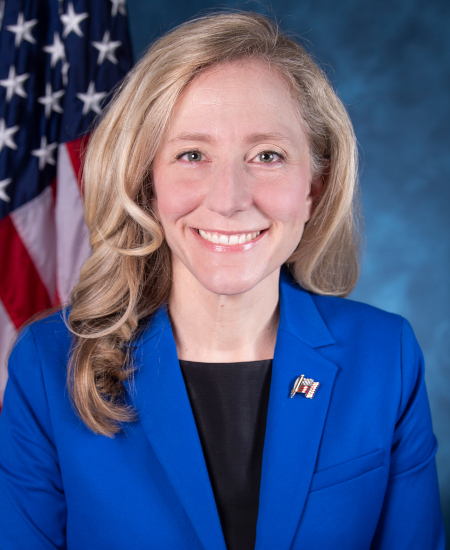
Rep. Abigail Davis Spanberger
Sponsored bills
Maddy summaryThis symbolic resolution expresses congressional support for designating September 29, 2024, as "Veterans of Foreign Wars of the United States Day" to honor the organization's 125th anniversary. It requests the President issue a proclamation encouraging government agencies and the public to observe the day with ceremonies, though it creates no new laws or policy changes. The resolution recognizes the VFW's historical service to veterans but does not directly affect any individuals or programs.
Maddy summaryHR 8613, the NSF and USDA Interagency Research Act, requires the U.S. Department of Agriculture (USDA) and the National Science Foundation (NSF) to formally coordinate joint research on agricultural priorities through agreements like memoranda of understanding. It directs them to collaborate on specific areas including food security, precision agriculture tools, soil health monitoring, and STEM workforce development, with funding for centers at colleges and universities. The bill establishes mechanisms for sharing data, supporting research infrastructure, and awarding grants to educational institutions to advance agricultural research and education. It also mandates a congressional report within two years detailing coordination efforts, research achievements, and future opportunities. This legislation primarily affects USDA, NSF, and educational institutions participating in joint research initiatives.
Maddy summaryHR 7015, the CAREERS Act, expands federal funding for workforce training programs to better serve rural communities. It modifies eligibility to include career and technical education schools and requires training programs to align with specific rural industry sectors like broadband, healthcare, agriculture, manufacturing, and water services. The bill mandates grantees to report on employment outcomes for participants and addresses rural workforce challenges such as worker displacement and youth migration. This directly affects rural workforce development boards, training providers, and workers in designated rural industries seeking job skills and career pathways.
Maddy summaryHR 6867 establishes an Office of Conservation Innovation within the USDA's Natural Resources Conservation Service (NRCS), directly affecting NRCS conservation programs and the agricultural practices they support. The office will revise existing conservation standards, recommend interim standards, and propose new standards for practices like soil health, water management, and sustainable grazing. It requires the Chief to detail up to six technical specialists with expertise in areas including agronomy, water conservation, animal husbandry, and forest ecology. Funding for this office will come from existing annual appropriations for NRCS conservation operations, not new legislation.
Maddy summaryHR 6877, the Streamlining Conservation Practice Standards Act, requires the USDA to regularly review and update environmental protection practices on farms. It mandates a 5-year review cycle for all conservation standards, includes public input processes, and creates a faster pathway for adopting new or improved practices. Farmers and landowners participating in USDA conservation programs will directly experience these changes through updated guidelines and more transparent decision-making. The bill also establishes a streamlined process for developing interim standards that can become permanent, based on public feedback, technological advances, and state recommendations, all using existing conservation funding.
Maddy summaryThis bill amends the Department of Veterans Affairs' procurement rules to ensure women-owned small businesses receive equal priority in contracting preferences. It requires the VA to treat preferences for women-owned small businesses the same as other small business preferences under federal procurement law. Specifically, it adds a new provision (Section 8(m) of the Small Business Act) to VA procurement guidelines, mandating that all such preferences be afforded "the same degree of priority." This directly affects VA contracting officers and women-owned small businesses seeking federal contracts with the VA.
Maddy summaryThis bill adds "galactose-alpha-1,3-galactose" (alpha-gal) to the list of major food allergens under federal law. It requires food manufacturers to clearly label products containing alpha-gal, which is found in red meat and some other animal-derived foods, directly affecting consumers with alpha-gal syndrome (a meat allergy often triggered by tick bites). The law excludes certain mammal-derived ingredients (like those from alpha-gal-knockout animals) if they fall below a detectable limit. The new labeling requirement will take effect on January 1, 2026, giving manufacturers time to adjust. This change ensures clearer allergen information for people with this specific allergy.
Maddy summaryThe STOP TRANQ Act requires the U.S. government to include xylazine - a veterinary sedative increasingly mixed with illicit drugs - in the annual International Narcotics Control Strategy Report. This amendment adds xylazine to the list of substances tracked alongside illicit fentanyl, improving data collection on its role in drug trafficking and public health threats. The bill focuses on standardizing international reporting to better assess global drug trends, without altering enforcement or funding. It directly affects the Department of State and the Office of National Drug Control Policy, which produce the report.
Maddy summaryHR 9274, the SHAWL Act, establishes two new Smithsonian museums: the National Museum of the American Latino and the American Women’s History Museum. It authorizes both museums to be located within the National Mall’s "Reserve" area, overriding prior restrictions, and requires federal agencies managing potential sites to transfer jurisdiction to the Smithsonian after notifying congressional committees. The bill mandates that both museums accurately represent diverse cultures, histories, and viewpoints within Latino and women’s communities through exhibits and programs, requiring input from a broad range of community experts. It also requires the Smithsonian to submit biennial reports to Congress detailing compliance with these representation requirements.