

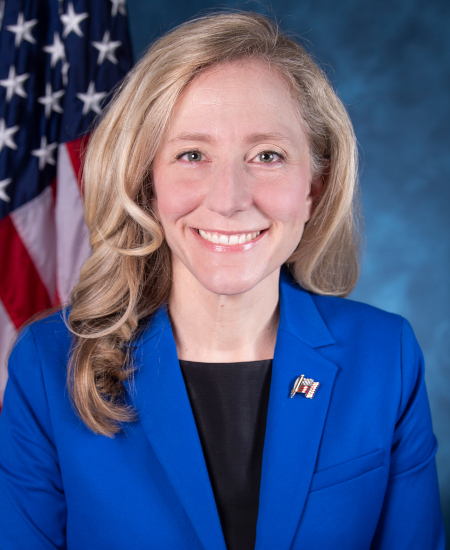
Photo of Abigail Davis Spanberger
D United States House · District 7 · Virginia

Rep. Abigail Davis Spanberger

Compare
Total votes
2,168
all sessions
Attendance
99%
19 missed
Higher than 78% of chamber peers
With party
95%
of cast votes
Near the chamber average
Bipartisan score
3%
crosses aisle rarely
Near the chamber average
Sponsored
950
bills & resolutions
Near the chamber average
Committees
0
assignments
950 bills and resolutions

Sponsored bills

Total
950
Primary
78
Co-sponsor
872
This page
950
matching current filters
Primary HR 9910
In committee · United States House · Lead sponsor
Supporting Federal Employees in the National Guard and Reserves Act

Maddy summaryThis bill increases the maximum annual military leave entitlement for federal employees serving in the National Guard or Reserves from 15 days to 36 days. It directly affects federal workers who are called to active duty or training for military service. The key provision amends Section 6323(a)(1) of Title 5, U.S. Code, to raise the leave allowance. This change provides more time for federal employees to fulfill military obligations without losing pay or job security. The policy update applies immediately to all eligible federal employees under current law.

In committee Oct 1, 2024 0 co-sponsors
Co-sponsor HR 1719
In committee · United States House · Co-sponsor
Honoring Our Fallen Heroes Act of 2023

Maddy summaryHR 1719, the Honoring Our Fallen Heroes Act of 2023, establishes a presumption that certain cancers diagnosed in public safety officers (like police and firefighters) are work-related if linked to their duties. It defines 22 specific cancers (including lung, mesothelioma, and WTC-related cancers) as "exposure-related," allowing officers or their families to receive benefits without proving direct work connection, provided they were diagnosed within 15 years of leaving active service. The bill also creates a process for adding new cancers to the list based on scientific evidence, requiring the Bureau to review petitions and make decisions within 180 days. This applies to deaths or disabilities occurring on or after January 1, 2023, directly affecting officers who developed covered cancers during service.

In committee Sep 25, 2024 1 co-sponsor
Co-sponsor HR 9172
In committee · United States House · Co-sponsor
DISPOSE Act

Maddy summaryThe DISPOSE Act authorizes the U.S. government to partner with Colombia, Mexico, and Peru to safely destroy chemicals used in illegal drug production. It requires the State Department, in coordination with Justice and Defense, to create a detailed implementation plan within 90 days - including timelines, budgets, and measurable goals - and provide annual progress reports to Congress on chemical destruction efforts. The initiative aims to prevent these chemicals from re-entering drug manufacturing, free storage space for future seizures, and reduce environmental harm from hazardous waste.

In committee Sep 24, 2024 1 co-sponsor
Co-sponsor HR 5526
Passed · United States House · Co-sponsor
Seniors’ Access to Critical Medications Act of 2024

Maddy summaryThis bill clarifies Medicare rules to allow doctors to provide certain critical medications directly in their offices without extra administrative hurdles. It specifically amends a Medicare provision (Section 1877(b)(2) of the Social Security Act) to remove a requirement that drugs furnished in-office must follow specific administrative rules, effective May 11, 2023. The bill also directs the removal of conflicting Medicare guidance published in 2021 and 2023, which had previously restricted this practice. This change directly affects Medicare beneficiaries (seniors) and doctors' offices that supply covered medications during patient visits. It streamlines access to necessary drugs by eliminating an unnecessary barrier to in-office medication administration under Medicare.

Passed Sep 24, 2024 1 co-sponsor
Co-sponsor HR 3433
Passed · United States House · Co-sponsor
Give Kids a Chance Act of 2024

Maddy summaryHR 3433, the "Give Kids a Chance Act of 2024," requires pharmaceutical companies developing certain cancer drugs to conduct pediatric studies if the drugs target molecular pathways relevant to childhood cancers. It directly affects drug manufacturers submitting new applications for cancer treatments, particularly those combining previously approved adult cancer drugs or containing a single new active ingredient. The bill amends FDA regulations to mandate these pediatric investigations only when specific conditions are met, such as when a drug's molecular target is relevant to pediatric cancer growth. The FDA must issue implementing guidance within 12 months, and reports to Congress will track implementation and effectiveness starting 2 years after enactment.

Passed Sep 24, 2024 1 co-sponsor
Co-sponsor HRES 1473
In committee · United States House · Co-sponsor
To condemn racism and bigotry towards Haitian people, to celebrate the vast contributions of people of Haitian descent to the United States, to condemn the spread of misinformation, and to call on Americans to affirm our shared humanity.

Maddy summaryHRES 1473 is a non-binding resolution passed by the U.S. House of Representatives that condemns racism, bigotry, and misinformation targeting Haitian people and their descendants. It celebrates the historical contributions of Haitian Americans to U.S. society, including founding cities (like Chicago via Jean Baptiste Point du Sable), advancing civil rights (W.E.B. Du Bois), and enriching healthcare, education, and culture. The resolution specifically calls on all Americans to reject racist tropes and misinformation, and urges elected officials to promote inclusivity and responsible communication. It was introduced in response to recent false claims that fueled threats against Haitian communities, such as the bomb threats in Springfield, Ohio.

In committee Sep 19, 2024 1 co-sponsor
Co-sponsor HR 4424
Passed · United States House · Co-sponsor
Vietnam Veterans Liver Fluke Cancer Study Act

Maddy summaryHR 4424, the Vietnam Veterans Liver Fluke Cancer Study Act, directs the Department of Veterans Affairs to study the rate of cholangiocarcinoma (a type of bile duct cancer) among veterans who served in the Vietnam theater during the Vietnam era. The bill requires the VA, working with the CDC, to analyze existing cancer registry data to compare cancer rates between these veterans and the general U.S. population, breaking down results by age, gender, race, ethnicity, and location. The VA must report its findings and recommendations to Congress within one year of completing the study, with ongoing periodic updates. This study aims to identify patterns and inform potential future actions for affected veterans, without changing current benefits or eligibility.

Passed Sep 18, 2024 1 co-sponsor
Co-sponsor HRES 1448
In committee · United States House · Co-sponsor
Expressing the sense of the House of Representatives that every person has the basic right to emergency health care, including abortion care.

Maddy summaryHRES 1448 is a non-binding House resolution stating that the House believes every person has the right to emergency health care, including abortion care, during medical emergencies. It specifically addresses concerns that abortion restrictions force medical providers to choose between treating patients in life-threatening situations or risking criminal charges. The resolution highlights that such restrictions disproportionately harm Black, Indigenous, people of color, immigrants, low-income individuals, and LGBTQI+ patients. It does not change existing laws but expresses congressional support for ensuring access to emergency care without legal barriers. The resolution was introduced by multiple House members and referred to the Energy and Commerce Committee.

In committee Sep 12, 2024 1 co-sponsor
Co-sponsor HR 9402
In committee · United States House · Co-sponsor
NSF AI Education Act of 2024

Maddy summaryHR 9402, the NSF AI Education Act of 2024, creates new funding programs to expand artificial intelligence education across U.S. schools and colleges. It establishes scholarships and fellowships for undergraduate and graduate students in AI-related fields, with priority for programs focused on K-12 AI education, AI in manufacturing/agriculture, and outreach to rural institutions and Tribal Colleges. The bill also creates "Centers of AI Excellence" at community colleges and career technical schools to integrate AI into curricula and workforce development, and provides research funding specifically for AI teaching methods in K-12 schools serving low-income, rural, and Tribal communities. Additionally, it incorporates AI skills development into the National STEM Teachers Corps to prepare educators to teach AI concepts in classrooms.

In committee Sep 11, 2024 1 co-sponsor
Co-sponsor HR 9211
In committee · United States House · Co-sponsor
LIFT AI Act

Maddy summaryThe LIFT AI Act (HR 9211) provides federal funding to develop AI literacy education for K-12 students and teachers. It directs the National Science Foundation to award grants to colleges, nonprofits, or consortia for creating classroom curriculum, teacher training, and evaluation tools focused on AI skills like ethical use, critical interpretation, and problem-solving. The bill specifically targets schools (K-12) and aims to integrate AI literacy into existing lessons through project-based learning and professional development. Key provisions include developing learner-centered materials, training educators on AI proficiency, and creating tools to assess student progress in AI literacy.

In committee Sep 11, 2024 1 co-sponsor
Showing 61 to 70 of 950 bills
Previous 1 … 6 7 8 … 95 Next