

Health Care Fairness for Military Families Act of 2021 This bill modifies the extension of dependent coverage under TRICARE by allowing a dependent under the age of 26 to be covered without an additional premium. Additionally, the bill authorizes such coverage of dependents without a premium regardless of whether they are eligible to enroll in an employer sponsored plan.
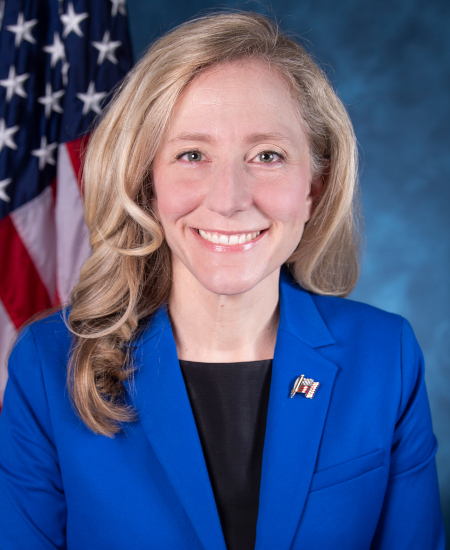
Rep. Abigail Davis Spanberger
Sponsored bills
Civics Learning Act of 2021 This bill expands the use of American History and Civics Education—National Activities grants to prioritize innovative civics learning and teaching. Specifically, the bill expands the allowable uses of these grants to include before-, during-, and after-school activities and extracurricular activities; activities that include service learning and community service projects that are linked to school curriculum; activities that encourage and support student participation in school governance; and online and video game-based learning. Further, the Department of Education must ensure that specified percentages of grant funds are awarded on a diverse basis to eligible entities (e.g., institutions of higher education) that serve students and teachers at elementary schools, middle schools, and high schools.
This bill repeals the prohibition on the use of certain funds by the Securities and Exchange Commission to implement a rule, regulation, or order to require the disclosure of political contributions, contributions to tax exempt organizations, or dues paid to trade associations.
Transparent Representation Upholding Service and Trust in Congress Act or the TRUST in Congress Act This bill requires a Member of Congress, as well as any spouse or dependent child of a Member, to place specified investments into a qualified blind trust (i.e., an arrangement in which certain financial holdings are placed in someone else's control to avoid a possible conflict of interest) until 180 days after the end of their tenure as a Member of Congress.
Equal COLA Act This bill revises the formula used to calculate the cost-of-living adjustment for annuities paid under the Federal Employees Retirement System.
Financial Technology Protection Act This bill provides for the investigation of new financial technologies (e.g., digital currencies) and their use in terrorism and other illicit activities. Specifically, the bill establishes the Independent Financial Technology Task Force to Combat Terrorism and Illicit Financing, which must research terrorist and illicit use of new financial technologies and issue an annual report. The Department of the Treasury must establish a fund to provide a reward for a person who provides information leading to the conviction of an individual involved with terrorist use of digital currencies. Additionally, the bill establishes the FinTech Leadership in Innovation and Financial Intelligence Program to support the development of tools and programs to detect terrorist and illicit use of digital currencies.
SAFE Workers Act or the Secure And Fair Elections for Workers Act This bill requires the National Labor Relations Board (NLRB) to provide employees with the ability to vote remotely by telephone or the internet in union representation elections during the COVID-19 (i.e., coronavirus disease 2019) public health emergency. The bill further permits the NLRB's use of appropriations to issue directives or regulations providing for electronic voting methods.
Medicare Sequester COVID Moratorium Act This bill continues to exempt Medicare from budget sequestration orders until the end of the public health emergency relating to COVID-19 (i.e., coronavirus disease 2019).
Officer Eugene Goodman Congressional Gold Medal Act This bill directs the Speaker of the House of Representatives and the President pro tempore of the Senate to arrange for the presentation of a Congressional Gold Medal to U.S. Capitol Police Officer Eugene Goodman for his actions to protect the Senate chamber during the security breach at the U.S. Capitol on January 6, 2021.
This resolution affirms that Members of Congress elected for the 117th Congress from Arizona, Georgia, Michigan, Nevada, Pennsylvania, and Wisconsin were freely and fairly elected under lawful, constitutional procedures.