

Maddy summaryHF 2809 establishes a new crime for protesting directly in front of or about a person's home (excluding homes used as businesses). It makes this a misdemeanor, escalating to a gross misdemeanor if the person has a prior conviction under this law or ignores court orders like protection orders. The bill specifically allows peaceful protests about community meetings or assemblies held at locations commonly used for public discussion. This law applies to residential properties only and takes effect August 1, 2025.
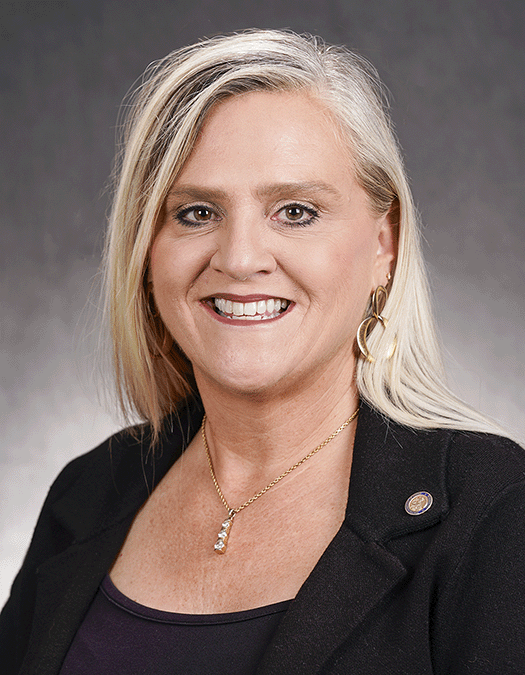
Rep. Pam Altendorf
Sponsored bills
Maddy summaryHF 3591 modifies Minnesota's public voter information lists by removing a voter's date of birth from public access (replacing "year of birth" with a specific ban in subdivision 9) and adding stronger privacy protections. The bill prohibits publishing voter data online, selling or sharing the information, and restricts its use to elections, political activities, or law enforcement. County auditors must withhold voter names upon safety-related requests and require users to sign written agreements guaranteeing proper use. These changes directly affect county election officials, organizations accessing voter lists, and registered voters whose personal data is now more protected. The bill updates Minnesota Statutes § 201.091, subdivisions 4 and 9, effective upon final enactment.
Maddy summaryHF 3607 requires all retail establishments (businesses selling goods or services to the public) to accept physical U.S. cash (paper money or coins) as payment for transactions. The bill defines "cash" and "retail establishment" to clarify the scope of the requirement. This law takes effect on August 1, 2026, applying to all sales occurring on or after that date. It directly affects businesses that currently decline cash payments, mandating acceptance without exception. The policy change is a straightforward consumer protection measure with no additional mechanisms or exemptions specified.
Maddy summaryHF 1 establishes a centralized Office of Inspector General (OIG) for Minnesota state government, replacing existing agency-specific inspector general offices. The OIG will oversee state spending, require agencies to halt payments when fraud is suspected, and mandate a fraud reporting hotline for employees and contractors. It directly affects all state agencies and recipients of state funds (such as contractors and organizations administering state programs) by requiring them to report suspected fraud and prohibiting retaliation against whistleblowers. The bill also specifies the OIG must coordinate with the legislative auditor and amends statutes related to fraud detection, waste prevention, and oversight.
Maddy summaryHF 2517 restricts MinnesotaCare (the state's Medicaid program) from using public funds to cover abortions, except in three specific cases: when the pregnancy endangers the patient's life, causes substantial and irreversible impairment of a major bodily function, or results from rape or incest. This directly affects MinnesotaCare enrollees who might seek abortion coverage, limiting public funding to those narrow exceptions. The bill amends Minnesota Statutes § 256L.03 to clarify that public funds cannot cover abortions outside these circumstances. The change applies to all MinnesotaCare-covered health services, excluding the listed exceptions.
Maddy summaryHF 29 suspends the scheduled 2030-2031 review of Minnesota's social studies academic standards and repeals requirements for schools to include ethnic studies content in their curriculum. It also cancels funding allocated for ethnic studies programs. The bill modifies existing education statutes by removing mandates for schools to integrate ethnic studies or Indigenous education into social studies standards, effectively eliminating these curriculum components. This directly affects Minnesota public schools and students by removing specific educational content requirements and associated funding. The changes take effect upon final enactment.
Maddy summaryHF 2883 restricts the use of state funds for abortions within Minnesota's state-sponsored health programs. It prohibits the commissioner of human services from using state money for abortion services, except when necessary to maintain eligibility for federal health programs. The bill applies specifically to state health programs administered by the human services commissioner and references Minnesota's legal definition of abortion. This policy change directly affects how state health funds can be allocated for reproductive care services.
Maddy summaryHF 3284 repeals Minnesota's 2017 law implementing REAL ID requirements for driver's licenses and identification cards. This bill removes state-level rules that previously required Minnesotans to obtain licenses meeting federal identification standards (like those needed for air travel). It directly affects residents who currently hold or apply for noncompliant licenses, as the repeal will eliminate the need to meet federal standards for state-issued IDs. The repeal takes effect July 1, 2026, and requires the state to prepare replacement legislation by February 2026 to update related statutes.
Maddy summaryHF 733 removes restrictions on handheld electronic devices used for bingo and pull-tab games in Minnesota. The bill amends state law to allow these devices, which must meet specific requirements like a $0.25 minimum ticket price, a limit of 36 bingo faces per game, and no slot machine-style features (e.g., spinning reels or bonus screens). It also requires devices to support visually impaired players and maintain transaction records. This change directly affects bingo and pull-tab operators by enabling new electronic gameplay options while maintaining key safeguards.
Maddy summaryHF 2230 requires all Minnesota pharmacies to offer ivermectin and hydroxychloroquine tablets for human use without a prescription. This bill directly affects every registered pharmacy in Minnesota by mandating the availability of these specific medications as over-the-counter drugs. The key provision amends Minnesota law to add a new requirement (Section 151.411) overriding existing restrictions, making it unlawful for pharmacies to refuse to sell these drugs without a prescription. The bill defines "over-the-counter drug" to include these medications, changing current pharmacy practice standards. This is a direct policy change to alter prescription requirements for two specific drugs.