

Maddy summaryHF 7 modifies multiple public safety laws in Minnesota. It requires law enforcement agencies to make bail/bond information public and mandates county attorneys to publicly report reasons for dismissing charges. The bill establishes mandatory minimum sentences for certain sex trafficking offenses and requires individuals subject to stays in sexual conduct cases to register as predatory offenders. It also increases penalties for assaulting police officers, obstructing highway/airport traffic, and expands law enforcement's use of tracking devices on fleeing vehicles. These changes apply directly to law enforcement agencies, prosecutors, and individuals involved in criminal cases.
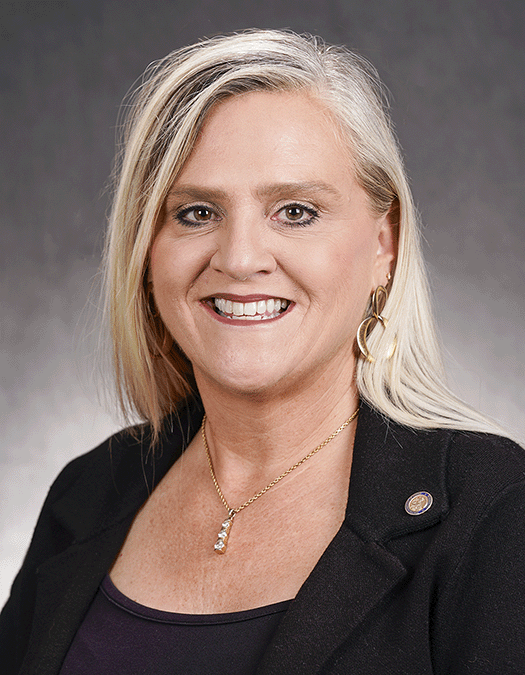
Rep. Pam Altendorf
Sponsored bills
Maddy summaryThis bill modifies Minnesota's "Read Act" to require literacy instruction based on "science of reading" research, emphasizing evidence-based methods like phonics and decoding while explicitly excluding the three-cueing system. It establishes a new Office of Achievement and Innovation within the Department of Education to support literacy implementation and creates a statewide school performance reporting system. The bill also allows school boards to opt out of complying with certain recently enacted state education laws or rules and authorizes fund transfers for education programs through fiscal year 2029. These changes directly affect all Minnesota public school districts, educators, and students by reshaping literacy instruction requirements and school accountability systems.
Maddy summaryHF 1618 shortens the timeframe for county auditors and the secretary of state to provide voter list copies to registered Minnesota voters from 10 to two business days after a written or electronic request. Registered voters must pay reproduction costs for copies, but public access to voter lists remains free without cost. This amendment to Minnesota Statutes 2024, section 201.091, aims to improve timely access to voter information while maintaining existing restrictions on using voter list data for non-election purposes.
Maddy summaryHF 1617 requires Minnesota election officials to test voting systems at least 10 days before absentee ballots are used. The bill mandates specific testing procedures to verify systems correctly mark ballots (including with assistive technology) and count votes for all candidates and questions, including testing for invalid votes. Public notice of test times must be given 5 days in advance, tests must be observed by two election judges from different major parties, and results must be available for public inspection within 24 hours. This bill directly affects county election officials and ensures transparency in pre-election voting system verification for Minnesota elections.
Maddy summaryHF 1619 amends Minnesota law to improve how voter registration status is maintained. It requires county auditors to post voting history within six weeks ten days after each election, and the secretary of state to change registration status to "inactive" for voters who haven’t voted in four years. This directly affects voters whose status changes, requiring them to re-register before voting in future elections. The bill clarifies that late or rejected mail ballots count for maintaining registration but not for public voting history lists. It ensures voter lists remain accurate by removing inactive voters while maintaining eligibility for those who re-register.
Maddy summaryHF 21 would require a three-fifths supermajority vote in both the Minnesota House and Senate to extend a peacetime emergency declaration beyond 14 days. Currently, such extensions beyond 14 days could be approved by the Executive Council, but this bill would shift that authority to the legislature. The bill directly affects governors seeking to prolong emergency powers and the legislative process for reviewing those requests. It does not change the initial 14-day emergency declaration period or the governor's authority to declare emergencies under existing criteria. Note: This bill was introduced but not passed during the 2025 legislative session.
Maddy summaryHF 3724 prohibits all Minnesota counties, cities, townships, school districts, and other local governments from adopting or using ranked-choice voting for local elections. The bill defines ranked-choice voting as any system where voters rank candidates by preference, and bans its use for local offices like mayor or city council. It also explicitly prohibits this voting method for all federal and state offices. The law prevents local governments from establishing such systems through rules, resolutions, or ordinances.
Maddy summaryHF 3723 requires voters applying for absentee ballots to verify their identity using either a Minnesota driver's license number, state ID number, or the last four digits of their Social Security number before the ballot is mailed. County auditors and municipal clerks must electronically submit these applications to the secretary of state for verification against government databases, with unverifiable applications forwarded to law enforcement. The bill directly affects voters seeking absentee ballots and county/municipal election officials processing applications. Key provisions include mandatory verification before mail delivery, a secure website for submission, and a requirement for the secretary of state to validate permanent absentee voters 60-75 days before elections. The law takes effect July 1, 2026.
Maddy summaryHF 3721 requires Minnesota colleges and universities that accept state or federal financial aid to provide voter registration forms and voting information to students each fall and spring semester, and 15 days before voter registration deadlines in election years. Institutions must maintain a webpage with resources on voting eligibility, deadlines, absentee voting, and contact details for a campus vote coordinator, and designate a staff member to manage voter engagement efforts. Each institution must report its implementation to the secretary of state by November 30 annually, with the secretary of state sharing effective strategies with the legislature by February 1. This bill directly affects postsecondary institutions and their students in Minnesota, focusing on improving voter access through mandated support services.
Maddy summaryHF 3720 reinstates specific eligibility requirements for Minnesota legislators to participate in party caucuses, directly affecting state lawmakers seeking caucus membership. The bill revives Minnesota Statutes section 202A.16, subdivisions 1-3, which had been removed, applying retroactively from July 1, 2023. This restores the prior rules governing who qualifies to join legislative party caucuses, without creating new policy or altering voting procedures.