

Maddy summaryHF 3603 directs Minnesota's Commissioner of Children, Youth, and Families to request a federal waiver by January 1, 2027, to prohibit SNAP (food stamp) benefits from purchasing candy, energy drinks, and soda. The bill defines "candy" as sugar-based products like chocolate bars, "energy drinks" as caffeinated beverages marketed for energy (excluding coffee/tea), and "soda" as carbonated sugary drinks (excluding low-sugar options). If approved, this waiver would restrict SNAP recipients in Minnesota from using benefits for these specific items. The bill does not change current SNAP rules but seeks federal permission for this targeted restriction.
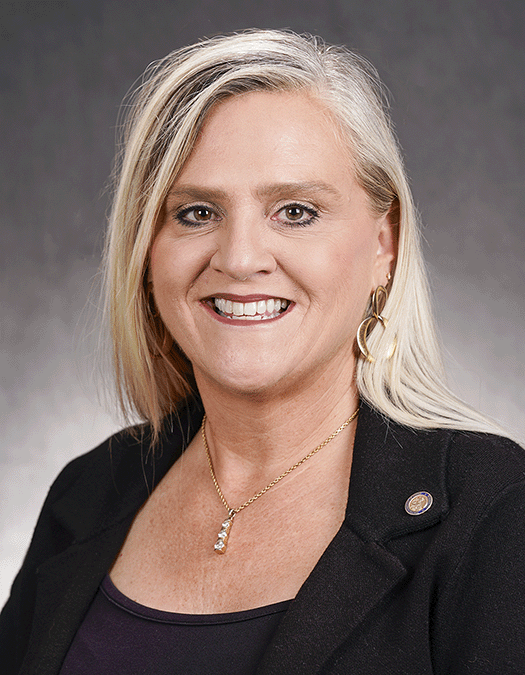
Rep. Pam Altendorf
Sponsored bills
Maddy summaryHF 194 increases property tax relief for Minnesota veterans with service-connected disabilities by raising the exclusion amount for their homesteads. It raises the exclusion from $150,000 to $200,000 for veterans with a 70%+ disability rating, and from $300,000 to $400,000 for veterans with a total (100%) permanent disability. Surviving spouses of qualifying veterans who died while serving or with a total disability also gain eligibility for the higher $400,000 exclusion if they continue living in the home. This directly affects veterans with VA-certified disabilities and their eligible spouses, reducing their property tax burden on their primary residence. The bill amends Minnesota Statutes section 273.13, subdivision 34.
Maddy summaryHF 100 would amend Minnesota tax law to allow taxpayers to subtract the full amount of their Social Security benefits from their state taxable income, removing previous limits. Currently, Minnesota caps this subtraction at $5,840 for joint filers, $4,560 for singles, and lower amounts for separate filers. The bill eliminates these maximums, meaning eligible taxpayers could deduct all their Social Security benefits without reduction. It directly affects Minnesota residents receiving Social Security income who file state tax returns. The change takes effect for taxable years beginning after December 31, 2024.
Maddy summaryThis bill creates a new crime called disruption of worship services in Minnesota, targeting individuals who enter religious buildings with the intent to disrupt scheduled services by committing a crime. The law defines a religious establishment as a building used for worship that is clearly marked with a sign or other identifier. First-time offenders face gross misdemeanor charges, while repeat offenders could be charged with a felony punishable by up to five years in prison or a fine of $10,000 or both. The provisions take effect on August 1, 2026, and apply only to crimes committed on or after that date.
Maddy summaryThis bill modifies income and asset requirements for households receiving SNAP benefits in Minnesota. It requires SNAP households to demonstrate that their gross income does not exceed 200 percent of the federal poverty guidelines, while net income must still meet federal SNAP requirements. The legislation also changes how vehicles are counted toward asset limits, specifically requiring that vehicles with a trade-in value of $100,000 or more be included in personal property calculations rather than being excluded. These changes directly affect Minnesota residents applying for or receiving SNAP assistance by adjusting eligibility criteria for income and vehicle assets.
Maddy summaryThis bill requires publicly funded state and local correctional facilities in Minnesota to check the immigration status of certain noncitizens and notify U.S. Immigration and Customs Enforcement when they are housed there. The law applies to individuals in pretrial confinement, those convicted of felonies, and people committed to mental health institutions, mandating that facility officers immediately report nationality, conviction details, commitment duration, citizenship country, and last entry information to federal immigration authorities. Additionally, the bill requires a one-time review of all felony inmates in public facilities by July 1, 2026, to identify any noncitizens and report their status to federal officials. This policy change directly affects correctional facilities, sheriffs, and county officials who manage public institutions, while requiring them to share specific inmate information with U.S. immigration officers.
Maddy summaryThis bill prohibits individuals convicted of a crime of violence from receiving Minnesota's major public assistance programs, including MFIP, medical assistance, food support, and MinnesotaCare. It achieves this by adding new disqualification clauses to existing state statutes that specifically target those with violent crime convictions, while maintaining eligibility rules for other offenses. The law applies to convictions under Minnesota law or equivalent statutes from other states or the federal government, and it removes a previous provision that allowed certain drug-related benefits to continue under specific conditions.
Maddy summaryThis bill authorizes the issuance of up to $22 million in state bonds to fund the replacement of unsafe and undersized buildings and facilities at Dakota County regional parks. The funds will be used to upgrade infrastructure at Lebanon Hills Regional Park and Lake Byllesby Regional Park, including new swimming beach facilities with accessible restrooms and showers, improved campground lodges with storm shelters, and updated trails and amenities. The legislation directs the commissioner of employment and economic development to manage the grant process for designing and constructing these improvements, with the bond sale handled by the commissioner of management and budget.
Maddy summaryThis bill requires Minnesota's Secretary of State to share voter and election data with federal agencies upon request. It applies to all individuals in the statewide voter registration system, including those who attempted to register but were not approved, had outdated registrations, or registered but never voted. The Secretary of State must provide the requested data within 180 days of the request or by 90 days before the next scheduled election, whichever comes first. The law takes effect immediately after final passage and covers requests made on or after that date.
Maddy summaryHF 3584 transfers oversight of aquaculture regulations from the Commissioner of Natural Resources to the Commissioner of Agriculture, clarifying the latter’s authority. The bill updates rules for private fish hatcheries, requiring aquaculture operations to follow specific licensing, inspection, and fish health protocols (including annual VHS virus testing for certain facilities). It also modifies requirements for transporting aquatic life between facilities and stocking non-public waters, mandating bill of lading submissions. The bill appropriates funds to support these regulatory changes and administrative functions.