

Maddy summaryHF 500 repeals Minnesota's Nursing Home Workforce Standards Board and related statutes (sections 181.211-181.217) that previously established requirements for nursing home staffing and worker protections. This bill directly affects nursing home employers in Minnesota by removing these specific regulatory standards. The key mechanism is the complete repeal of the board and its associated provisions, eliminating the legal framework that required nursing homes to comply with workforce standards and penalties for noncompliance.
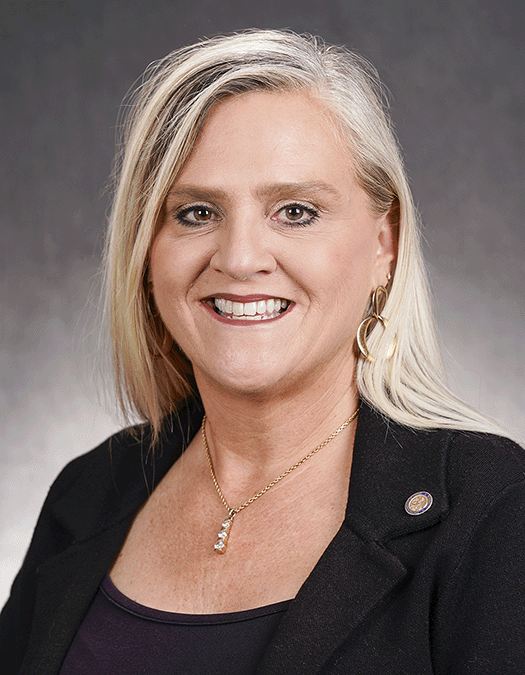
Rep. Pam Altendorf
Sponsored bills
Maddy summaryHF 3152 prohibits healthcare providers in Minnesota from administering gene-based vaccines, defined as those using mRNA, modified mRNA, self-amplifying mRNA, or DNA technology. The bill directly affects medical professionals and facilities that administer such vaccines within the state. Violations carry a misdemeanor penalty of $500 per incident, and licensing boards must review licenses of violators. The law aims to ban the use of these specific vaccine technologies through a statutory prohibition and financial penalty.
Maddy summaryHF 2407 requires Minnesota long-term care facilities to allow residents to have one designated support person (chosen by the resident) physically present while they are at the facility. This applies to both nursing homes and assisted living facilities. Facilities may restrict this right only during medical procedures (like surgeries), or if the support person is violent or threatening, and must follow written grievance procedures if a resident's request is denied. The bill directly affects residents in these facilities by expanding their right to personal support during care.
Maddy summaryHF 8 streamlines Minnesota's environmental permitting process to improve efficiency and transparency. It sets specific timeframes (90 days for simpler permits, 150 days for complex ones), requires the Pollution Control Agency to issue separate construction and operation permits for certain facilities, and mandates that petitioners for environmental assessments must live in affected or neighboring counties. The bill also eliminates preliminary environmental assessment steps for projects requiring full environmental impact statements and requires the agency to publish annual reports tracking permitting progress. These changes directly affect developers, landowners, and the Pollution Control Agency in processing environmental permits.
Maddy summaryHF 19 establishes education savings accounts (ESAs) for Minnesota students from low-income households, defined as families earning no more than four times the income threshold for free school meals. The bill allows parents to use state funds to pay for qualifying education expenses - including tuition at eligible nonpublic schools, tutoring, approved curriculum, and school supplies - at participating schools or providers. Participation is capped at 5% of public school enrollment in the first year, increasing by 3% annually, with priority given to kindergarten students and those who attended public school full-time the prior year. The program directly affects eligible students (ages 18 and under) and their families, with funds restricted to approved educational services and materials.
Maddy summaryHF 2371 requires healthcare providers to obtain written, informed consent before performing pelvic, breast, urogenital, or rectal examinations on patients who are anesthetized or unconscious. This applies to most situations, with limited exceptions for emergencies, exams within a previously consented-to procedure, or court-ordered evidence collection. Violating this requirement is a gross misdemeanor and may lead to disciplinary action by the provider's licensing board. The law takes effect August 1, 2025, directly affecting patients under anesthesia/unconsciousness and healthcare professionals performing such exams.
Maddy summaryHF 2387 amends Minnesota Statutes § 124D.118 to establish a program allowing schools to provide free half-pint milk to students who do not participate in the full school lunch program. This directly affects public and nonpublic schools in Minnesota, enabling students to receive milk without needing to take a complete lunch, thereby reducing food waste from uneaten meals. The bill authorizes state reimbursement of 20 cents per milk serving for kindergarten students and up to 50 cents (or USDA rate) for lunch milk, with funding appropriated for fiscal years 2026 and 2027. Schools must follow commissioner-established guidelines to participate, focusing on daily milk access as a nutritional supplement.
Maddy summaryHF 2949 prohibits Minnesota legislators and executive branch appointees (including commissioners and deputy commissioners) from receiving compensation from any nonprofit organization that receives state grant funding. The bill amends Minnesota Statutes to add this restriction to existing rules governing private employment for public officials, explicitly covering both current officeholders and former commissioners within one year of leaving their position. Key provisions include banning compensation from nonprofits receiving state grants, regardless of where the work is performed, and requiring legislative committees to enforce these rules. This directly affects state lawmakers and executive appointees who might otherwise work for or receive payment from nonprofits receiving state grants. The policy change aims to prevent potential conflicts of interest between public office and nonprofit grant recipients.
Maddy summaryHF 363 establishes a $5 per acre property tax credit for agricultural land certified under Minnesota's agricultural water quality program in specific counties (Dodge, Fillmore, Goodhue, Houston, Mower, Olmsted, Wabasha, and Winona). This credit directly affects farmers who have land certified by the Department of Agriculture under the water quality program in those counties. The credit reduces property taxes payable to local governments, with the state reimbursing counties and school districts through annual appropriations from the general fund. Payments for the credit will begin for property taxes due in 2026.
Maddy summaryHF 2885 allows school staff with valid firearm permits and completed training to carry weapons on school property. It requires the Bureau of Criminal Apprehension to provide free annual active shooter training to eligible teachers and employees at public, charter, and postsecondary schools. The bill amends Minnesota law to clarify that permitted school staff carrying firearms on campus will not face misdemeanor charges under existing school property firearm restrictions. This directly affects certified school staff who hold current permit-to-carry licenses and complete the mandated training program. The policy changes focus on modifying penalties for permitted staff while maintaining restrictions for others on school grounds.