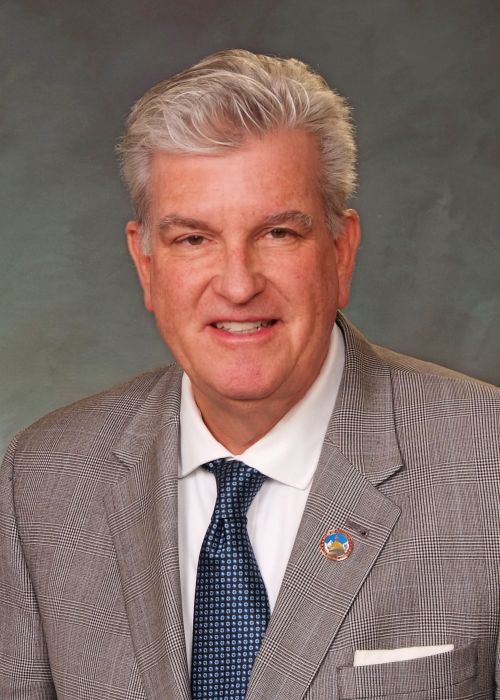
Photo of John Carson
R Colorado Senate · District 30 On the 2026 ballot

Sen. John Carson

Compare
Total votes
1,000
all sessions
Attendance
82%
202 missed
Near the chamber average
With party
91%
of cast votes
Near the chamber average
Bipartisan score
6%
crosses aisle rarely
Higher than 94% of chamber peers
Sponsored
243
bills & resolutions
Near the chamber average
Committees
4
assignments
243 bills and resolutions

Sponsored bills

Total
243
Primary
41
Co-sponsor
202
This page
243
matching current filters
Co-sponsor HB 25-1204
Signed into law · Colorado House · Co-sponsor
Colorado Indian Child Welfare Act

The act codifies the federal "Indian Child Welfare Act of 1978" into state law as the "Colorado Indian Child Welfare Act" (CO-ICWA) and provides additional protections for Indian children and children known or determined to be Indian children under state law. (Note: This summary applies to this bill as enacted.)

Signed into law May 31, 2025 1 co-sponsor
Co-sponsor SB 25-278
Signed into law · Colorado Senate · Co-sponsor
Epinephrine Administration in Schools

The act changes the term "epinephrine auto-injector" to "emergency-use epinephrine" in order to encompass alternatives to injecting epinephrine as a means to treat anaphylaxis in school settings. (Note: This summary applies to this bill as enacted.)

Signed into law May 30, 2025 1 co-sponsor
Co-sponsor SB 25-128
Signed into law · Colorado Senate · Co-sponsor
Agricultural Worker Service Providers Access Private Property

Current law states that an employer shall not interfere with an agricultural worker's reasonable access to key service providers (KSP) at any location when the worker is not performing compensable work and with respect to health-care providers at any time. The act exempts an employer's property from this provision; except that the act prohibits an employer from interfering with a worker's access to KSP through remote channels on the employer's property. The act also removes language referring to health-care providers. Current law states that the division of labor standards and statistics (division) may adopt rules regarding additional times that an employer may not interfere with a worker's reasonable access to KSP. The act clarifies that such rules must apply only to locations other than the employer's property. Lastly, the act states the division shall not adopt rules that: Infringe upon an employer's private property rights; or Conflict with the common law rights of an individual to access private property in a time of emergency.(Note: This summary applies to this bill as enacted.)

Signed into law May 29, 2025 1 co-sponsor
Co-sponsor SB 25-301
Signed into law · Colorado Senate · Co-sponsor
Remove Authorization Requirement Adjust Chronic Prescription

The act allows a health-care provider to, under certain circumstances, adjust the dose or frequency of a chronic maintenance drug without needing prior authorization from an insurance carrier. (Note: This summary applies to this bill as enacted.)

Signed into law May 29, 2025 1 co-sponsor
Co-sponsor SB 25-296
Signed into law · Colorado Senate · Co-sponsor
Insurance Coverage for Breast Cancer Examinations

The act makes changes to requirements for preventive care coverage by health insurers for breast cancer screening, including: Relocating in statute the high-risk breast cancer screening requirements; Defining and specifying criteria for the use of diagnostic breast examinations and supplemental breast examinations; and Clarifying that, in addition to regular breast cancer screening, diagnostic and supplemental breast examinations that are medically necessary and conducted within nationally recognized screening guidelines do not require cost sharing by the patient.(Note: This summary applies to this bill as enacted.)

Signed into law May 29, 2025 1 co-sponsor
Co-sponsor SB 25-061
Signed into law · Colorado Senate · Co-sponsor
Federally Recognized Tribes & Construction of Laws

Current Colorado laws do not always expressly provide whether the laws apply to the Southern Ute Indian Tribe or the Ute Mountain Ute Tribe (Tribes). The act creates a rule of construction that a law does not apply to the Tribes unless the law clearly and expressly states that the law applies to the Tribes. The act further clarifies that if the general assembly enacts a new law or materially amends an existing law that is silent as to its application to the Tribes or to tribally controlled entities; purports to apply statewide; or grants a governmental agency or entity civil, criminal, or regulatory authority, it is presumed that the law does not apply within the exterior boundaries of the reservations to the Tribes, including the Tribes' officials and employees acting in their official capacities, to a tribally controlled entity, or to Tribal lands. The act reinforces that these rules of construction do not: Preclude or limit the authority of the Tribes' governing bodies from requesting inclusion in legislation pending before the general assembly; Abrogate the sovereign immunity of the state or the Tribes; or Affect the rights of the state, the Tribes, or other persons to pursue legal remedies that may be available to contest the application of laws passed by the general assembly.(Note: This summary applies to this bill as enacted.)

Signed into law May 28, 2025 1 co-sponsor
Co-sponsor SB 25-290
Signed into law · Colorado Senate · Co-sponsor
Stabilization Payments for Safety Net Providers

The act creates the provider stabilization fund for use by Colorado department of health care policy and financing (department) to distribute provider stabilization payments to safety net providers who provide services to low-income, uninsured individuals on a sliding-fee schedule or at no cost. Provider stabilization payments will be distributed to eligible safety net providers based on the proportion of low-income, uninsured individuals that an individual provider serves in comparison to the total number of low-income, uninsured individuals served by all eligible safety net providers. The state treasurer is directed to make an interest-free loan of interest earnings on the principal in the unclaimed property trust fund (UPTF) and, if the interest earnings are insufficient, from the principal of the UPTF as well, to the provider stabilization fund as follows: $25 million for the 2025-26 state fiscal year; $20 million for the 2026-27 state fiscal year; and $15 million for each of the 2027-28, 2028-29, and 2029-30 state fiscal years. The act specifies that the loan from the UPTF to the provider stabilization fund is an interfund loan that is not classified as revenue, is booked as an interfund receivable or payable, is not state fiscal year spending or state revenues, and does not count against the state fiscal year spending limit or the excess state revenues cap. The department is directed to repay the loan by January 1, 2045, but in any year in which state revenues do not exceed the limit on state fiscal year spending, the department must present to the joint budget committee a proposal to repay all or a portion of the loan at an earlier time, and to the extent possible, the general assembly must prioritize repaying the loan starting in the 2030-31 state fiscal year or sooner if funds are available. The provider stabilization fund also consists of any money the general assembly appropriates, transfers, or credits to the fund and any gifts, grants, or donations the department may receive for the fund. The act directs the department to leverage money in the provider stabilization fund to obtain federal matching money. The act establishes a provider stabilization fund advisory board (advisory board) to assist the department in implementing and administering the provider stabilization fund. The department, with assistance from the advisory board, is required to submit an annual report on the provider stabilization fund to specified committees, the governor, and the medical services board in the department. The advisory board is scheduled for repeal on September 1, 2031, and is subject to a sunset review by the department of regulatory agencies before the repeal. The act appropriates $25,000,000 from the provider stabilization fund to the department to implement the act, allocated as follows: $138,505 for personal services to administer the act, including 2.0 FTE; $15,900 for operating expenses; and $24,845,595 for provider stabilization payments to eligible safety net providers.(Note: This summary applies to this bill as enacted.)


Signed into law May 28, 2025 1 co-sponsor
Co-sponsor HB 25-1271
Signed into law · Colorado House · Co-sponsor
Federal Benefits for Youth in Foster Care

Beginning on or before July 1, 2027, the act requires a county department of human or social services (county department) to determine whether a child or youth who is in foster care and who has a deceased parent (child or youth) may be eligible to receive survivor benefits administered by the United States railroad retirement board, social security administration, or veterans benefits administration (federal survivor benefits). The county department must make an initial eligibility determination within 90 days after assuming legal custody of or authority over the child or youth. Under current law, certain federal agencies appoint a representative payee or fiduciary (representative payee) to receive and manage federal benefits on behalf of a child or youth in foster care. If a child or youth may be eligible for federal survivor benefits and the county department is the most appropriate representative payee, the act requires the county department to apply for federal survivor benefits on behalf of the child or youth. If the county department determines that the child or youth may be eligible for federal survivor benefits but that the county department is not the most appropriate representative payee, the county department shall provide information to the prospective representative payee that the county department has identified about how to apply for federal survivor benefits on behalf of the child or youth and how to become the child's or youth's representative payee. Under current law, a county department serving as a representative payee may use federal benefits to offset the cost of providing basic care and services to a child or youth in foster care. The act prohibits this offset practice with respect to federal survivor benefits. Instead, the act directs a county department serving as a representative payee to establish an account for the federal survivor benefits (account). A county department serving as a representative payee must save money in the account for the needs of the individual child or youth. Once the child or youth leaves foster care, the county department is required to release funds in the account to the child or youth. The act sets forth various accounting and notice requirements related to federal survivor benefits and requires the department of human services (department), in consultation with interested stakeholders, to adopt rules providing guidance for county departments. The guidance extends to procedures for identifying a representative payee, county department responsibilities when federal survivor benefits are denied or when a child or youth leaves foster care, and policies governing the establishment and maintenance of an account for federal survivor benefit funds. The department must provide technical assistance to a county department about how to conserve federal survivor benefit funds in the best interests of an individual child or youth. (Note: This summary applies to this bill as enacted.)
Signed into law May 28, 2025 1 co-sponsor
Co-sponsor HB 25-1222
Signed into law · Colorado House · Co-sponsor
Preserving Access to Rural Independent Pharmacies

The act prevents a pharmacy benefit manager (PBM) from prohibiting a rural independent pharmacy from using a private courier or a delivery service to deliver a prescription drug to a patient. A PBM is required to reimburse a rural independent pharmacy for a prescription drug in an amount not less than the national average drug acquisition cost for the dispensed prescription drug ingredients, plus pay a dispensing fee. When a PBM conducts an audit of a rural independent pharmacy and the audit results in a recoupment of more than $1,000 or a penalty of more than $1,000, the PBM must: Electronically notify the rural independent pharmacy of the rural independent pharmacy's rights to appeal at least 30 days before the recoupment of funds; If the rural independent pharmacy does not respond to the electronic notification within 30 days after the electronic notification, again electronically notify the rural independent pharmacy of the rural independent pharmacy's rights to appeal at least 30 days before the recoupment of funds; and If the rural independent pharmacy does not respond to the second electronic notification within 30 days after the second electronic notification, serve process on the rural independent pharmacy notifying of the rural independent pharmacy's rights to appeal at least 30 days before the recoupment of funds. The act allows a rural independent pharmacy to operate without being under the direct charge of a pharmacist if the initial interpretation and final evaluation of the prescription is done by a state-licensed pharmacist in person or remotely. (Note: This summary applies to this bill as enacted.)

Signed into law May 27, 2025 1 co-sponsor
Co-sponsor HB 25-1167
Signed into law · Colorado House · Co-sponsor
Alternative Education Campuses

For alternative education campuses (AECs), the act: Directs the department of education (department), when administering state education grants, to allocate priority points to AECs; Authorizes AECs to include certain high-risk students in the AEC's pupil count who are 21 years of age or younger during the budget year; Requires the department to prepare and post an annual report on enrollment trends, student demographics, and student mobility in AECs; and Exempts an AEC from losing its designation due to a fluctuation in enrollment for one school year. The act appropriates $9,613 from the general fund to the department for accountability and improvement planning. (Note: This summary applies to this bill as enacted.)

Signed into law May 24, 2025 1 co-sponsor
Showing 151 to 160 of 243 bills
Previous 1 15 16 17 25 Next