

The act creates the access to opportunity task force (task force) to study and report on how to expand access to effective public schools to address opportunity gaps. The act requires the task force to report its findings and recommendations to the education committees of the house of representatives and the senate, the governor, the state board of education, the commissioner of education, and the department of education on or before January 1, 2027. If the first meeting of the task force is not until after July 31, 2026, then the report deadline is 5 months after the task force's first meeting. The act specifies that the task force will only conduct a study and prepare a report if the department of education receives sufficient gifts, grants, and donations.(Note: This summary applies to this bill as enacted.)
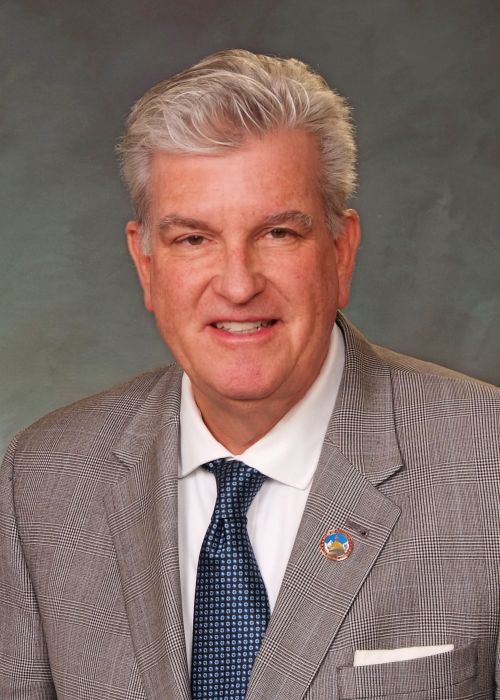
Sen. John Carson
Sponsored bills
The act requires the division of homeland security and emergency management (division) in the department of public safety to create and implement a state preparedness goal and system to improve state and community preparedness and responses to threats to Colorado. The division will perform other duties to support homeland security initiatives, including consolidating and coordinating homeland security-related training, education, and professional development; coordinating and updating homeland security and critical infrastructure protection plans; administering state and federal grants; and coordinating all-hazard public risk communication products. The act designates the office of emergency management (office) as the primary state agency responsible for coordinating disaster recovery, planning, training, exercise, and integration of the state recovery annex within the state emergency operations plan and reorganizes the office by:Moving the auxiliary communications unit from the office to the office of public safety communications in the division;Creating the state recovery task force within the office to coordinate disaster recovery efforts within the state, among other duties;Transferring certain duties and responsibilities related to the state's preparation for, and response to, security threats from the office of preparedness in the division to the office and repealing the office of preparedness. Information related to disaster survivors is exempt from public disclosure, subject to certain exceptions. The act repeals the requirement for the state controller to report to the joint budget committee about the expenditure of federal funds for costs associated with a disaster. Application requirements for the Colorado nonprofit security grant program are relaxed during exigent circumstances. The act changes the composition of state advisory boards related to homeland security and cybersecurity, including the homeland security and all-hazards senior advisory committee and the Colorado cybersecurity council. The act moves the Colorado commission of Indian affairs to the newly established office of tribal and American Indian and Alaska Native affairs in the office of the lieutenant governor and limits the terms of the at-large members of the commission. The office of tribal and American Indian and Alaska Native affairs is tasked with coordinating with the office of emergency management during emergencies, as appropriate.(Note: This summary applies to this bill as enacted.)
The act clarifies an existing requirement for the criminal conviction of a property owner by requiring that one or more criminal charges be brought as a prerequisite to any nuisance abatement or forfeiture proceeding. Existing law provides an exception to the conviction requirement for noninnocent owners who are not subject to criminal charges that no criminal conviction is necessary of the nonowner criminal defendant if the plaintiff proves its case by clear and convincing evidence that the property subject to the forfeiture proceeding is traceable proceeds of the charged offense or related criminal activity. The act clarifies this exception to first require a conviction of the nonowner criminal defendant before the noninnocent owner's property may be forfeited, while retaining other various exceptions that allow forfeiture actions to proceed against the interest of a claimant. The act establishes a right for indigent civil asset forfeiture defendants to access forfeiture defense counsel and creates a procedure for the appointment of forfeiture defense counsel in nuisance abatement and forfeiture proceedings. The state court administrator shall enter into a contract for services with a private contractor who regularly provides legal services for indigent clients or litigants to provide a legal defense to a civil asset forfeiture proceeding. The private contractor is subject to certain reporting requirements. The act creates a forfeiture defense counsel fund (fund) to pay for contracted forfeiture defense counsel who are authorized to represent persons against whom a nuisance abatement or forfeiture proceeding has been filed in connection with criminal charges. The fund is capped at $500,000, and starting in state fiscal year 2027-28, no general fund money is allowed to finance the fund. The balance of the fund over $500,000 is credited to the law enforcement community services grant program fund. The act transfers any unexpended and unencumbered money from the law enforcement community services grant program fund to the forfeiture counsel defense fund. The act alters the disposition of property and proceeds ordered forfeited in a nuisance abatement or forfeiture action. Currently, forfeited property and proceeds are applied first toward restitution and cost recovery for a list of stakeholders, and of the remainder, 50% is granted to the local governmental body with authority over the seizing agency, 25% is granted to the local behavioral health administrative services organization, and 25% is granted to the law enforcement community services grant program fund. The act amends the disposition of the remainder so that 50% is granted to the local governmental body with authority over the seizing agency, 25% is granted to the fund, and 25% is granted to the local behavioral health administrative services organization. The act appropriates $556,750 to the judicial department from the fund for civil asset forfeiture defense contracting and $55,000 to the department of local affairs from the fund for civil asset forfeiture portal administration.(Note: This summary applies to this bill as enacted.)
Maddy summarySB 132, known as the "Magnus Law," requires Colorado law enforcement officers to offer drivers involved in collisions resulting in death or suspected serious injury the opportunity to voluntarily take a breath test for alcohol. The bill mandates officers provide clear, plain-language advisement that the test is voluntary, refusal carries no penalty, and results cannot be used in court. It applies when officers reasonably suspect the driver was at fault and the driver isn't critically injured, creating a standardized protocol to ensure consistent investigation of potential impairment at serious crash scenes. This change aims to preserve evidence that might otherwise be lost, without altering existing legal standards for driving under the influence.
The act expands the 'Colorado Cottage Foods Act' (CCFA) by allowing for the sale of homemade foods that require refrigeration and foods that include meat and meat products. A producer of a food (producer) that requires time and temperature control must take a food safety course that includes food handling training concerning time and temperature control and acquire and maintain proof of course completion. A producer selling products that require time and temperature control for safety may sell one type of such food product, with the ability to offer up to 5 variations of that one type of food product. The producer must specify the individual food products that require time and temperature control for safety and provide a list of such food products to the department of public health and environment (department) or a county, district, or regional health agency (public health agency) upon request. A producer selling products under the CCFA is required to register with the department before selling. The department must issue a registration number to each producer and maintain an electronic registry of producers. A producer may earn up to $150,000 of net revenues under the CCFA each calendar year, increased from $10,000 . The department is required to adjust this cap annually for inflation. The act authorizes a public health agency that inspects or investigates homemade food products produced pursuant to the CCFA to impose a fine for a violation of the requirements of the CCFA and to recover the cost of the inspection or investigation. If a public health agency determines that, on 3 separate occasions within 12 months, a producer has misbranded food that requires time and temperature control for safety or failed to comply with requirements related to food that requires time and temperature control for safety, the producer shall not sell foods that require time and temperature control. The act creates the cottage foods cash fund (cash fund) and transfers $300,000 into the cash fund ($200,000 from the medication administration cash fund and $100,000 from the assisted living residence cash fund). The act also appropriates $119,354 to the department to implement the act.(Note: This summary applies to this bill as enacted.)
Maddy summaryThis bill designates a two-mile stretch of Colorado Highway 14 in Weld County as 'Mono & Matt Road' to honor Edwardo 'Mono' Hernandez and Matthew Garcia, two high school basketball players who died in a 2014 traffic accident. The legislation authorizes the Colorado Department of Transportation to install signs for the new name and allows the department to accept donations for this purpose while exploring a cooperative agreement with Weld County for future maintenance. By placing the names on a specific roadway, the bill creates a permanent physical tribute to the students in the location where the accident occurred.
The act requires the state treasurer to transfer $1.2 million from the universal high school scholarship cash fund (fund) to the Colorado economic development fund and $2.3 million from the fund to the general fund on June 30, 2026.(Note: This summary applies to this bill as enacted.)
The act creates the retail theft prevention advisory board (advisory board) in the division of criminal justice in the department of public safety (division). The advisory board shall develop procedures related to applying for a grant for the retail theft prevention grant program created in the act; review grant applications and award grants; collect and analyze data related to organized felony-level retail theft and gift card fraud trends, losses, prosecutions, and outcomes in Colorado; and develop policy recommendations in coordination with state and federal partners on how to combat felony-level retail theft and gift card fraud. The act creates the retail theft prevention grant program in the division. A state or local law enforcement agency, district attorney's office, multijurisdictional or regional task force, or tribal law enforcement agency may apply for a grant, which may be used to investigate and prosecute organized felony-level retail theft or gift card fraud; develop or invest in technology, data-sharing systems, and analytics tools to analyze felony-level retail theft and gift card fraud metrics; provide training and technical assistance to retailers or law enforcement agencies; and develop prevention and deterrence initiatives specific to felony-level retail theft and gift card fraud. Beginning January 2028, the act requires the division to annually report during its 'SMART Act' hearing certain information about the retail theft prevention grant program and felony-level retail theft in Colorado. The act extends the crime prevention through safer streets grant program (safer streets grant program) to November 1, 2029, and makes the retail theft prevention grant program an allowable use of the money appropriated for the safer streets grant program. On July 1, 2027, $200,000 of the unexpended and unencumbered money remaining at the end of the 2026-27 state fiscal year from the money appropriated for the safer streets grant program reverts to the general fund.(Note: This summary applies to this bill as enacted.)
Effective January 1, 2028, the act repeals a requirement that requires motor-vehicle license plates to be retired and reissued in certain circumstances and authorizes the owner to transfer the plates to a new motor vehicle. The act requires the department of revenue (department) to develop, implement, and maintain a comprehensive contingency plan to ensure continuity of operations and the protection of critical services in the event of a disruption in vehicle licensing operations. Standards are set for the contingency plan. The governor's office of information technology must provide the appropriate network and equipment support to the department. To implement this act, $18,170 is appropriated to the department from the Colorado DRIVES vehicle services account in the highway users tax fund.(Note: This summary applies to this bill as enacted.)
The act changes terminology related to child prostitution to commercial sexual activity with a child in the crimes of soliciting for child prostitution, pandering of a child, keeping a place of child prostitution, pimping a child, inducement of child prostitution, and patronizing a prostituted child, including changing the name of the offenses for soliciting for child prostitution, keeping a place of child prostitution, inducement of child prostitution, and patronizing a prostituted child. A court is required to sentence an offender convicted of one of the listed offenses, other than soliciting for commercial sexual activity with a child, to at least the minimum of the presumptive range for the level of offense associated with the crime. For an offense of soliciting for commercial sexual activity with a child, if the court sentences the person to probation, the court shall order as a condition of probation that the person serve 364 days in the county jail. In the crime of soliciting for commercial sexual activity with a child, the act adds knowingly soliciting a child for commercial sexual activity as a means of committing the offense and requires that when arranging or offering to arrange a meeting, the offender must know that meeting will facilitate commercial sexual activity with a child. The act removes the spousal exception from the crime of engaging in commercial sexual activity with a child. The act makes the penalty for internet luring of a child a class 3 felony when the offense is committed with the intent to meet for the purpose of engaging in commercial sexual activity. In this circumstance, a court is required to sentence the offender to at least the minimum of the presumptive range for the class 3 felony.(Note: This summary applies to this bill as enacted.)