

The act permits the state, a county, a city and county, a school district, or a municipality to, with approval from a school district's board of education, install and utilize automated vehicle identification systems (system) on the school district's school buses to detect a driver of a vehicle that overtakes a stopped school bus with actuated visual signal lights in violation of current law. A school district that installs and utilizes a system for this purpose must enter into a memorandum of understanding with one or more law enforcement agencies. If a system detects a violation, the state, a county, a city and county, or a municipality may impose a civil penalty of up to $300. The act creates a rebuttable presumption that when an image produced by a system includes an electronic indicator signifying that a school bus's visual signal lights are actuated, the visual signal lights are presumed to be actuated and operational and the school bus is presumed to be stopped to receive or discharge school children. The act mandates that the fines collected through the use of the system must not be used as the basis for the compensation to the system manufacturer or vendor and that the compensation must not be based exclusively upon the number of citations issued or revenue generated by the system.(Note: This summary applies to this bill as enacted.)
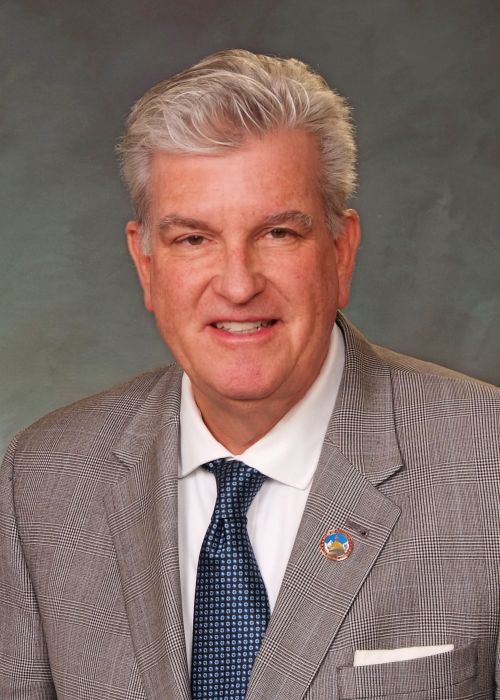
Sen. John Carson
Sponsored bills
Under current law, there are 2 total program formulas to finance public schools. Absent the satisfaction of a statutorily specified condition, the first formula is scheduled to stop determining total program after the 2024-25 budget year (expiring formula), and the second formula is scheduled to determine total program beginning in the 2030-31 budget year (new formula). For the 2025-26 budget year through the 2029-30 budget year (transition period), total program is scheduled to be determined by using figures that were calculated under both the expiring formula and the new formula. The act: Extends the transition period by one year, so that it is from the 2025-26 budget year through the 2030-31 budget year; and Postpones the exclusive use of the new formula to determine total program until the 2031-32 budget year. The act changes how each school district's and institute charter school's annual total program is determined during the transition period. For the 2025-26 and 2026-27 budget years, each school district's and institute charter school's annual total program is the greater of the school district's or institute charter school's total program for the 2024-25 budget year or the amount calculated under the expiring formula plus an amount equal to 15% in 2025-26 and 30% in 2026-27 of the difference between the amounts calculated under the new formula and the expiring formula. For the 2027-28 budget year through the 2030-31 budget year, each school district's and institute charter school's annual total program is the greater of the district's or institute charter school's calculation under the expiring formula plus 1% of that calculation, or: For the 2027-28 budget year, the amount calculated under the expiring formula plus an amount equal to 45% of the difference between the amounts calculated under the new formula and the expiring formula; For the 2028-29 budget year, the amount calculated under the expiring formula plus an amount equal to 60% of the difference between the amounts calculated under the new formula and the expiring formula; For the 2029-30 budget year, the amount calculated under the expiring formula plus an amount equal to 75% of the difference between the amounts calculated under the new formula and the expiring formula; and For the 2030-31 budget year, the amount calculated under the expiring formula plus an amount equal to 90% of the difference between the amounts calculated under the new formula and the expiring formula. Under current law, there are specified conditions that apply to the transition period. If the joint budget committee determines that a specified condition occurs in a budget year during the transition period, then for the next budget year and each budget year thereafter, the transition is suspended, and each school district's total program is determined pursuant to the calculation and determination required for the budget year when the condition occurred. For one of the existing conditions, the act specifies that an income tax deposit to the state education fund that was made to correct an error does not count toward determining whether the condition has been satisfied. A school district's funded pupil count is a figure that is used as a part of determining a school district's total program. Under the expiring formula, a school district's funded pupil count is calculated by determining the greater of the school district's pupil enrollment for the applicable budget year or the average of the school district's pupil enrollment for the applicable budget year and the immediately preceding 4 budget years. Under current law, the new formula calculates a school district's funded pupil count by determining the greater of the school district's pupil enrollment for the applicable budget year or the average of the school district's pupil enrollment for the applicable budget year and the immediately preceding 3 budget years. The act changes the new formula so that: For the 2025-26 budget year, a school district's funded pupil count is calculated by determining the greater of the school district's pupil enrollment for the applicable budget year or the average of the school district's pupil enrollment for the applicable budget year and the immediately preceding 3 budget years; and For the 2026-27 budget year and each budget year thereafter, a school district's funded pupil count is calculated by determining the greater of the school district's pupil enrollment for the applicable budget year or the average of the district's pupil enrollment for the applicable budget year and the immediately preceding 2 budget years. However: If a statutorily specified condition is satisfied, and consequently for the 2026-27 budget year, a district's total program is not determined as scheduled under the transition period, then for the 2026-27 budget year, and each budget year thereafter, funded pupil count will continue to be determined by the greater of the school district's pupil enrollment for the applicable budget year or the average of the school district's pupil enrollment for the applicable budget year and the immediately preceding 3 budget years; and If, for the 2027-28 budget year, the state education fund balance is projected to be less than $200 million, then the general assembly is required to implement a smoothing factor or the funded pupil count will be determined by the greater of the school district's pupil enrollment for the applicable budget year or the average of the school district's pupil enrollment for the applicable budget year and the immediately preceding budget year for the 2027-28 budget year and each budget year thereafter. The act expiring formula is changed so that, starting in the 2027-28 budget year, the funded pupil count used in the expiring formula is the same funded pupil count that is used in the new formula to determine a district's total program during the transition period. The total program for the 2025-26 budget year is determined using the formula changes in the act. The act: Increases the statewide base per pupil funding for the 2025-26 budget year by $195.42 to account for inflation; Sets a new statewide base per pupil funding amount for the 2025-26 budget year at $8,691.80; and Sets the total program funding for the 2025-26 budget year for all school districts and institute charter schools to at least $10,036,070,748 or $10,031,606,090, depending upon whether Senate Bill 25-315 becomes law. Under current law, a new at-risk measure is required to be implemented in the 2025-26 budget year. The act repeals this requirement and requires the department of education (department) to collect data necessary to identify individual student census block groups to account for students who are at-risk of below-average academic performance and education outcomes because of socioeconomic disadvantages or poverty, but who may not qualify for free or reduced price lunch. Under current law, as a part of the charter contract, a district charter school and the school district, or the institute charter school and state charter school institute (institute), must agree on funding and services provided by the school district or institute to the charter school, subject to parameters. The act: Suspends the use of these provisions after the 2025-26 budget year; Repeals charter school at-risk supplemental aid after the 2026-27 budget year, following its gradual phase out during the 2025-26 and 2026-27 budget years; Creates incremental funding for charter schools for the 2025-26 budget year; and Requires the general assembly to consult with charter school representatives to ensure that charter schools are aligned with the implementation of the new formula. The act raises the limit from $750 million to $1 billion for the amount of money that the general assembly may appropriate to restore any or all qualified charter school debt reserve funds to their qualified charter school debt service fund requirements. Under current law, $41 million of interest and income earned on money in the public school fund is credited to certain purposes, and any remaining interest and income may be credited as specified by the general assembly or remain in the public school fund. The act requires that any remaining interest and income is credited to the public school capital construction assistance fund. The total annual amount of revenue credited to the public school capital construction fund is capped at $150 million, adjusted for inflation; except that money received from public school fund interest and income does not apply toward the cap. Any amount above the cap is credited to the state public school fund instead. The act creates the kids matter account within the state education fund. Beginning July 1, 2026, the state treasurer must deposit in the account all state revenues collected from an existing tax on 0.00065% on federal taxable income, as modified by law, of every individual, estate, trust, and corporation. The money in the account must only be used for district total program funding and total state funding for all categorical programs. Under current law, the department is required to contract with an entity to develop and implement a public information campaign to emphasize the importance of learning to read by third grade and highlight local education providers that are achieving high percentages of third-grade students who demonstrate reading competency. The act repeals the requirement that the department contract with an entity to develop and implement the information campaign. The act authorizes the department to use any unexpended money that was appropriated for the out-of-school time program grant program and is remaining at the end of the 2024-25 or 2025-26 state fiscal years in the 2025-26 or 2026-27 state fiscal years without further appropriation. The act creates and implements certain parameters for multifunction school activity buses. For the 2025-26 state fiscal year, the act: Appropriates $7,009,989 to the department from the state education fund for at-risk supplemental aid; Appropriates $7.6 million to the department from the public school capital construction assistance fund for public school capital construction assistance board cash grants; Appropriates $25 million to the department from the public school capital construction assistance fund for public school capital construction assistance board lease payments; and Adjusts the 2025-26 long bill by decreasing the cash funds appropriation from the state education fund for the state share of district's total program by $15,775,837; decreasing the cash funds appropriation from the state education fund for at-risk per pupil additional funding by $5 million; and decreasing the cash funds appropriation from the public school capital construction assistance fund for public school capital construction assistance board cash grants by $45,648,087.(Note: This summary applies to this bill as enacted.)
The act clarifies when a teacher may conclude that an early elementary school student has a significant reading deficiency requiring remediation through a specialized approach to instruction (READ plan) based on a body of evidence that includes information in addition to the student's scores on a reading assessment. Current law requires certain parental communications in connection with a student's READ plan. The act requires the addition of specific information regarding characteristics of dyslexia, if applicable, to the parental communications. Beginning no later than the 2027-28 school year, a local education provider must either develop its own screening process for identifying early elementary school students with characteristics of dyslexia or implement a universal dyslexia screener that conforms to certain new requirements. A local education provider that implements a screener may include the screener in an interim reading assessment or administer the screener separately from the interim assessment. Either way, the screener must accurately and reliably identify students at risk of reading difficulties. If an interim reading assessment includes a screener, the assessment must meet standards for validity and reliability, encourage data-driven instructional decision making, and promote efficient administration and effective follow-up. (Note: This summary applies to this bill as enacted.)
The act creates a voluntary procedure by which an individual may elect to contribute a portion of their state income tax refund as a donation to the animal protection fund (fund). For the income tax years immediately following the year in which the executive director of the department of revenue (department) files written certification with the revisor of statutes that a line on the income tax return form has become available and that the animal protection fund voluntary contribution (contribution) is next in the queue established pursuant to statute, the executive director of the department shall ensure that the Colorado state individual income tax return form contains a line by which each individual taxpayer may designate the amount of the contribution, if any, that the individual wishes to make to the fund. Money in the fund is continuously appropriated to the department of agriculture. Unlike many other types of permitted voluntary contributions, the contribution is not subject to sunset review and is not subject to repeal if the contribution generates no more than $50,000 during the period between January 1 and September 1 of a tax year. The act requires the department to determine annually the total amount donated through the contribution and report that amount to the state treasurer and to the general assembly. The state treasurer shall credit that amount to the fund. All interest derived from the deposit and investment of money in the fund is credited to the fund. The general assembly shall appropriate annually from the fund to the department its costs of administering money designated as contributions to the fund. For the 2025-26 state fiscal year, the act appropriates $11,606 from the fund to the department for the implementation of the act. (Note: This summary applies to this bill as enacted.)
The act establishes a definition of "mobile food establishment" to mean a retail food establishment that is operated from a vehicle, can change location, and is intended to operate from a commissary kitchen. The act establishes a reciprocal food safety license between the city and county of Denver (Denver) and other local governments throughout the state. The department of public health and environment (CDPHE) issues a statewide health department license (state license) based on the state health code to mobile food establishments that is valid in all local government jurisdictions throughout the state except for Denver. Denver issues a Denver-specific retail food license (Denver license) to mobile food establishments that is based on Denver's health code and that is only valid within Denver's jurisdiction. The act establishes reciprocity between these two licenses so that the state license is valid in Denver and the Denver license is valid across the state. The act requires the owner or operator of a mobile food establishment that wishes to take advantage of this reciprocity to provide a copy of either their Denver license or the state license to the local government in which they intend to operate or to Denver at least 14 days in advance of when they intend to operate. When a mobile food establishment is operating in a local government jurisdiction, including Denver's jurisdiction, the mobile food establishment must comply with all laws of the local government and is subject to inspection and enforcement by the local government. For a mobile food establishment with a state license that intends to operate in Denver, the mobile food establishment must submit certain documentation including, if requested, a summary of any violations within the previous calendar year related to the license or the operation of the mobile food establishment. The act also establishes that a fire safety permit that has been issued to a mobile food establishment by a local government is valid in any other local government jurisdiction if the fire safety permit was issued: By a local government that has adopted the most recent international fire code or a fire code that has incorporated the minimum standards for mobile food establishments developed by the division of fire prevention and control; and After completing an inspection by a certified fire inspector. The act requires that a mobile food establishment send a copy of the fire safety permit to the local government in which they intend to operate at least 14 days in advance of operation. While operating in a local government's jurisdiction, the mobile food establishment must comply with that local government's fire safety code and is subject to inspection and enforcement by the local government. The act authorizes the division of fire prevention and control to adopt minimum codes and standards for the operation of mobile retail food establishments for use by local governments. The act takes effect January 1, 2026. (Note: This summary applies to this bill as enacted.)
Under current law, life care institutions provide life and health support services to resident seniors who reside at the life care institution through the help of independent living arrangements, assisted living, or skilled nursing. The act allows life care institutions to provide community-based continuing care services to seniors in their homes and other services that benefit individuals who are awaiting admission to a life care institution. (Note: This summary applies to this bill as enacted.)
For construction of multifamily, attached housing of 2 or more units, the act creates the multifamily construction incentive program (program). A builder may chose to participate in the program by: Providing a warranty that covers any defect and damage at no cost to the homeowner for specified periods; Having a third-party inspection performed on the property; and Recording a notice of election to participate in the program in the real property records before the property is offered for sale. For construction defect claims brought for the construction of housing for which the builder is a participant in the program, the act: Requires a claimant to file a certificate of review with the complaint, if the complaint is against an architect or engineer; Limits actions to claims that have resulted in: Actual damage to real or personal property; actual loss of the use of real or personal property; actual bodily injury or wrongful death; an unreasonable reduction in the capability of, or an actual failure of, a building component to perform an intended function or purpose; or an unreasonable risk of bodily injury or death to, or a threat to the life, health, or safety of, the occupants of the residential property; and Requires that a construction professional must send or deliver to the claimant an offer to settle the claim or a written response that identifies the standards that apply to the claim and explains why the defect does not require repair. For all construction defect claims, the act: Establishes a claimant's duty to mitigate an alleged construction defect and specifies how a claimant may satisfy this duty and the consequences to a claimant that fails to satisfy this duty; Requires a construction professional who is the defendant in a construction defect action to submit specified information to the claimant; Prohibits an insurer from cancelling, denying, or reducing coverage based on any claim for benefits covered by an existing liability insurance policy issued to a construction professional based on the construction professional's offer to repair or settle a construction defect claim; Tolls the statute of limitations or repose during a claimant's mitigation of an alleged construction defect; Increases the percentage of owners that an executive board of a unit owners' association (executive board) must obtain approval from before initiating a construction defect claim on behalf of the owners from a majority to 65%; and Requires an executive board that is successful in a construction defect claim or settlement to first use the net monetary damages or net proceeds received as a result of the claim to repair the construction defect. The act requires a local government to establish a fast-track approval process for an application for for-sale multifamily condominium projects in order to qualify for assistance from the state affordable housing fund. (Note: This summary applies to this bill as enacted.)
Maddy summarySJR 25-023 is a procedural resolution that establishes a joint committee of five members from the Senate and House of Representatives. This committee is tasked with formally notifying the Governor that the legislative session is about to conclude and to ask if he has any final communications for the General Assembly.
Maddy summarySJR 25-024 is a procedural resolution that establishes the final adjournment date for the First Regular Session of the Seventy-fifth General Assembly. It declares that when the session concludes on May 7, 2025, it will stand adjourned "sine die," meaning it will be the final adjournment without a set date to reconvene. This directly affects the members of the General Assembly by formalizing the end of their legislative session.
Maddy summarySJR 25-020 is a commemorative resolution that recognizes Colorado Mesa University's 100-year anniversary. The bill celebrates the university's history, achievements, and impact on students and the western Colorado community. It directs that copies of the resolution be sent to the university's Board of Trustees and Century Project Steering Committee.