

Under current law, the title board must set a ballot title for an initiative petition that is brief, does not conflict with another title for an initiative petition filed for the same election, and is in the form of a question that may be answered 'yes/for' or 'no/against' and that unambiguously states the principle of the provision sought to be added, amended, or repealed by the initiative. The act adds a requirement that the title board write a ballot title using accessible language, which means plain language that is understood by the widest possible audience. In determining whether a ballot title is written using accessible language, the title board may consider whether the title:Avoids using legal, technical, or specialized terminology when possible;Clearly identifies the principal change in law or policy proposed by the proposed statutory or constitutional amendment;Avoids unnecessary qualifiers, double negatives, and overly complex phrasing;Organizes clauses so that the effect of a 'yes/for' or 'no/against' vote is readily understood; andPresents necessary information within the ballot title in a logical and readable order. In addition, current law requires that specific language appear in the ballot title for certain initiatives that increase or reduce tax revenue. For initiatives that reduce state tax revenue or local district property tax revenue through a tax change, this required language must appear at the beginning of the ballot title. For initiatives that increase tax revenue for any district through a tax change, this required language must appear directly after language required by the Taxpayer's Bill of Rights. The act modifies these statutory provisions so that the required ballot title language must only be substantially similar to the specific statutory language and may appear anywhere in the ballot title. The act applies to initiative petitions submitted to the secretary of state for title setting on or after the effective date of the act.(Note: This summary applies to this bill as enacted.)
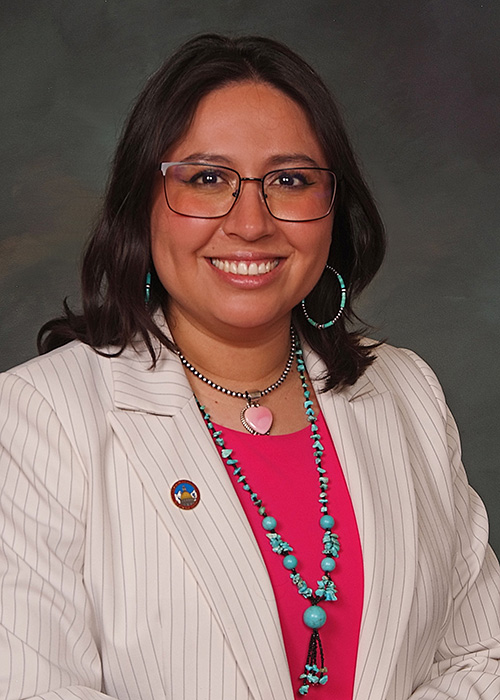
Rep. Elizabeth Velasco
Sponsored bills
The act appropriates the following amounts for the 2026-27 state fiscal year from the Colorado water conservation board (CWCB) construction fund to the CWCB or the division of water resources in the department of natural resources for the following projects:Continuation of the satellite monitoring system, $380,000 (section 1 of the act);Continuation of the floodplain map modernization program, $500,000 (section 2);Continuation of the weather modification permitting program, $500,000 (section 3);Continuation of the Colorado Mesonet project, $200,000 (section 5);Continuation of the water forecasting partnership project, $2,500,000 (section 6);Continuation of Colorado decision support system operation and maintenance, $750,000 (section 7);Support for water plan agency actions, $1,350,000 (section 9);Continuation of the Colorado watershed restoration and flood mitigation projects, $5,000,000 (section 10); andContinuation of the upper Colorado river commission planning, $750,000 (section 11). Section 4 directs the state treasurer to transfer up to $6,000,000 from the CWCB construction fund to the CWCB litigation fund on or before July 1, 2026. Section 8 restores the fish and wildlife resources fund balance by transferring $2,000,000 from the CWCB construction fund to the fish and wildlife resources fund. Section 12 authorizes the CWCB to make a loan in an amount of $151,500,000 from the severance tax perpetual base fund to the city of Fort Collins to support the Halligan water supply project. Section 13 authorizes the CWCB to make a loan in an amount of $20,166,670 from the severance tax perpetual base fund to the Lower Latham Reservoir Company for the Jurgens reservoir construction project. Section 14 appropriates $37,700,000 from the water plan implementation cash fund to the CWCB to award grants that will help implement the state water plan. Section 15 clarifies that the money that is currently in the turf replacement fund is appropriated for designated purposes to the CWCB until June 30, 2028. Any money remaining in the turf replacement fund on July 1, 2028, is transferred to the CWCB construction fund. Section 16 makes technical corrections so that money appropriated in 2025 is available to the department of natural resources executive director's office for the purpose of paying for a study by the Colorado water center at Colorado state university. Under current law, the CWCB may authorize loans up to $10 million from the CWCB construction fund or severance tax perpetual base fund without legislative authorization. The act increases that amount to $30 million (section 17).(Note: This summary applies to this bill as enacted.)
The act prohibits the Colorado lottery or any licensed lottery retailer from selling lottery tickets or instant scratch game tickets produced by the lottery for sale to the public on a credit basis.(Note: This summary applies to this bill as enacted.)
The act allows persons who are indigenous to receive compensation for traditional Native American healing ceremonies and practices and related expenses under the 'Colorado Crime Victim Compensation Act', which includes:Traditional counseling and healing from an elder or spiritual healer;Traditional ceremonial practices;Ceremonial burials, including clothing for the deceased, meals, and other related expenses;Child care during burial ceremonies;Reimbursement for honoraria provided in connection with ceremonial services; andReasonable travel expenses related to the traditional Native American healing ceremonies and practices.(Note: This summary applies to this bill as enacted.)
In 2022, the general assembly enacted, and the governor subsequently signed into law, House Bill 22-1358 ('Concerning measures to eliminate the presence of lead in the drinking water of certain facilities where children are present, and, in connection therewith, making an appropriation'), which required child care centers, family child care homes, and each public school that serves any of grades preschool through eighth grade to:Test its drinking water sources by having a state-certified laboratory measure the lead content of water drawn from each drinking water source; andSatisfy other requirements concerning the provision of safe drinking water. House Bill 22-1358 also created the school and child care clean drinking water fund (fund) to help schools, child care centers, and family child care homes comply with House Bill 22-1358. House Bill 22-1358 included a repeal date of June 30, 2026, for its provisions. The act extends the provisions, with amendments, until June 30, 2029. The act also adds high schools (i.e., schools that serve grades 9 to 12) to the scope of House Bill 22-1358, which means that high schools may receive grants from the fund and must satisfy certain requirements on or before dates specified in the act. The act requires the department to adopt rules establishing how a child care center shall demonstrate compliance with the requirements concerning the testing for the presence of lead in drinking water.(Note: This summary applies to this bill as enacted.)
The act prohibits using an automated driving system to drive a commercial motor vehicle unless an individual who holds a commercial driver's license is in the vehicle, monitors the vehicle's driving, and intervenes, if necessary, to avoid illegal or unsafe driving. The individual must be in the driver's seat if hazardous materials are being transported. The penalty is $1,000 for a first offense, is $2,000 for a second offense, and doubles for each subsequent offense. The act does not apply to a light-duty vehicle or a truck-mounted attenuator. The prohibition is repealed September 1, 2031. The chief of the Colorado state patrol will analyze the act's effects on commercial vehicle safety on highways. By November 1, 2030, the chief of the Colorado state patrol will issue a report to the relevant committees of the house of representatives and senate. The report must make recommendations as whether to continue the prohibition and, if continued, any recommended legislation to improve the prohibition. For the 2026-27 state fiscal year, $14,357 is appropriated to the department of revenue from the Colorado DRIVES vehicle services account in the highway users tax fund to implement the act.(Note: This summary applies to this bill as enacted.)
The act extends for an additional 10 years the availability of the state income tax credit allowed to a taxpayer who makes a qualifying monetary contribution to promote child care in the state equal to 50% of the total value of the contribution, not to exceed $100,000, through income tax years commencing prior to January 1, 2038.(Note: This summary applies to this bill as enacted.)
The act makes the following changes to the 'Labor Peace Act':Specifies that employees' right to bargain collectively includes the right to bargain collectively concerning any mandatory subject of bargaining;Eliminates the requirement for a second election to negotiate a union security agreement clause in the collective bargaining process;Declares that it is not an unfair labor practice for an employer to refuse to agree to a lawful proposal made by the exclusive representative of the employees, or for the exclusive representative of the employees to refuse to agree to a lawful proposal made by the employer, concerning a mandatory subject of bargaining if the refusing party has bargained in good faith with the other party; andRequires employers and employees, through their exclusive representative, to bargain in good faith.(Note: This summary applies to this bill as enacted.)
The act requires an institution of higher education (institution) that operates a student health center to provide abortion medication to all students enrolled at the institution. The act requires an institution that has an on-site prescription drug outlet or other outlet to maintain a stock of and provide access to abortion medication to students enrolled at the institution. The act requires an institution that does not have an on-site prescription drug outlet or other outlet to either submit a prescription for abortion medication to an off-campus prescription drug outlet or other outlet or dispense abortion medication through the institution's student health center if permitted by the student health center's licensure. The act prohibits an institution from knowingly providing personally identifiable information contained in a student's patient records, billing records, or precise location data related to accessing abortion medication in response to a request from another state seeking to impose liability for accessing abortion medication. An institution is not required to provide access to or stock abortion medication if doing so would jeopardize an institution's federal grant participation, require the institution to deviate from generally accepted billing practices, modify the generally accepted standards of medical practice, or conflict with the institution's sincerely held religious beliefs or practices.(Note: This summary applies to this bill as enacted.)
Beginning on January 1, 2027, the act authorizes an optional collision prevention fee (fee), which is collected at the time of registration of a passenger motor vehicle, light-weight truck, motorcycle, or recreational vehicle (motor vehicle). An individual may decline to pay the fee when registering a motor vehicle, and nonpayment of the fee does not affect the individual's ability to register the motor vehicle. In connection with imposing the fee, the statewide bridge and tunnel enterprise (enterprise) within the department of transportation (department) is required to collaborate with:The department of revenue and county clerks to develop language to notify individuals about the fee, including explicit language regarding the ability to decline to pay the fee and the fact that nonpayment of the fee will not affect an individual's ability to register a motor vehicle; andThe department of revenue, the department, county clerks, the division of parks and wildlife, and other impacted stakeholders to conduct a public outreach campaign to educate the public about the fee and what benefits the fee will provide. The enterprise is required to initiate the public outreach campaign as soon as practicable and must develop and deliver customer-facing educational materials to county clerks on or before December 1, 2026.The fee amount is set at $5 and, beginning in state fiscal year 2028-29, the enterprise is allowed to adjust this fee amount upward for inflation. 75% of the revenue from the fee is credited to the newly created collision prevention fund (fund), which is continuously appropriated to the enterprise for use in the following ways:To fund wildlife safe passage projects, defined as one or more projects that reduce wildlife-vehicle collisions and improve habitat connectivity by providing wildlife road crossings;To provide matching money as required by federal grant programs relating to wildlife safe passage projects; To expend for administrative and personnel expenses related to those purposes; andTo promote the fee and fund to maximize participation in the optional fee, in collaboration with the department of revenue, impacted stakeholders, and interested organizations.In determining which wildlife safe passage projects the enterprise will undertake, the enterprise is required to:Consult with the division of parks and wildlife (division) and the Colorado wildlife and transportation alliance;Consult with the tribal government if the project is on or adjacent to tribal land;Consult with relevant local governments with jurisdiction over the area of the proposed project and any relevant local organizations engaging in work to reduce vehicle collisions;Consider studies concerning the prioritization of wildlife within the state;Consider whether the wildlife safe passage project is related to a bridge or tunnel project undertaken by the enterprise; andIn consultation with the division, consider opportunities for landowner agreements or additional conservation efforts that may be necessary to ensure the continued functionality of infrastructure associated with a proposed wildlife safe passage project. 25% of the revenue from the fee is credited to the wildlife cash fund and continuously appropriated to the division to provide services related to wildlife connectivity and wildlife crossing-related conservation efforts. The act also modifies the process for the keep Colorado wild pass fee, which is an existing optional fee paid at the time an individual registers a motor vehicle, to align with the process for the collision prevention fee by removing the presumption that an individual who declines to pay the keep Colorado wild pass fee is presumed to decline to pay that fee in subsequent years with respect to registration of the same motor vehicle. With this change, an individual must affirmatively opt out of the payment of both the keep Colorado wild pass fee and the collision prevention fee each year that the individual registers the motor vehicle. For the 2026-27 state fiscal year:$53,516 is appropriated from the DRIVES cash fund to the department of revenue for use by the division of motor vehicles; Of funds appropriated from the parks and outdoor recreation cash fund to the department of natural resources for use by the division, $778 is reappropriated to the department of revenue for use by the division of motor vehicles; and$19,940 is appropriated from the legal services cash fund, from revenue received from the department from the collision prevention fund, to the department of law to provide legal services for the department.(Note: This summary applies to this bill as enacted.)