

The act requires certain transit agencies that have at least one million unlinked passenger trips in the most recent year, and that are not the Colorado department of transportation or a regional transportation authority that provides funding for but does not directly provide transit services (covered transit agencies), to take specific actions to increase transit access. On and after June 30, 2027, a covered transit agency shall ensure that clear, up-to-date transit system maps are displayed at all rail stations, bus stations, and bus rapid transit stops and that information on fare rates and structures and eligibility requirements and application instructions for fare discount programs is available online and displayed in all transit vehicles and at all rail stations, bus stations, and transit stops with a covered shelter. A covered transit agency may meet these requirements by displaying summary information and a link or quick response (QR) code to a website with detailed information. A covered transit agency is not required to replace its fixed signage, displays, or maps solely to comply with these new requirements and, instead, is only required to update the required information upon the regularly scheduled replacement of any signage, displays, or maps. On and after June 30, 2027, a covered transit agency shall ensure that all publicly available information that it disseminates related to accessing its transit services, including fare structures, transit maps, service schedules, and the rights and responsibilities of transit riders, is translated into languages that are widely spoken in any county in which the covered transit agency operates or that are required by a covered transit agency's existing language access plan. A covered transit agency may use an existing language access plan to satisfy these language access requirements. Covered transit agencies are required to annually report their progress on the action areas required by the act, and other required information, to the governor and a joint meeting of the transportation committees of the general assembly beginning on or before January 31, 2028, and on or before each January 31 thereafter. Covered transit agencies must post this annual report on a publicly accessible website. Covered transit agencies are only required to report information that they already collect and may satisfy any of the information required to be reported by referencing or including a link to a publicly accessible official report that includes the required information.(Note: This summary applies to this bill as enacted.)
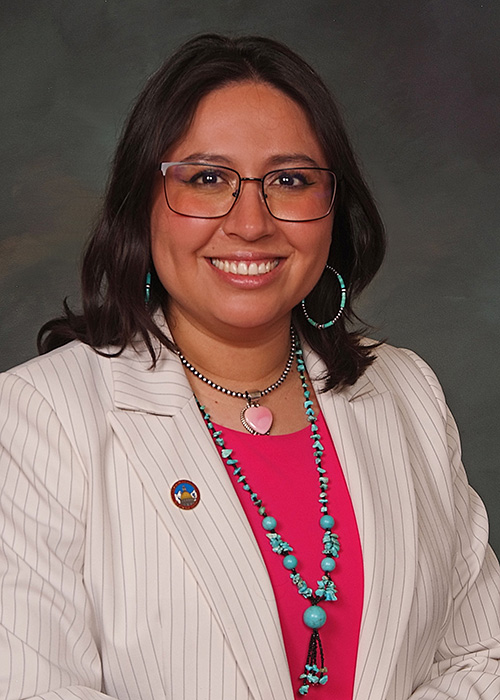
Rep. Elizabeth Velasco
Sponsored bills
The act creates the 'Transit Investment Area Act' to facilitate the financing of transit and rail station infrastructure. Specifically, the act:Allows a local government and a transit agency to jointly undertake a transit investment project. To finance the project, the local government may apply to the Colorado economic development commission (commission) to designate a transit investment area and an approved financing entity;Authorizes the approved financing entity, which may be a newly created transit investment authority, a county revitalization authority, a metropolitan district, or an urban renewal authority, to receive state sales tax increment revenue. This revenue consists of the state sales tax collected in the designated area above a base amount, plus an additional 20% to account for out-of-area deliveries.Permits the financing entity to issue bonds and use the state sales tax increment revenue to finance eligible improvements related to the transit project;Prohibits the financing entity from using the state sales tax increment revenue to acquire property through eminent domain;Requires projects to comply with specified hiring, apprenticeship, and workforce standards;Caps the commission's approval authority at no more than 3 transit investment projects in any calendar year and no more than 6 in total and caps the total state sales tax increment revenue dedicated to all projects at $75 million per fiscal year; andAuthorizes the commission to revoke project approval if substantial work does not commence within 5 years and requires financing entities to submit annual reports and independent financial audits. The act requires the Colorado office of economic development, in consultation with the department of local affairs and the department of transportation, to publish a transit and housing investment zone map on or before October 30, 2026. The act creates the Colorado affordable housing in transit and housing investment zones tax credit (tax credit). The tax credit is administered in the same manner as the Colorado affordable housing in transit-oriented communities income tax credit; except that the tax credit is awarded in connection with housing projects in transit and housing zones. The act authorizes the Colorado Housing and Finance Authority to allocate up to $8,333,333 in tax credits each calendar year beginning in the 2027 calendar year through the 2033 calendar year. For the 2026-27 state fiscal year, the act appropriates $213,349 to the office of the governor for use by economic development programs.(Note: This summary applies to this bill as enacted.)
The act requires a minor who is under 18 years old to have written permission of the minor's parent or legal guardian to obtain an instruction permit to drive a motorcycle. The act does not apply to emancipated minors.(Note: This summary applies to this bill as enacted.)
The act encourages the state forest service, the department of natural resources, the department of personnel, and the department of transportation (covered agency) to prioritize the use of ecoregionally specific plant material that supports pollinator habitats when certain conditions are met. In planning and executing a vegetation project, each covered agency is required to satisfy certain requirements. To the extent practicable, each covered agency shall coordinate with the other covered agencies with regard to purchasing. Each covered agency, subject to available funding, shall establish a training program for relevant staff that includes certain minimum components. On and after January 1, 2028, to the extent practicable, each covered agency shall integrate mowing and grazing based on recommendations included in the 2022 study commissioned by the department of natural resources pursuant to Senate Bill 22-199. The act requires the office of the state architect to support and encourage the development and renovation of sustainable sites to maximize pollinator health on properties within the state capitol complex, other state buildings, and, where applicable, on leased property. The act requires the Colorado state university cooperative extension service (extension) to perform a Colorado native plant availability study (study) in consultation with certain parties. On or before August 1, 2031, the extension shall issue a report summarizing the results of the study. The extension shall make the report publicly available on its website and provide copies of the report to the governor and specified legislative committees of reference. The extension may seek, accept, and expend gifts, grants, and donations for the purpose of implementing the act. The extension is not required to perform the study or issue a report unless and until the extension acquires sufficient gifts, grants, and donations to pay for the performance of such duties.(Note: This summary applies to this bill as enacted.)
Maddy summaryThis bill establishes a joint committee of five legislators to inform the Governor that the current legislative session is about to end. The committee, composed of three House members and two Senate members, will also ask the Governor if he has any final messages for the assembly. Although the bill was introduced in 2026, it was ultimately not passed as the Senate laid it on the table. Its primary function is a procedural step to ensure proper communication between the legislature and the executive branch at the conclusion of a session.
The act:Allows the department of public health and environment (department) to expend money from the community impact cash fund to provide grants for municipal solid waste landfill methane emission reduction projects;Requires the environmental justice advisory board to prioritize a grant request from a local government that owns or operates a municipal solid waste landfill over a grant request from a private entity that owns or operates a municipal solid waste landfill;Requires an entity that receives money from the department to use the money as supplemental funding only; andAmends the definition of 'disproportionately impacted community'.(Note: This summary applies to this bill as enacted.)
Each county in the state is categorized for purposes of establishing the salaries of elected officers in the county. The statutory salary amounts are adjusted every 2 years for inflation and take effect for terms commencing after any change is made. The act changes the category of Cheyenne county from V-D to V-C, the category of Dolores county from V-C to V-D, the category of Lake county from IV-B to IV-A, and the category of Pitkin county from II-B to I-A. The category changes will increase Cheyenne county official salaries as follows:County commissioner salary increases from $61,236 to $67,360;County sheriff salary increases from $68,646 to $75,511;County treasurer, assessor, and clerk salary increases from $61,236 to $67,360; andPart-time county coroner salary increases from $13,841 to $15,225. The category changes will decrease Dolores county official salaries as follows:County commissioner salary decreases from $67,360 to $61,236;County sheriff salary decreases from $75,511 to $68,646;County treasurer, assessor, and clerk salary decreases from $67,360 to $61,236; andPart-time county coroner salary decreases from $15,225 to $13,841. The category changes will increase Lake county official salaries as follows:County commissioner salary increases from $83,382 to $90,330;County sheriff salary increases from $111,735 to $121,046;County treasurer, assessor, and clerk salary increases from $83,382 to $90,330;Part-time county coroner salary increases from $37,077 to $40,167; andFull-time county coroner salary increases from $83,382 to $90,330. Pitkin county is a home rule county that may set the compensation for its officers and employees. The category changes may increase Pitkin county official salaries as follows:County commissioner salary increases from $121,634 to $158,669;County sheriff salary increases from $147,135 to $201,926;County treasurer, assessor, and clerk salary increases from $121,634 to $158,669; andFull-time county coroner salary increases from $121,634 to $158,669.(Note: This summary applies to this bill as enacted.)
The act requires the secretary of state to refer a ballot issue at the November 2026 general election to seek voter approval for the state, beginning in the 2026-27 state fiscal year, to retain and spend an amount of state revenue equal to the amount of state public K-12 education funding in excess of the limitation on state fiscal year spending and to increase state public K-12 education funding by up to 2% per year for 10 years. The act directs legislative council staff to determine the amount of state public K-12 education funding and describes how legislative council staff will make that determination. The act creates a positive factor to increase state public K-12 education funding. The amount of the positive factor compounds annually for 10 years. The positive factor for the 2026-27 budget year is 2% of the program foundation calculated for the 2025-26 budget year. For the 2027-28 through 2034-35 budget years, it is the sum of 2% of the prior year's program foundation plus the prior year's positive factor. For the 2035-36 budget year and beyond, it is the sum of 2% of the 2034-35 program foundation plus the 2034-35 positive factor. A district's share of the positive factor is calculated proportionally based on the district's total program under the new school finance formula relative to the statewide total program. A district may only use its positive factor funding for increasing teacher pay, improving teacher retention, lowering class sizes, and increasing access to career and technical courses. For the 2026-27 state fiscal year, the children's account consists of an amount of money equal to the amount of state revenues that the state retains for a given fiscal year pursuant to voter approval of the act. For state fiscal years commencing on or after July 1, 2027, the account consists of that same amount minus an amount equal to the total dollar amount of warrants issued by the state treasurer to reimburse local governments for property tax exemptions. Money in the account must first be spent to pay districts their positive factor, then any remaining funds are appropriated for disability services and school services and to increase annual contact hours, and finally to programs prioritizing child care and full-day preschool. The act directs the state auditor to conduct and publish a report on excess state revenues for each state fiscal year that the state retains and spends state revenues in excess of the limitation on state fiscal year spending. That report must include descriptions of:The amount of state revenues that the state retained and spent that would otherwise have been in excess of the limitation on state fiscal year spending; andHow the state expended the state revenues that the state retained and spent that would otherwise have been in excess of the limitation on state fiscal year spending. Beginning August 1, 2027, the act requires each local education provider to post, online for free public access in a format that can be downloaded and sorted, its actual expenditures of any positive factor received. Lastly, the act updates provisions regarding the expanded earned income tax credit, the family affordability tax credit, and the affordable housing financing fund to ensure that voter approval of the act does not adversely impact those programs.(Note: This summary applies to this bill as enacted.)
In 2024, the general assembly enacted Senate Bill 24-205, which created consumer protections in interactions with artificial intelligence systems. The act repeals and reenacts those provisions with new requirements regarding the use of automated decision-making technology in consequential decisions. The act defines an 'automated decision-making technology' (ADMT) as a technology that processes personal data and uses computation to generate output, including predictions, recommendations, classifications, rankings, scores, or other information that is used to make, guide, or assist a decision, judgment, or determination concerning an individual. The act defines a 'consequential decision' as a decision that relates to an individual's access to, eligibility for, or compensation related to education, employment, housing, financial or lending services, insurance, health-care services, or essential government services and public benefits. The act requires the developer of an ADMT (developer) that is used to materially influence a consequential decision (covered ADMT), starting January 1, 2027, to provide a deployer of a covered ADMT (deployer) with technical documentation describing the covered ADMT's intended uses, categories of training data, known limitations, and instructions for appropriate use and human review. Developers must notify deployers of material updates or modifications to the covered ADMT. Both developers and deployers are required to retain records necessary to demonstrate compliance with the act for at least 3 years. The act establishes consumer notice requirements, mandating that deployers provide clear and conspicuous notice to consumers at the point of interaction with a covered ADMT. A deployer is required to provide a consumer with a plain language description of a covered ADMT's role within 30 days after the covered ADMT makes a consequential decision that results in an adverse outcome for the consumer. The attorney general must adopt rules to clarify these post-adverse outcome disclosure requirements by January 1, 2027. Consumers have the right to request personal data and correction of factually incorrect personal data used by a covered ADMT. The act also grants consumers the right to request meaningful human review and reconsideration following a covered ADMT making a consequential decision resulting in an adverse outcome. The attorney general is directed to enforce the act through the 'Colorado Consumer Protection Act', and a violation of the act is deemed a deceptive trade practice. Before initiating an action before January 1, 2030, the attorney general must provide the developer or deployer with a 60-day notice and opportunity to cure the alleged violation, if a cure is deemed possible. The act does not create a new private right of action but establishes how fault is allocated between developers and deployers in civil actions alleging unlawful discrimination under existing law. Specified entities are exempted from the requirements of the act to the extent the entities comply with other legal obligations.(Note: This summary applies to this bill as enacted.)
The bill recreates the wildfire matters review committee (interim committee) to succeed the wildfire matters review committee that repealed on September 1, 2025. The purpose of the interim committee is to review the implementation and effectiveness of state policies and resources for wildfire prevention and mitigation and to consider and recommend legislation or other policy changes to address all matters relating to wildfire prevention and mitigation including public safety, forest health, and cooperation with appropriate federal agencies and local governments.The interim committee consists of 10 members of the general assembly appointed as follows:5 members of the senate: 3 appointed by the president of the senate and 2 appointed by the minority leader of the senate; and5 members of the house of representatives: 3 appointed by the speaker of the house of representatives and 2 appointed by the minority leader of the house of representatives. The appointing authorities must make their original appointments to the interim committee no later than June 1, 2026. The term of appointment is 2 years. Incumbent members may be reappointed to the committee.The bill requires the interim committee to meet at least twice and allows the committee to take 2 field trips during every interim. The committee's duties are to:Review the implementation and effectiveness of state policies and resources for wildfire prevention and mitigation;Seek presentations and comments from individuals with professional expertise relating to wildfire prevention and mitigation and from representatives of relevant state agencies, local governments, private industry, and impacted communities; andRecommend legislation or other policy changes to address matters related to wildfire prevention and mitigation, including public safety, forest health, and cooperation with appropriate federal agencies and local governments.The bill allows the committee to recommend up to 5 bills during each interim.The committee is repealed, effective June 30, 2031.(Note: This summary applies to this bill as introduced.)