

The act limits the benefits pregnant women and children with a certain family household income and citizen or immigration status are eligible for under the state medical assistance program and the medical assistance program. Eligible pregnant women and children are subject to the following limitations on benefits:Beginning July 1, 2026, there is an annual cap on dental services in the amount of $1,100;Beginning January 1, 2027, behavioral health services offered must be provided on a fee-for-service basis only;Beginning January 1, 2027, services offered through the accountable care collaborative are no longer covered; andBeginning January 1, 2027, managed care services through the medical assistance program are no longer covered. Beginning January 1, 2027, children under 19 years old whose family household income does not exceed 260% of the federal poverty line, adjusted for family size, and who are not eligible for the medical assistance program due to their immigration status, are not eligible for home- and community-based services, community first choice, long-term home health, private duty nursing, hospice care, and nursing home care unless those children already receive those services on or before December 31, 2026. Beginning January 1, 2027, the act caps enrollment of children in the state medical assistance program at 25,000 children if either enrollment exceeds 25,000 or the expenditures for a fiscal quarter exceeds one-quarter of the appropriation for state medical assistance plus 5% to account for seasonality fluctuations. If one of the conditions is met, the enrollment cap begins on the first day of the month following 60 days after the department of health care policy and financing (state department) determines that the condition was met. The act repeals provisions requiring the state department to develop an outreach and enrollment strategy for enrolling eligible groups into new coverage options and repeals the state children's basic health plan. The act appropriates $3,378,166 from the general fund to the state department to implement the act and reduces appropriations to the state department by $14,202,723 if certain conditions are met.(Note: This summary applies to this bill as enacted.)
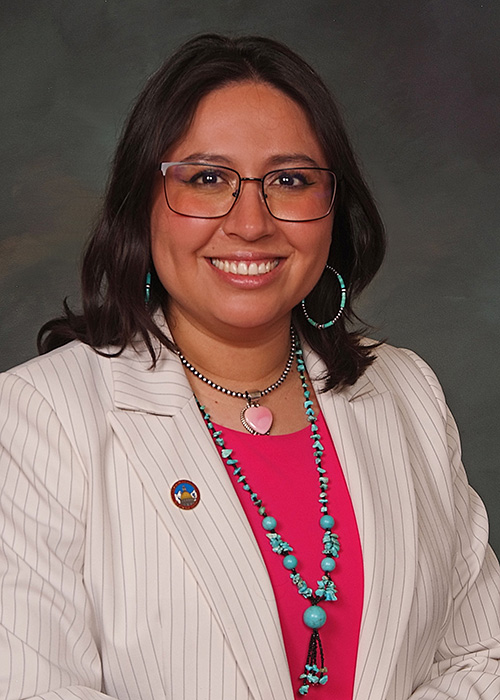
Rep. Elizabeth Velasco
Sponsored bills
The act exempts Colorado courts' e-filing system from the requirement that users certify that they will not disclose personal identifying information obtained from the system for federal immigration enforcement. The act authorizes a public health agency to inspect or examine a facility that houses or detains individuals who are noncitizens for purposes of civil immigration proceedings. Under current law, the department of public health and environment is authorized to inspect facilities that house or detain individuals who are noncitizens for purposes of civil immigration proceedings. The act expands the inspection authority, including the frequency of inspections and things that are subject to inspection. A facility that refuses to allow the inspection is subject to a civil penalty. The department of public health and environment is authorized to set fees for inspections and deposit the money from the fees in the immigration facility inspection and detention cash fund, which is created in the state treasury. The act authorizes the department of public health and environment to require facilities that house or detain individuals who are noncitizens for purposes of civil immigration proceedings to comply with requirements, including health and safety standards and reporting requirements. A facility that fails to comply is subject to a civil penalty. The act requires the department of public health and environment to submit an annual report to the attorney general concerning facilities' compliance with these new requirements and make the report publicly available on its website. The act requires the P.O.S.T. board to establish training standards related to peace officer compliance with current laws concerning civil immigration detainers. P.O.S.T.-certified peace officers must complete the training before December 31, 2027. The act requires the attorney general to develop and make publicly available a policy regarding current laws concerning the protection of personal identifying information. The act appropriates $107,283 to the department of public health and environment from the immigration facility inspection and detention cash fund.(Note: This summary applies to this bill as enacted.)
The act requires the division of labor standards and statistics (division) in the department of labor and employment (CDLE), on or before January 15, 2027, to begin collecting data concerning temperature-related injury or illness or temperature-related emergencies at worksites and to:Develop a platform on CDLE's website where users can provide information about occurrences of temperature-related injury or illness or temperature-related emergencies;Obtain from the department of public health and environment (CDPHE) data that CDPHE has collected through its syndromic surveillance program regarding occurrences of heat-related injury or illness or heat-related emergencies; andCollect similar data from the division of workers' compensation and the Center for Improving Value in Health Care. On or before July 1, 2028, the act requires the division to develop a model temperature-related injury and illness prevention plan (TRIIPP) that thereafter must be made available on CDLE's website. Additionally, the act requires the division to review and update the model TRIIPP at least every 5 years and grants the division authority to adopt rules necessary to implement the act. $76,651 is appropriated from the general fund to the department for use by the division.(Note: This summary applies to this bill as enacted.)
The act requires the division of administration in the department of public health and environment (division), no later than July 2029, to propose a final rule (rule) establishing certain limits on the emission of nitrogen oxides and sulfur dioxide (emission limits) from an electric generating unit (unit) that is owned or operated by an electric utility; is located in the state; and emitted 200 tons or more of nitrogen oxides, or sulfur dioxide, or both in calendar year 2024 (covered unit). The rule must require compliance with the emission limits as soon as practicable after December 31, 2034, and must not cover units that, before December 31, 2029, have ceased operations; burn natural gas, fuel oil, or both only; or have certain systems installed. A unit that operates after December 31, 2034, must install certain pollution controls and comply with the emission limits on or before December 31, 2034. An owner or operator of a unit is required to provide quarterly emission reports showing compliance with the rule to the division. On August 1, 2029, the air quality control commission in the department of public health and environment (AQCC) must submit to the general assembly a list of any units that are subject to a federal order. If there are any units subject to a federal order, the AQCC must also submit to the general assembly recommendations on whether to amend the requirements for units subject to federal order. An investor-owned utility or wholesale electric cooperative that is the owner or operator of a unit is required, beginning 150 days after the issuance of a federal order requiring the unit to remain operating after the unit was scheduled to retire (order) and continuing every 90 days until the order is no longer in effect, to file a report with the public utilities commission (commission) that contains certain information about the costs to operate the unit and the amount of electricity generated by the unit. The commission must make these reports publicly available. An investor-owned utility is also permitted to submit an application for a financing order to recover the costs of complying with an order. Any decision by the commission approving or modifying a portfolio in an electric resource plan of an investor-owned utility serving more than 500,000 customers must approve an amount of accredited capacity that allows the investor-owned utility to reliably achieve certain retirement and carbon dioxide emission reduction requirements. This requirement applies to an investor-owned utility serving more than 500,000 customers until the division determines that the investor-owned utility has achieved certain carbon dioxide emission reductions or until the investor-owned utility has retired all covered units, whichever is later.(Note: This summary applies to this bill as enacted.)
Maddy summaryHJR 1028 is a joint resolution that declares the Colorado House of Representatives' intent to honor a $2 million investment in school funding studies by creating a multi-year plan to address their findings. The bill directs the legislature to review the recommendations from two recent studies, which found that current school funding levels are inadequate and teacher salaries are too low, and to decide which study's methodology to follow for implementation. It requires the development of a structured plan that includes revenue triggers to phase in changes aimed at improving school funding equity and teacher compensation.
Maddy summaryHR 1007 is a commemorative resolution honoring Colorado's 150th anniversary of statehood in 2026. The bill directly affects the people of Colorado and various government officials by formally recognizing the state's history, culture, and achievements. Its key provisions call on citizens to celebrate this milestone with gratitude and dedication to liberty while committing to preserve natural resources, promote civic education, and strengthen infrastructure. The resolution does not create new laws or funding but serves as a symbolic acknowledgment of the state's legacy and future goals.
The act prohibits employers from making deductions from the wages or compensation of an employee for personal protective equipment. The act also requires an employer with 500 or more employees who are engaged in the slaughter of livestock or the rendering or packaging of meat to provide its employees reasonable access to restrooms. The division of labor standards and statistics in the department of labor and employment may fine an employer who fails to provide restroom access.(Note: This summary applies to this bill as enacted.)
The act requires the state treasurer to transfer $1.2 million from the universal high school scholarship cash fund (fund) to the Colorado economic development fund and $2.3 million from the fund to the general fund on June 30, 2026.(Note: This summary applies to this bill as enacted.)
Currently, the 'Workers' Compensation Act of Colorado' provides that certain cancers contracted by firefighters are considered occupational diseases presumed to have been a result of the firefighters' employment. A firefighter's employer or an insurer may rebut this presumption by showing by a preponderance of the medical evidence that the cancer did not occur on the job. The act expands the types of cancer that are considered occupational diseases and strengthens the rebuttable presumption to require an employer to show clear and convincing evidence that the cancer did not occur on the job. The act exempts firefighters who are employed by the state.(Note: This summary applies to this bill as enacted.)
On or before December 1, 2026, and annually thereafter, the act requires each transportation broker that administers nonemergency medical transportation to medicaid members to submit certain information to the department of health care policy and financing (state department) regarding transportation providers that the transportation broker contracts with. Beginning January 1, 2027, the state department is required to include this information in its annual 'SMART Act' presentation. The act changes the term 'qualified alien' to 'qualified noncitizen' to align with federal requirements. If the state department plans to implement, apply, or enforce new multiple procedure payment reductions for outpatient therapy services, the act requires the state department to provide notice to the impacted providers of the changes at least 6 months prior to implementing the changes and to hold at least one stakeholder meeting to discuss the payment reductions. The act requires the state department to reimburse a provider who is licensed and authorized to prescribe, dispense, compound, or administer medication-assisted treatment in a jail setting. The act requires the medical services board to adopt rules before January 1, 2027, to comply with federal community engagement requirements and requires the state department make available on its website data on the community engagement requirements and their impact on medical assistance enrollment. The act requires the state department to collect direct care service cost to administrative cost ratio information from home- and community-based service provider agencies and submit a report to the general assembly detailing the information collected. The act repeals the state medical assistance and services advisory council.(Note: This summary applies to this bill as enacted.)