

The act requires the university of Colorado's natural hazards center to conduct a study by July 1, 2024, to determine what municipalities, sheriff's offices, counties, fire districts, and local 911 agencies need to be able to provide emergency alerts in minority languages, and what local 911 agencies need in order to provide live interpretation during a 911 call. The study must: Identify the components of multi-hazard early warning systems that are necessary in order to reach residents and visitors without requiring an opt-in, as well as opt-in options, outputs for emergency alert systems, and the ability to provide emergency alerts in minority languages; Survey state agencies, counties, municipalities, sheriff's offices, fire districts, fire authorities, and local 911 agencies to identify the capabilities of existing emergency alert systems in Colorado compared to the identified essential components; Identify gaps in the capabilities of existing emergency alert systems requiring correction; Identify resources, including federal funding opportunities, to implement a grant program to assist municipalities, sheriff's offices, counties, fire districts, and local 911 agencies in obtaining emergency response technology systems that can provide emergency alerts in minority languages; Determine best practices, which may be identified by reviewing programs in other states, for hiring multilingual and multicultural staff; Determine best practices for engaging local community organizations with connections to populations that speak a minority language; and Present research regarding effective emergency alerts for people with disabilities after consultation with a statewide organization that advocates for people with disabilities. The university of Colorado's natural hazard center shall submit its study report to the division of homeland security and emergency management in the department of public safety and to the general assembly by January 8, 2024. The act appropriates $77,009 from the general fund to the department of higher education to implement the study. APPROVED by Governor May 12, 2023 EFFECTIVE May 12, 2023 (Note: This summary applies to this bill as enacted.)
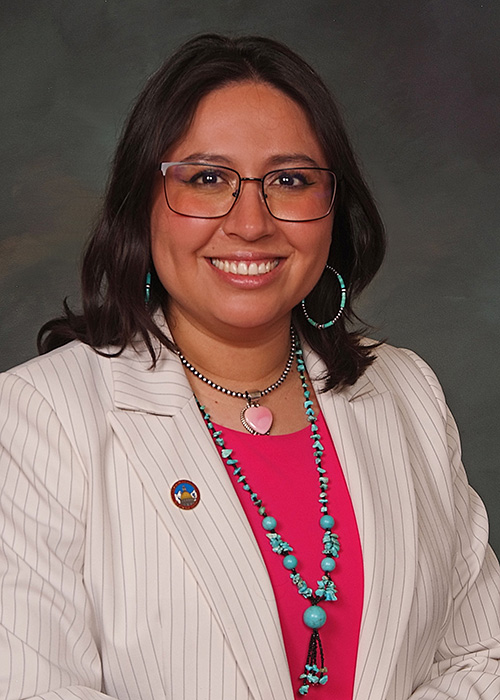
Rep. Elizabeth Velasco
Sponsored bills
Section 1 of the bill authorizes an individual to move from one corner of public land to another corner of public land where 2 public parcels meet 2 private parcels and share a common border, without being liable for criminal or civil trespass, if: 2 parcels of public land touch so that the individual can reasonably step from one parcel of public land to the other parcel of public land, or if there's a fence, could make the step as if there were not a fence; The individual moves over private land only as much as necessary to cross from one parcel of public land to the other; The individual does not step on or stand on the privately owned land or touch a fence on or other improvement to the privately owned land, but the individual may use mechanical means to move over the privately owned land; and The individual does not use a vehicle other than a wheelchair to cross over the private land. This authorization does not apply to the following: Moving over an improvement to public land that is designed to be occupied by individuals; Entering public land to use it in a way that violates the law; Moving over public land that the governing entity has prohibited the general public from entering or has controlled access to. Section 1 also prohibits a landowner from erecting an improvement to such a corner that is more than 54 inches high within 4 feet of the corner. Section 2 requires a court to dismiss a trespass tort if the defendant has complied with section 1. A successful defendant is awarded costs, including attorney fees. Section 3 instructs the parks and wildlife commission to promulgate rules codifying the actions allowed in section 1. The division of parks and wildlife will publicize the rules.(Note: This summary applies to this bill as introduced.)
The act adopts federal regulations concerning the "Indian Child Welfare Act of 1978" as state law so that Colorado will continue to ensure that Indian children are protected in cases of guardianship and adoption. APPROVED by Governor May 4, 2023 EFFECTIVE May 4, 2023(Note: This summary applies to this bill as enacted.)
The act requires a public school or school district to allow a qualified student to wear and display traditional Native American regalia at a school graduation ceremony and applies to pre-kindergarten, kindergarten, primary school, and secondary school graduation ceremonies. The act requires public colleges and universities to allow a qualified student to wear and display traditional Native American regalia at a college graduation ceremony. APPROVED by Governor May 4, 2023 EFFECTIVE May 4, 2023 (Note: This summary applies to this bill as enacted.)
The bill repeals statutory provisions prohibiting counties and municipalities from enacting any ordinance or resolution that would control rent on private residential property or a private residential housing unit (rent control) and sets the following guidelines for the enactment of rent control: Rent control must be uniformly applied among all renters that are similarly situated; Rent control must be uniformly applied among all private residential properties and private residential housing units that are similarly situated; except that: For 15 years from the date on which the first certificate of occupancy was issued, no rent control may be applied; Rent control may be applied to a mobile home or mobile home park regardless of the date the mobile home or mobile home park was built or the date a certificate of occupancy was issued; and No rent control may be applied to housing units provided by nonprofit organizations and regulated by fair market rents published by the United States department of housing and urban development or any other similar federal or state program; and Rent control that limits the amount of an annual rent increase must not impose a limit less than the percentage increase in the consumer price index plus three percentage points plus reasonable increases reflective of the actual costs of substantial renovations. Regardless of the first two of these guidelines, the bill permits a local government to have or adopt an ordinance or regulation that is expressly intended and designed to increase the supply of affordable housing. The bill also makes a conforming amendment. (Note: Italicized words indicate new material added to the original summary; dashes through words indicate deletions from the original summary.) (Note: This summary applies to the reengrossed version of this bill as introduced in the second house.)
Current law allows insurance policies to be translated to and issued in a language other than English if the insurer certifies that the English-language policy that is translated complies with state insurance laws. Section 1 of the act requires the insurer to also certify that the policy has been correctly translated by a certified translator or, if a certified translator is not available to translate the policy to the particular language, by a qualified translator who certifies that the translation is correct. Section 2 requires insurers that issue commercial or personal automobile, homeowners', or renters' insurance policies to offer, make available, and issue the policy application, the policy, and related documents and forms in the same language that the insurer used in advertisements for the policy and to offer an applicant a form to select the applicant's language of choice for those documents. Section 2 also specifies remedies for an insurer's failure to comply with this requirement. APPROVED by Governor April 11, 2023 EFFECTIVE January 1, 2024 NOTE: This act was passed without a safety clause. (Note: This summary applies to this bill as enacted.)
During disaster emergencies, the state uses incident management teams to provide on-scene incident management support during incidents or events that exceed a local jurisdiction's capability or capacity. Some of these incident management teams are staffed by civil defense workers. Under current law, certain civil defense workers are not eligible to be compensated for their response. The act removes this limitation and allows those civil defense workers to be compensated for their response. APPROVED by Governor March 17, 2023 EFFECTIVE March 17, 2023 (Note: This summary applies to this bill as enacted.)