The bill allows a board of county commissioners to adopt an ordinance or resolution to: Regulate the distribution of cigarettes, tobacco products, or nicotine products; and Prohibit the distribution or retail sale of cigarettes, tobacco products, or nicotine products, including prohibiting the sale of any or all flavored cigarettes, flavored tobacco products, or flavored nicotine products. (Note: Italicized words indicate new material added to the original summary; dashes through words indicate deletions from the original summary.) (Note: This summary applies to the reengrossed version of this bill as introduced in the second house.)
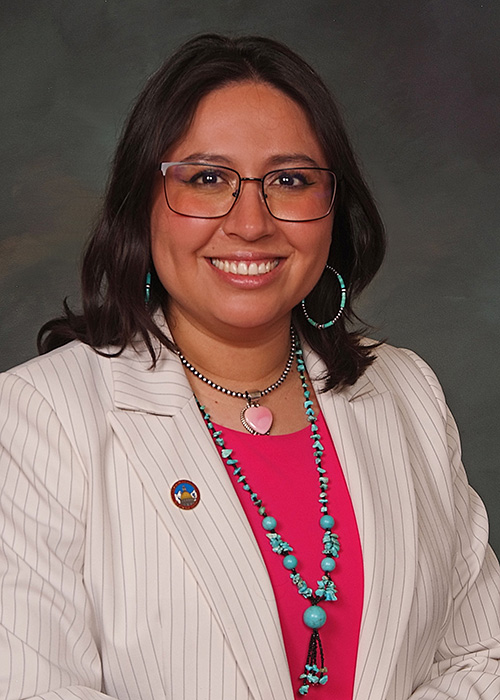
Rep. Elizabeth Velasco
Sponsored bills
The bill allows a preschool, public school, or public college or university student to wear and display religious or cultural regalia at a graduation ceremony. The bill prohibits a preschool, school, or public college or university from restricting what a student may wear under the student's required graduation attire. The bill allows a preschool, school, or public college or university to prohibit a student from wearing or displaying an item that is likely to cause substantial disruption of, or material interference with, a graduation ceremony, but the prohibition must be the least restrictive means necessary to accomplish a specifically identified important government interest. Prior to the start of the 2024-25 school year, the bill requires a preschool, school, and public college or university to develop and adopt a policy that aligns with the requirements of this bill. (Note: This summary applies to this bill as introduced.)
Wildfire Matters Review Committee. The bill directs the board of governors of the Colorado state university system (board) to conduct, or cause to be conducted, a comprehensive study on biochar, including its use in wildfire mitigation efforts. The bill specifies minimum topics that the study must include. The board is required to submit a report on the findings of the study to specified committees of the general assembly.(Note: This summary applies to this bill as introduced.)
The act moves the regional health connector program (program) from the university of Colorado school of medicine to the prevention services division (division) in the department of public health and environment (department). The act requires the division to administer the program and requires the department to contract with a third-party entity to coordinate and oversee the program. The contracted entity is required to distribute money to each locally based host organization, which hires and supports a regional health connector to engage in program activities. For the 2023-24 state fiscal year, the act appropriates $1.5 million to the department of higher education for use by the regents of the university of Colorado for allocation to the school of medicine and $71,903 to the department for use by the division for the program. For the 2024-25 state fiscal year, the act annually appropriates $1.5 million to the division for the program. APPROVED by Governor June 7, 2023 EFFECTIVE August 7, 2023 NOTE: This act was passed without a safety clause and takes effect 90 days after sine die. (Note: This summary applies to this bill as enacted.)
The act requires the state treasurer to transfer $95,000 from the general fund to the natural disaster mitigation cash fund to defray expenses incurred by the natural disaster mitigation enterprise (enterprise) before the enterprise receives fee revenue or revenue bond proceeds. The transfer is a loan from the state treasurer to the enterprise that is required to be repaid and is not a grant for purposes of the state constitution or any other state law. The enterprise is required to repay the loan and accumulated interest by December 31, 2025. APPROVED by Governor June 6, 2023 EFFECTIVE June 6, 2023 (Note: This summary applies to this bill as enacted.)
The act creates a water testing program for mobile home parks (parks). The testing program is developed and administered by the water quality control division (division) in the department of public health and environment (department). The act also sets testing prioritization criteria and testing standards. Within 10 days after receiving test results, the division will notify the following of the test results and, if the testing reveals a water quality issue, include information about the availability of the complete test results, any violation of water quality standards, recommended actions, remediation, and the grant program established in the act: The park owner; The county department of health where the park is located; The municipality where the park is located, if any; The division of housing in the department of local affairs; The water supplier; and The environmental justice ombudsperson (ombudsperson). Upon receiving the notice, the park owner must: Notify the park residents within 5 days in the language chosen by the residents; Comply with orders of the division; and Not impose the cost of compliance on park residents. Within 120 days after receiving the notice, the park owner must prepare and submit to the division a remediation plan. The park owner must complete the remediation plan based on a schedule approved by the division, consult with the division, and provide a reasonable and sufficient amount of accessible drinking water or department-approved filters to park residents if necessary to address acute health risks. The division will coordinate with the division of housing in the department of local affairs to identify potential money, including grant money from the grant program created in the act, to support park water quality remediation. The division will develop an action plan to address and improve water quality in parks. Standards are established for the action plan and the development of the action plan. The act creates a grant program to help park owners, nonprofit entities, and local governments address water quality issues in parks. Standards are set for obtaining and spending grants. The division will implement and administer the grant program. The general assembly will annually appropriate money to the department to fund the grant program. The act is enforced by the attorney general and the division, which may issue cease-and-desist orders. The attorney general may request a temporary restraining order, preliminary injunction, permanent injunction, or any other relief necessary to protect the public health, water quality, or environment. The act establishes that: The division may impose a civil penalty of up to $10,000 plus an additional $5,000 per full calendar month the violation continues; A park owner that fails to register under the "Mobile Home Park Act Dispute Resolution and Enforcement Program" violates the "Colorado Consumer Protection Act"; Retaliation against a tenant for making a complaint is prohibited; and A person may bring a civil action under the "Mobile Home Park Act". Civil penalties are deposited in the mobile home park water quality fund to be used to provide grants through the grant program and for the division to administer and enforce the act. The ombudsperson is given the duty to represent park residents in matters of water quality. The act adds water quality issues to the database created by the "Mobile Home Park Act Dispute Resolution and Enforcement Program", which tracks complaints filed against parks. To implement the act, $3,611,859 is appropriated from the general fund to the mobile home park water quality fund, of which $3,407,448 is reappropriated to the department for administration, personal services, and the purchase of legal services, and $136,885 is appropriated from the general fund to the mobile home park act dispute resolution and enforcement program fund for use by the department of local affairs. APPROVED by Governor June 5, 2023 EFFECTIVE June 5, 2023 (Note: This summary applies to this bill as enacted.)

The act requires the office of liaison for missing and murdered Indigenous relatives (office) in the department of public safety (department) to: Conduct case reviews of violent or exploitative crimes against an Indigenous person and publish a report about the case reviews annually; Communicate with relevant department divisions regarding investigations in cases involving missing or murdered Indigenous relatives; Seek a position for a representative of the Indigenous community on the sentencing reform task force of the Colorado commission on criminal and juvenile justice; Collaborate with Indigenous-led organizations and the Colorado district attorneys' council (CDAC) to assist CDAC in developing and providing training for victim advocates who work on missing or murdered Indigenous relatives cases; and Designate one employee of the office to serve as a point of contact for families in need of support regarding ongoing or completed missing or murdered Indigenous relatives cases. Office personnel may inspect relevant criminal justice records and medical, coroner, and laboratory records in the custody of state or local agencies that are necessary for the office to perform its duties. The office may seek, accept, and expend gifts, grants, or donations in order to carry out the office's duties and to provide financial support to missing or murdered Indigenous relatives' families. The act requires the community volunteer advisory board within the office (advisory board) to prepare an annual report that includes a summary of the advisory board's work during the prior year and issues related to the office's work. The advisory board is required to submit its report to the judiciary and state affairs committees of the house of representatives and the senate. The state's fusion center in the office of prevention and security within the department shall create a dedicated phone line for missing or murdered Indigenous relatives that operates 24 hours a day, 7 days a week, and connects callers with the appropriate contact at the office or the Colorado bureau of investigation. The act appropriates $191,973 from the general fund to the department of public safety for administrative services and expenses related to the division of homeland security and emergency management and $170,601 from the general fund to the judicial department for information technology infrastructure. APPROVED by Governor June 2, 2023 EFFECTIVE June 2, 2023(Note: This summary applies to this bill as enacted.)

The act creates the "Born to Be Wild" special license plates for certain motorcycles, passenger cars, trucks, or noncommercial or recreational motor vehicles. An applicant qualifies for the issuance of the special license plates if the applicant pays the following fees to the department: A one-time $25 fee that is credited to the highway users tax fund; An annual $50 fee that is credited to the wildlife cash fund in the division of parks and wildlife; and A one-time $25 fee that is credited to the Colorado DRIVES vehicle services account. The division of parks and wildlife is directed to use the money collected and credited to the wildlife cash fund for implementing nonlethal means of mitigating and preventing conflict with gray wolves and promoting the license plate. To implement this act, $99,642 is appropriated to the department of revenue for use by the division of motor vehicles. This appropriation consists of $11,054 from the Colorado DRIVES vehicle services account in the highway users tax fund and $88,588 from the license plate cash fund. APPROVED by Governor May 20, 2023 EFFECTIVE August 7, 2023 NOTE: This act was passed without a safety clause and takes effect 90 days after sine die. (Note: This summary applies to this bill as enacted.)
The act establishes a wildfire resiliency code board (board) in the division of fire prevention and control (division) within the department of public safety (department) for the purposes of ensuring community safety from and more resiliency to wildfires by reducing the risk of wildfires to people and property through the adoption of statewide codes and standards. The board consists of 21 appointed voting members with specific government or industry qualifications and 3 non-voting members. The board is required to promulgate rules concerning the adoption of codes and standards for the hardening of structures and reducing fire risk in the defensible space surrounding structures in the wildland-urban interface in Colorado, including rules that: Define the wildland-urban interface and identify areas of the state that are within it; Adopt minimum codes and standards based on best practices to reduce the risk to life and property from the effects of wildfires; Identify hazards and types of buildings, entities, and defensible space around structures to which the codes apply; and Establish a process for a governing body to petition the board for a modification to the codes and establish the criteria and process for the board to grant or deny an appeal from a decision of the board on a petition for modification. The act also creates the wildfire resiliency code board cash fund (cash fund) and, subject to annual appropriation by the general assembly, the department shall use money in the fund to implement the provisions of the act. The state treasurer is required to transfer $250,000 from the general fund to the cash fund on July 1, 2023. The act requires a governing body with jurisdiction in an area within the wildland-urban interface that has the authority to adopt building codes or fire codes to adopt and enforce a code that meets or exceeds the minimum standards of the codes adopted by the board within 3 months of the date the board adopts its codes. Enforcement of the governing body's adopted codes is done in accordance with the rules and regulations for code enforcement adopted by the governing body and the period to comply with a governing body's adopted codes must be in accordance with the governing body's rules and regulations or within 3 months of adoption, whichever is sooner. If the governing body does not have rules and regulations for code enforcement, the governing body may request support from the division to enforce the code. For the 2023-24 state fiscal year, the act appropriates $9,302 from the general fund to the cash fund and reappropriates the money to the department of public safety for use by the division for the board and for vehicle lease payments. An additional $250,000 is appropriated to the department for use by the division from the cash fund for the board. APPROVED by Governor May 12, 2023 EFFECTIVE May 12, 2023 (Note: This summary applies to this bill as enacted.)