

Existing law authorizes the establishment of the San Diego Unified Port District for the acquisition, construction, maintenance, operation, development, and regulation of harbor works and improvements for the harbor of San Diego and for the promotion of commerce, navigation, fisheries, and recreation. Existing law establishes the board of commissioners of the port district, which is required to draft a master plan for harbor and port improvement and for the use of all the tidelands and submerged lands under the port district's jurisdiction. This bill would require the board, in implementing the master plan, to include funding for cooperative infrastructure and capital projects that directly address maritime industrial impacts by the port in cities that host maritime terminals, as specified. In addition to that funding, this bill would require the board to dedicate 1% of the port's revenue, as specified, for those cooperative infrastructure and capital projects. This bill would also require the board to dedicate 1% of the port district's rental income, as specified, to converting industrial properties in disadvantaged communities, as defined, within the district to open space. By requiring the board to provide this funding, this bill would impose a state-mandated local program. The California Constitution requires the state to reimburse local agencies and school districts for certain costs mandated by the state. Statutory provisions establish procedures for making that reimbursement. This bill would provide that, if the Commission on State Mandates determines that the bill contains costs mandated by the state, reimbursement for those costs shall be made pursuant to the statutory provisions noted above.
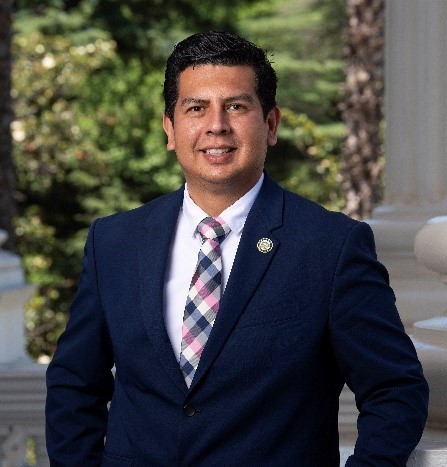
Asm. David Alvarez
Sponsored bills
Existing law prescribes the duties of the State Registrar of Vital Statistics (State Registrar) and local registrars of births and deaths with respect to the registration of certificates of live birth, fetal death, or death, and marriage licenses. Existing law requires the State Registrar to prescribe and furnish all record forms for use in carrying out the provisions governing vital records and prohibits the use of any record form or format other than those prescribed by the State Registrar. Existing law requires every live birth, fetal death, death, and marriage that occurs in the state to be registered with the local registrar. Existing law requires certificates of live birth, fetal death, or death, and a marriage license to include specified information, such as the full name of the child on a certificate of live birth and the full names of the parties to be married on a marriage license. Existing law also requires the county clerk to issue a confidential marriage license, as specified, on a form prescribed by the State Registrar. This bill would require the State Registrar to require the use of a diacritical mark on an English letter to be properly recorded, when applicable, on a certificate of live birth, fetal death, death, marriage license and certificate, or confidential marriage license and certificate, and would require the use of a diacritical mark to be deemed an acceptable entry by the State Registrar. The bill would provide that the absence of a diacritical mark on a certificate of live birth, fetal death, or death, or a marriage license does not render the document invalid nor affect any constructive notice imparted by proper recordation of the document. The bill would authorize, if a name is not accurately recorded because of the absence of a diacritical mark on an English letter in any certificate of live birth, fetal death, death, or marriage already registered, the person asserting the omission, or the person's conservator, or if a minor, the person's parent or guardian, to submit a written request to the State Registrar for the issuance of a new certificate of birth, fetal death, death, or marriage stating the changes necessary to make the name correct. The bill would require the State Registrar to review the request and, if the request is accompanied with the payment of a specified fee, to issue a new certificate of live birth, fetal death, death, or marriage with the accurate name identified in the request. The bill would also authorize, if a name is not accurately recorded because of the absence of a diacritical mark on an English letter on any confidential license and certificate of marriage already registered, the party asserting the omission to make an affidavit, under oath, stating the changes necessary to make the record correct and file it with the county clerk. The bill would require the county clerk to review the amendment for acceptance for filing, and if accepted, file the amendment and note the fact of the amendment, with its date, on the otherwise unaltered original confidential license and certificate of marriage. By requiring the affidavit to be under oath, the bill would expand the crime of perjury, thereby imposing a state-mandated local program. By increasing duties on county clerks, the bill would impose a state-mandated local program. The California Constitution requires the state to reimburse local agencies and school districts for certain costs mandated by the state. Statutory provisions establish procedures for making that reimbursement. This bill would provide that with regard to certain mandates no reimbursement is required by this act for a specified reason. With regard to any other mandates, this bill would provide that, if the Commission on State Mandates determines that the bill contains costs so mandated by the state, reimbursement for those costs shall be made pursuant to the statutory provisions noted above.
Existing law requires the State Energy Resources Conservation and Development Commission (Energy Commission) to undertake various actions in furtherance of meeting the state's clean energy and pollution reduction objectives, including actions related to electric vehicles. Existing law requires the Energy Commission, in consultation with the State Air Resources Board (state board) and the Public Utilities Commission (PUC) , to prepare a statewide assessment of fuel cell electric vehicle fueling infrastructure and fuel production needed to support the adoption of zero-emission trucks, buses, and off-road vehicles at levels necessary for the state to meet the goals and requirements of Executive Order No. N-79-20 and any state board regulatory action that requires or allows zero-emission vehicles in the heavy-duty vehicle and off-road sectors. Existing law also requires the Energy Commission, working with the state board and the PUC, to prepare a statewide assessment of the electric vehicle charging infrastructure needed to support the levels of electric vehicle adoption required for the state to meet its goals of putting at least 5,000,000 zero-emission vehicles on California roads by 2030, and of reducing emissions of greenhouse gases to 40% below 1990 levels by 2030. This bill would require the assessment of the fuel cell electric vehicle fueling infrastructure and fuel production to additionally include an assessment of storage and transport facilities, and the assessment of the electric vehicle charging infrastructure to additionally include electric system infrastructure and electric generation. The bill would expand the scope of the latter assessment to include the electric vehicle charging infrastructure, electric system infrastructure, and electric generation needed for the state to meet the goals of Executive Order No. N-79-20 and any state board regulatory action that requires or allows zero-emission vehicles in the heavy-duty vehicle and off-road sectors. The bill would require both assessments to identify any barriers to the deployment of hydrogen infrastructure and any barriers to the deployment of electric infrastructure, respectively, for medium- and heavy-duty fleets and recommendations for addressing those barriers. The bill would require the Energy Commission to publish a determination regarding the adequacy of completed or planned charging or fueling sites for the 5 years following the completion of the initial statewide assessment and the findings of the electric vehicle charging infrastructure assessment, as provided. The bill would also require the Energy Commission to identify any charging or fueling site deficiencies and categorize those deficiencies by refueling speed and by type of facility, as either a public facility or a private facility. The bill would require the Energy Commission to update the electric vehicle charging infrastructure assessment and the determination at least once every 2 years. The California Global Warming Solutions Act of 2006 designates the state board as the state agency charged with monitoring and regulating sources of emissions of greenhouse gases. Existing law requires the state board, at least every 5 years, as provided, in consultation with the Department of Transportation, the Energy Commission, and the Governor's Office of Business and Economic Development and in collaboration with relevant stakeholders, to update the state board's 2016 mobile source strategy to include a comprehensive strategy for the deployment of medium-duty and heavy-duty vehicles in the state for the purpose of bringing the state into compliance with federal ambient air quality standards and reducing motor vehicle greenhouse gas emissions from the medium-duty and heavy-duty vehicle sector. Existing law requires the state board to recommend reasonable and achievable goals for reducing emissions from medium-duty and heavy-duty vehicles by 2030 and 2050, respectively, as part of the comprehensive strategy based on factors that include specified goals. This bill would require those goals to include the goals established in Executive Order No. N-79-20 for the transition of medium- and heavy-duty fleets to zero-emission vehicles. The bill would also require the state board's updates to the mobile source strategy to include a strategic plan to meet the deadlines in Executive Order No. N-79-20 and would also require the state board, in developing the comprehensive strategy, to incorporate the findings of the above-described assessments.
Existing law requires the State Department of Public Health to license and regulate skilled nursing facilities (SNFs) and intermediate care facilities (ICFs) . Existing law requires the State Department of Social Services to license and regulate residential care facilities for the elderly (RCFEs) . A violation of those licensing provisions is generally a crime. Existing law prohibits those facilities from prohibiting the formation of a family council, which is a meeting of family members, friends, or representatives of 2 or more residents to confer in private without facility staff. Existing law prohibits those facilities from willfully interfering with the formation, maintenance, or promotion of a family council, as specified. This bill would make changes to the definition and scope of prohibited interference. Existing law sets forth various requirements on facilities relating to a family council with regard to providing a designated staff person, providing adequate posting and meeting space for the family council, and responding to written requests, concerns, or recommendations within specified timeframes. For SNFs and ICFs, this bill would require that the designated staff person be approved by the family council, as specified. The bill would require that the family council be allowed to meet virtually or at an offsite location at its discretion. If a family council submits written requests, concerns, or recommendations, the bill would require the facility to respond in writing regarding any action or inaction within 14 calendar days, as specified. Existing law authorizes staff or visitors to attend family council meetings, at the group's invitation. This bill would instead authorize facility staff to attend meetings only at the invitation of the family council. Existing law requires a facility to inform family members or representatives of the existence of the family council, if applicable. This bill would also require the facility to inform friends identified in certain materials and to provide the name and contact information of the family council representative prior to or within 5 business days after the resident's admission. The bill would make certain other related changes. The bill would, for SNFs and ICFs, to the extent not in conflict with state and federal law, require a facility to inform the identified family members, friends, and representatives of their right to have their contact information shared with the family council. The bill would, for RCFEs, require a facility to inform the identified family members, friends, and representatives of their right to have their contact information shared with the family council and of their right to consent or withhold consent to their contact information being shared. If an RCFE does not have a family council, existing law requires the facility to provide written information to a newly admitted resident's family or representative of their right to form a family council. This bill would also add a resident's friends as recipients of that information, and would apply those provisions to SNFs and ICFs, as specified. Under existing law, a violation of the family council-related provisions is subject to specified civil penalties. In the case of RCFEs, existing law exempts a violation of those provisions from the above-described criminal penalty. This bill would also specify that, in the case of SNFs and ICFs, a violation of those provisions is exempt from the above-described criminal penalty.
Existing law prohibits a local authority from enacting or enforcing an ordinance on matters covered by the Vehicle Code unless expressly authorized by the Vehicle Code. Existing law authorizes local authorities to adopt rules and regulations by ordinance or resolution regarding specified matters, including, among others, crossing guards, the operation of bicycles, the removal of illegally parked vehicles, and cruising, as defined. This bill would remove the authorization for a local authority to adopt rules and regulations by ordinance or regulation regarding cruising. Existing law makes it unlawful to operate a passenger vehicle, or commercial vehicle under 6,000 pounds, that has been modified from its original design so that any portion of the vehicle, other than the wheels, has less clearance from the surface of a level roadway than the clearance between the roadway and the lowermost portion of any rim of any wheel in contact with the roadway. This bill would repeal that prohibition. This bill would incorporate additional changes to Section 21100 of the Vehicle Code proposed by AB 825 and SB 50 to be operative only if this bill and AB 825, this bill and SB 50, or this bill, AB 825, and SB 50 are enacted and this bill is enacted last.
(1) Existing law establishes the California Community Colleges, under the administration of the Board of Governors of the California Community Colleges, as one of the segments of public postsecondary education in this state. Existing law establishes community college districts throughout the state and authorizes them to operate campuses and provide instruction to students. Existing law authorizes community college districts to admit nonresident students, and requires that nonresident students be charged a nonresident tuition fee unless an exemption applies. Existing law includes among these exemptions any nonresident who is both a citizen and resident of a foreign country if the nonresident has demonstrated a financial need, as specified. Existing law authorizes the attendance of certain exempted, nonresident students to be reported as resident full-time equivalent students (FTES) for state apportionment purposes. This bill would additionally exempt from the nonresident tuition fee a nonresident, low-income student who: (1) is a resident of Mexico, (2) registers for lower division courses at Cuyamaca College, Grossmont College, Imperial Valley College, MiraCosta College, Palomar College, San Diego City College, San Diego Mesa College, San Diego Miramar College, or Southwestern College, and (3) has residence within 45 miles of the California-Mexico border, as provided. The bill would, in any academic year, prohibit more than 150 FTES at each of these community colleges from being exempted from payment of the nonresident tuition fee. The bill would require the governing boards of the community colleges that choose to use this exemption to adopt one uniform policy to determine a student's residence classification, establish procedures for an appeal and review of the residence classification, and determine whether a student is low income. The bill also would require the governing boards of the community colleges that choose to use this exemption, as a condition of its students receiving the exemption described above, to collaborate with each other to ensure the adoption of the uniform policy. The bill would additionally authorize the attendance of nonresident students who receive this exemption to be reported as resident FTES for state apportionment purposes, as specified. The bill would provide that a nonresident student exempted under the above-mentioned exemption is not exempted pursuant to the existing provision involving any nonresident who is both a citizen and resident of a foreign country. The bill would require the governing boards of the community colleges that choose to use this exemption, on or before January 1, 2028, to jointly submit a report to the Legislature that includes, but is not limited to, the demographics, attendance rate, and class completion rate of nonresident students who receive the exemption described above. The bill's provisions would become inoperative on July 1, 2028, and would be repealed on January 1, 2029, as specified. The bill would also make related findings and declarations. (2) This bill would make legislative findings and declarations as to the necessity of a special statute for Cuyamaca College, Grossmont College, Imperial Valley College, MiraCosta College, Palomar College, San Diego City College, San Diego Mesa College, San Diego Miramar College, and Southwestern College. (3) This bill would not become operative unless the Board of Governors of the California Community Colleges enters into an attendance agreement that provides reciprocal rights to California residents attending a university in the State of Baja California that reasonably conforms to the benefits conferred upon residents of Mexico pursuant to certain provisions of the bill, as provided.
The California Environmental Quality Act (CEQA) requires a lead agency, as defined, to prepare, or cause to be prepared, and certify the completion of an environmental impact report on a project that it proposes to carry out or approve that may have a significant effect on the environment or to adopt a negative declaration if it finds that the project will not have that effect. CEQA also requires a lead agency to prepare a mitigated negative declaration for a project that may have a significant effect on the environment if revisions in the project would avoid or mitigate that effect and there is no substantial evidence that the project, as revised, would have a significant effect on the environment. CEQA authorizes the lead agency, if the lead agency determines that a project is exempt from CEQA, to file a notice of exemption with the Office of Planning and Research or the county clerk of each county in which the project is located. This bill would, until January 1, 2033, exempt from CEQA certain actions taken by a public agency related to affordable housing projects, as defined, if certain requirements are met. The bill would require the lead agency, if the lead agency determines an action related to an affordable housing project is exempt from CEQA under this provision and approves or carries out the project, to file a notice of exemption with the Office of Planning and Research and the county clerk of each county in which the project is located. By increasing the duties of a lead agency, this bill would impose a state-mandated local program. The California Constitution requires the state to reimburse local agencies and school districts for certain costs mandated by the state. Statutory provisions establish procedures for making that reimbursement. This bill would provide that no reimbursement is required by this act for a specified reason.
The Planning and Zoning Law requires each county and city to adopt a comprehensive, long-term general plan for its physical development, and the development of certain lands outside its boundaries, that includes, among other mandatory elements, a housing element. That law allows a development proponent to submit an application for a development that is subject to a specified streamlined, ministerial approval process not subject to a conditional use permit, if the development satisfies certain objective planning standards. Existing law, the Zenovich-Moscone-Chacon Housing and Home Finance Act, establishes the California Tax Credit Allocation Committee within the Department of Housing and Community Development. Existing law requires the committee to allocate state low-income housing tax credits in conformity with state and federal law that establishes a maximum rent that may be charged to a tenant for a project unit constructed using low-income housing tax credits. This bill would require that a housing development project be a use by right upon the request of an applicant who submits an application for streamlined approval, on any land owned by an independent institution of higher education or religious institution on or before January 1, 2024, if the development satisfies specified criteria, including that the development is not adjoined to any site where more than one-third of the square footage on the site is dedicated to industrial use. The bill would define various terms for these purposes. Among other things, the bill would require that 100% of the units, exclusive of manager units, in a housing development project eligible for approval as a use by right under these provisions be affordable to lower income households, except that 20% of the units may be for moderate-income households, and 5% of the units may be for staff of the independent institution of higher education or the religious institution that owns the land, provided that the units affordable to lower income households are offered at affordable rent, as set in an amount consistent with the rent limits established by the California Tax Credit Allocation Committee, or affordable housing cost, as specified. The bill would authorize the development to include ancillary uses on the ground floor of the development, as specified. This bill would specify that a housing development project that is eligible for approval as a use by right under the bill is also eligible for a density bonus, incentives, or concessions, or waivers or reductions of development and parking standards, except as specified. The bill would require a development subject to these provisions to provide off-street parking of up to one space per unit, unless a state law or local ordinance provides for a lower standard of parking, in which case the law or ordinance applies. The bill would prohibit a local government from imposing any parking requirement on a development subject to these provisions if the development is located within one-half mile walking distance of public transit, either a high-quality transit corridor or a major transit stop, as those terms are defined, or it is within one block of a car share vehicle. This bill would require a local government that determines a proposed development is in conflict with any objective planning standards, as specified, to provide the developer with written documentation explaining those conflicts under a specified timeframe. The bill would provide that the development shall be deemed to satisfy the required objective planning standards if the local government fails to provide the requisite documentation explaining any conflicts. The bill would authorize a local government to conduct a design review, as described, only if the design review focuses on compliance with the requisite criteria of a streamlined, ministerial review process. The bill would prohibit a local government from using a design review, as specified, from inhibiting, chilling, or precluding a streamlined, ministerial approval. The bill would require a local government to issue a subsequent permit for developments approved under the provisions of this act. The bill would include findings that changes proposed by this bill address a matter of statewide concern rather than a municipal affair and, therefore, apply to all cities, including charter cities. The California Environmental Quality Act (CEQA) requires a lead agency, as defined, to prepare, or cause to be prepared, and certify the completion of, an environmental impact report on a project that it proposes to carry out or approve that may have a significant effect on the environment or to adopt a negative declaration if it finds that the project will not have that effect. CEQA does not apply to the ministerial approval of projects. This bill, by requiring approval of certain development projects as a use by right, would expand the exemption for ministerial approval of projects under CEQA. The bill would repeal its provisions as of January 1, 2036. By adding to the duties of local planning officials with respect to approving certain development projects, this bill would impose a state-mandated local program. The California Constitution requires the state to reimburse local agencies and school districts for certain costs mandated by the state. Statutory provisions establish procedures for making that reimbursement. This bill would provide that no reimbursement is required by this act for a specified reason.