

Existing law, referred to as the Density Bonus Law, requires a city or county to provide a developer that proposes a housing development within the city or county with a density bonus and other concessions or incentives or concessions, as specified, if the developer agrees to construct specified percentages of units for lower income households or very low income households, and meets other requirements. Existing law defines the term "density bonus" for these purposes to mean a density increase over the otherwise maximum allowable gross residential density as of the date of the application, as described. Existing law defines the term "maximum allowable residential density" for these purposes to mean the maximum number of units allowed under the zoning ordinance, specific plan, or land use element of the general plan, or, if a range of density is permitted, the maximum number of units allowed by the specific zoning range, specific plan, or land use element of the general plan applicable to the project. Existing law provides under that definition that if the density allowed under the zoning ordinance is inconsistent with the density allowed under the land use element of the general plan or specific plan, the greater density prevails. This bill would instead define "maximum allowable residential density" to mean the greatest number of units allowed under the zoning ordinance, specific plan, or land use element of the general plan, or, if a range of density is permitted, the greatest number of units allowed by the specific zoning range, specific plan, or land use element of the general plan applicable to the project. The bill would also remove from that definition the provision stating that the greater density prevails if the density allowed under the zoning ordinance is inconsistent with the density allowed under the land use element of the general plan or specific plan. This bill would require a city, county, or city and county to grant an additional density bonus, calculated as specified, when (1) an applicant proposes to construct a housing development that conforms to specified requirements, (2) the applicant agrees to include additional rental or for-sale units affordable to very low income households or moderate-income households, as specified, and (3) the housing development conforms to specified requirements and provides 24% of the total units to lower income households, conforms to specified requirements and provides 15% of the total units to very low income households, or conforms to specified requirements and provides 44% of the total units to moderate-income units. The bill would require a city, county, or city and county to grant four incentives or concessions for a project that includes at least 16% of the units for very low income households or at least 45% for persons and families of moderate income in a development in which the units are for sale. The bill would increase the incentives or concessions for a project in which 100% of all units are for lower income households, as specified, from 4 to 5. The Density Bonus Law prohibits a local government from conditioning the submission, review, or approval of an application pursuant to the Density Bonus Law on the preparation of an additional report or study that is not otherwise required by state law, but provides that this provision does not prohibit a local government from requiring an applicant to provide reasonable documentation to establish eligibility for a requested density bonus, incentives or concessions, waivers or reductions of development standards, and parking ratios, as specified. This bill would instead provide that this provision does not prohibit a local government from requiring an applicant to provide reasonable documentation to establish eligibility for a requested density bonus and parking ratios, as specified. The California Constitution requires the state to reimburse local agencies and school districts for certain costs mandated by the state. Statutory provisions establish procedures for making that reimbursement. This bill would provide that no reimbursement is required by this act for a specified reason. This bill would incorporate additional changes to Section 65915 of the Government Code proposed by AB 323 and SB 713 to be operative only if this bill and either or both of those bills are enacted and this bill is enacted last.
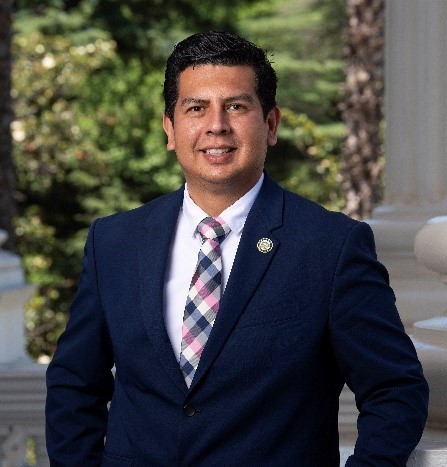
Asm. David Alvarez
Sponsored bills
Existing law establishes the California State University, under the administration of the Trustees of the California State University, and the University of California, under the administration of the Regents of the University of California, as 2 of the segments of public postsecondary education in this state. Existing law provides for the missions and functions of these segments, and states that the University of California has the sole authority in public higher education to award doctoral degrees in all fields of learning, except that it may agree with the California State University to award joint doctoral degrees in selected fields. However, existing law authorizes the California State University to offer doctoral programs in education, audiology, physical therapy, occupational therapy, and public health without that agreement. This bill would authorize the California State University to award professional or applied doctoral degrees statewide that do not duplicate University of California doctoral degrees and satisfy certain requirements. The bill would require a California State University campus seeking authorization to offer a professional or applied doctoral degree program pursuant to the bill to submit specified information on the proposed doctoral degree for review by the office of the Chancellor of the California State University, and approval by the trustees, as provided. The bill would authorize professional or applied doctoral degree programs that are approved for implementation by the trustees pursuant to the bill to be implemented at any California State University campus, but would limit the number of doctoral degree programs that may be offered at a California State University campus. The bill would prohibit the trustees from approving more than 10 new doctoral degree disciplines pursuant to the bill per academic year. The bill would require the Legislative Analyst's Office to conduct a systemwide evaluation of doctoral degree programs established pursuant to the bill and report the results of the evaluation to the Legislature and the Governor on or before December 31, 2028.
Existing law authorizes the governing board of a school district to provide a comprehensive educational counseling program for all pupils enrolled in the school district. Existing law provides that educational counseling may include counseling in developing pupil knowledge of financial aid planning for postsecondary education, including, among others, financial aid programs and resources for foster and homeless youth. This bill would establish the Dream Resource Center Grant Program for the purpose of providing pupils, including undocumented pupils, in grades 9 to 12, inclusive, with specified resources. The bill would require the State Department of Education, in administering the program, to review applications and award grants based off of a tiered point system that prioritizes applications for funding, as provided. The bill would authorize a school district, county office of education, or charter school, including those that have already established a Dream Resource Center at one or more schoolsites, to apply to the department to be eligible to receive a grant, as provided. The bill would require a local educational agency that receives a grant under the program to use it for creating a Dream Resource Center or for supplementing, but not supplanting, an existing Dream Resource Center, as provided. The bill would require the department, on or before June 1, 2026, to submit a report to the appropriate policy committees of the Legislature detailing the successes, best practices, barriers or constraints, and outcomes of Dream Resource Centers funded with these grants. The bill would condition the implementation of these provisions on an appropriation by the Legislature for these purposes in the annual Budget Act or other statute.
(1) The Trial Court Interpreter Employment and Labor Relations Act (the act) establishes procedures governing the employment and compensation of certified and registered trial court interpreters and court interpreters pro tempore employed by the courts. Existing law requires trial courts to appoint trial court employees, rather than independent contractors to perform interpretation of court proceedings, as specified. Existing law permits a court to appoint an independent contractor for interpretation in specified circumstances, including when an interpreter is paid directly by the parties to the proceeding. The bill, beginning January 1, 2025, would authorize an interpreter that is certified or registered and paid directly by the parties in a proceeding to be appointed under these provisions. (2) The act establishes an employee classification entitled "court interpreter pro tempore" and requires employees in this classification to work under specified conditions, including being paid on a per diem basis for work performed, unless a memorandum of understanding or agreement with a recognized employee organization provides otherwise. Existing law requires a court to offer to employ an interpreter as a court interpreter pro tempore that meets specified criteria and specifies how the court is required to accept and process applications for court interpreters pro tempore. Beginning January 1, 2025, this bill would instead rename a court interpreter pro tempore as an intermittent, part-time interpreter and would make conforming changes. The bill, on January 1, 2025, would eliminate the requirement that a court offer to employ as a court interpreter an interpreter who meets the specified criteria requiring the hiring of court interpreters and the provisions regarding the acceptance and processing of applications for court interpreters pro tempore. The bill would also authorize courts to hire registered or nonregistered interpreters as employees to perform relay interpretation, as defined, but only if the trial court has employed an interpreter of the same language pair. (3) Existing law creates the regional court interpreter employment relations committee for the purposes of developing regional terms and conditions of employment for court interpreters and for collective bargaining with recognized employee organizations, as specified. Existing law authorizes trial courts to employ certified and registered interpreters to perform spoken language interpretation for the trial courts in full-time or part-time court interpreter positions created by the trial courts with the authorization of the regional committee and subject to meet and confer in good faith. Existing law provides an order of priority for applicants that courts are required to adhere to when hiring interpreters, except as specified. Beginning January 1, 2025, this bill would remove the requirement for the authorization of the regional committee and meet and confer provisions when a court seeks to employ an interpreter for full-time, part-time, or intermittent, part-time interpreter positions created by the court. The bill, beginning January 1, 2025, would modify the prioritization for court interpreters who have previously performed work for that trial court. The bill would authorize trial courts to set additional local compensation, as defined, for interpreters. (4) Existing law provides for a regional transition period, defined as January 1, 2003, to July 1, 2005, except to the extent that a region may have a memorandum of understanding at an earlier point, regarding the employment of interpreters pursuant to the provisions of the act. This bill would remove various references to the transition period and various compliance deadlines related to the transition period. The bill would update obsolete cross-references and make other technical changes. (5) The California Constitution vests the judicial power of the state in the Supreme Court, courts of appeal, and superior courts, and establishes the Judicial Council to, among other things, adopt rules of court and perform functions prescribed by statute. This bill would require the Judicial Council to conduct a court interpreter workforce study and provide recommendations to the Legislature on or before January 1, 2026, regarding court interpreter availability and the future court interpreter workforce. The bill would require the Judicial Council to work in collaboration with key stakeholder groups, as specified.
Existing law classifies controlled substances into 5 schedules and places the greatest restrictions and penalties on the use of those substances placed in Schedule I. Existing law classifies the drug fentanyl in Schedule II. Existing law prohibits a person from possessing for sale or purchasing for purposes of sale specified controlled substances, including fentanyl, and provides for imprisonment in a county jail for 2, 3, or 4 years for a violation of this provision. Existing law also imposes an additional term, and authorizes a trial court to impose a specified fine, upon a person who is convicted of a violation of, or of a conspiracy to violate, specified provisions of law with respect to a substance containing heroin, cocaine base, and cocaine, if the substance exceeds a specified weight. This bill would add fentanyl to the substances for which additional terms or fines can be imposed and would require a defendant who violates those laws with respect to a substance containing heroin, fentanyl, or cocaine, as specified, to know of the substance's nature or character as a controlled substance to be subjected to an additional term and authorized fine. By increasing the penalty for, and by changing the definition of, a crime, the bill would impose a state-mandated local program. The California Constitution requires the state to reimburse local agencies and school districts for certain costs mandated by the state. Statutory provisions establish procedures for making that reimbursement. This bill would provide that no reimbursement is required by this act for a specified reason.
Existing law establishes the California DREAM Loan Program, which provides a student attending a participating campus of the University of California or California State University with a loan, referred to as a DREAM loan, if the student satisfies specified requirements, including a requirement that the student be exempt from paying nonresident tuition or meets equivalent requirements adopted by the Regents of the University of California, and that the student be enrolled in an instructional program, as defined, or, commencing with the 2020–21 academic year, a graduate program. This bill would, commencing with the 2024–25 academic year, authorize participating institutions to award DREAM grants to grant-eligible students, as defined, if the institution has unawarded funds in the institution's DREAM revolving fund, as specified. The bill would require the amount of the DREAM grant offered to an individual student to be determined by the institution, not to exceed the student's financial need, and would prohibit a DREAM grant awarded pursuant to these provisions from counting towards the annual or aggregate borrowing limits established for the California DREAM Loan Program.
Existing law creates various transit districts throughout the state, with specified powers and duties relative to providing public transit service. Existing law provides various provisions applicable to all public transit and transit districts. Existing law requires the Mineta Transportation Institute at San Jose State University to, on or before December 31, 2023, develop and make available on its internet website a survey for the purpose of promoting consistency in the collection of specified survey data to inform efforts to improve the safety of riders and reduce street harassment on public transit. This bill would require a transit operator, as defined, to collect and publish specified survey data for the purpose of informing efforts to improve the safety of riders and reduce street harassment on public transit on or before December 31, 2024, to the extent feasible with the funding it receives to conduct these activities from the Department of Transportation under a funding agreement with a transit operator to collect and publish that survey data, as provided. The bill would require the department to enter into these funding agreements on or before July 1, 2024. The bill would require a transit operator to conduct outreach activities with subpopulations of riders who are underrepresented in surveys and impacted by street harassment to gain insight into the perspectives of these riders based on their experiences. The bill would authorize a transit operator to collect survey data in multiple languages to reach limited-English-proficient riders impacted by street harassment, as provided. The bill would require a transit operator to publish and make publicly available on its internet website the survey data collected pursuant to these provisions and promptly notify the Governor and the Legislature of publication of the survey data. The bill would provide that specified information collected by a transit operator in the 5 years before the effective date of this bill is deemed to be survey data collected by the transit operator for purposes of the bill, and that specified outreach activity conducted by a transit operator in the 5 years before the effective date of this bill is deemed to be outreach activity conducted by the transit operator for purposes of the bill. To the extent the bill imposes additional duties on a local agency, the bill would impose a state-mandated local program. The California Constitution requires the state to reimburse local agencies and school districts for certain costs mandated by the state. Statutory provisions establish procedures for making that reimbursement. This bill would provide that, if the Commission on State Mandates determines that the bill contains costs mandated by the state, reimbursement for those costs shall be made pursuant to the statutory provisions noted above.
Existing law establishes the Medi-Cal program, which is administered by the State Department of Health Care Services and under which qualified low-income individuals receive health care services. The Medi-Cal program is, in part, governed and funded by federal Medicaid program provisions. Existing law sets forth a schedule of covered benefits under the Medi-Cal program. This bill would, commencing on July 1, 2024, add pharmacogenomic testing as a covered benefit under Medi-Cal, as specified. The bill would define pharmacogenomic testing as laboratory genetic testing that includes, but is not limited to, a panel test, to identify how a person's genetics may impact the efficacy, toxicity, and safety of medications. The bill would condition implementation of this benefit coverage on receipt of any necessary federal approvals and the availability of federal financial participation. The bill would authorize the department to implement these provisions through all-county letters or similar instructions. The bill would also make related legislative findings.
Existing law vests the Public Utilities Commission with regulatory authority over public utilities, including gas corporations. Existing law requires the commission to require each gas corporation to provide bundled basic gas service to all core customers in its service territory unless the customer chooses or contracts to have natural gas purchased and supplied by another entity. Existing law requires the commission, in consultation with the State Air Resources Board, to consider adopting specific biomethane procurement targets or goals for each gas corporation, as specified. This bill would revise that latter requirement to instead require the commission to consider adopting specific biomethane procurement targets or goals for each gas corporation and core transport agent, as defined. If the commission adopts the biomethane procurement targets or goals, the bill would require the commission to authorize a core transport agent to enter into an agreement with a gas corporation for the gas corporation to procure the core transport agent's proportionate share of biomethane in order to satisfy the biomethane procurement targets or goals, with all costs paid for by the core transport agent and any environmental attributes allocated by the commission in a fair and transparent manner. The bill would require the commission to initially allocate each core transport agent their proportional share of the existing biomethane procurement targets established by commission Decision 22-02-025, as specified. Under existing law, a violation of the Public Utilities Act or an order, decision, rule, direction, demand, or requirement of the commission is a crime. Because the provisions of this bill would be a part of the act and because a violation of a commission action implementing its requirements would be a crime, the bill would impose a state-mandated local program. The California Constitution requires the state to reimburse local agencies and school districts for certain costs mandated by the state. Statutory provisions establish procedures for making that reimbursement. This bill would provide that no reimbursement is required by this act for a specified reason.
Existing law, until January 1, 2024, increases the smog abatement fee on certain vehicles by a specified amount and requires the revenues generated by the increase to be deposited in the Air Quality Improvement Fund and the Alternative and Renewable Fuel and Vehicle Technology Fund. Existing law, until January 1, 2024, increases vehicle registration fees and certain service fees for identification plates by specified amounts. Existing law requires the revenue generated by the increase in those fees to be deposited in the Alternative and Renewable Fuel and Vehicle Technology Fund and either the Air Quality Improvement Fund or the Enhanced Fleet Modernization Subaccount, as provided. This bill would extend the increases in those charges to July 1, 2035. Existing law, until January 1, 2024, prohibits the State Air Resources Board from enforcing any element of its clean fuels outlet regulations or other regulation that requires or has the effect of requiring suppliers, as defined, to construct, operate, or provide funding for the construction or operation of publicly available hydrogen-fueling stations. Existing law, until January 1, 2024, requires the state board to aggregate and make available certain information regarding projected leases and sales of, and the registration of, hydrogen-fueled vehicles, to evaluate, based on that information, the need for additional publicly available hydrogen-fueling stations for the actual and projected number of hydrogen-fueled vehicles, the geographic areas where fuel will be needed, and station coverage, and to report the finding of the evaluation to the State Energy Resources Conservation and Development Commission (Energy Commission) . Existing law, until January 1, 2024, requires the Energy Commission to annually allocate $20,000,000 to fund the number of publicly available hydrogen-fueling stations identified by the state board, not to exceed 20% of the moneys appropriated by the Legislature from the Alternative and Renewable Fuel and Vehicle Technology Fund, until at least 100 publicly available hydrogen-fueling stations are operating in the state. This bill would extend the above-described provisions to July 1, 2035, and would repeal them as of January 1, 2036. The bill would require the annual allocation described above to instead be no less than 15% of the moneys appropriated by the Legislature from the Alternative and Renewable Fuel and Vehicle Technology Fund from revenues attributable to specified sources, would require the commission to make that allocation only until July 1, 2030, and would impose other specified requirements. The bill would also delete the requirements that the hydrogen-fueling stations be publicly available and that there be at least 100 hydrogen-fueling stations operating in the state. Existing law creates the Enhanced Fleet Modernization Program to provide compensation for the retirement and replacement of passenger vehicles and light-duty and medium-duty trucks that are high polluters. Existing law requires the Bureau of Automotive Repair to administer the program and the state board to adopt the guidelines for the program. Existing law requires the guidelines to ensure vehicle replacement or a mobility option be an option for all motor vehicle owners and may be in addition to compensation for vehicles retired. This bill would require the guidelines to ensure each replacement vehicle in the program be either a plug-in hybrid or zero-emission vehicle unless the state board makes a specified determination regarding either the availability of vehicles or the availability of charging and refueling capabilities in consultation with the Energy Commission, as specified. Existing law establishes the Air Quality Improvement Program under the administration of the State Air Resources Board for the purpose of funding air quality improvement projects relating to fuel and vehicle technologies. The primary purpose of the program is to fund projects to reduce criteria air pollutants, improve air quality, and provide funding for research to determine and improve the air quality impacts of alternative transportation fuels and vehicles, vessels, and equipment technologies. This bill would instead provide that the purpose of the program is to fund air quality improvement projects relating to zero-emission fuel and vehicle technologies and that the primary purpose of the program is to fund projects to reduce criteria air pollutants in the logistics, goods movement, off-road, warehouse, and port sectors, improve air quality in nonattainment basins, with a priority for projects located in the areas of extreme nonattainment, and improve the air quality impacts of zero-emission transportation fuels and vehicles, vessels, and equipment technologies. The bill would also revise the list of the types of projects eligible for funding under the program. Existing law establishes the Clean Transportation Program that is administered by the Energy Commission to provide financial assistance to develop and deploy innovative technologies that transform California's fuel and vehicle types to help attain the state's climate change policies with an emphasis on the development and deployment of technology and alternative and renewable fuels in the marketplace. Existing law authorizes the Energy Commission to make a single source or sole source award for applied research. This bill would revise and recast the Clean Transportation Program to, among other things, change the emphasis of the program to the development and deployment of zero-emission technology and fuels in the marketplace where feasible and near-zero-emission technology and fuels elsewhere. The bill would require certain information regarding electric vehicle charging infrastructure and hydrogen-fueling infrastructure funded by the program to be reported to the Energy Commission. The bill would additionally authorize the Energy Commission to make a single source or sole source award to public or nonpublic entities that manage a United States Department of Energy national laboratory. The bill would require the Energy Commission, on and after January 1, 2025, to expend at least 50% of the moneys appropriated to the program on programs and projects that directly benefit or serve residents of disadvantaged and low-income communities and low-income Californians. The bill would require the Energy Commission, for any hydrogen application scoring under the program, to provide preference to applicants with the least carbon-intensive proposed fuel, as specified. The bill would also require the Energy Commission, by January 1, 2026, in consultation with the State Air Resources Board and the Department of Motor Vehicles, to propose to the Legislature alternative funding methodologies or fee structures for funding zero-emission vehicle infrastructure for light-, medium-, and heavy-duty vehicles. The bill would require the proposal to include an assessment of the economic equity of the alternatives. Existing law requires the Energy Commission, in consultation with the Public Utilities Commission, to develop uptime recordkeeping and reporting standards for electric vehicle chargers and charging stations by January 1, 2024, that only apply to electric vehicle chargers and charging stations installed on or after January 1, 2024, and that received an incentive from a state agency or through a charge on ratepayers. Existing law authorizes the Energy Commission, in consultation with the Public Utilities Commission, to adopt tools to increase charging station uptime and to include incentives, as specified. Existing law repeals these provisions on January 1, 2035. This bill would require the Energy Commission, by January 1, 2025, to set standards for how these stations shall notify customers about the availability and accessibility of publicly available charging infrastructure. This bill also would require, rather than authorize, the Energy Commission to adopt tools to increase charging station uptime. This bill would declare that it is to take effect immediately as an urgency statute.