

The California Education for a Global Economy Initiative, approved by the voters as Proposition 58 at the November 8, 2016, statewide general election, requires school districts and county offices of education to solicit input on, and provide to pupils, effective and appropriate instructional methods, including establishing language acquisition programs, in order to ensure that all pupils, including English learners and native speakers of English, have access to the core academic content standards and become proficient in English. Existing regulations require a local educational agency, as part of the development of a local control and accountability plan or an annual update to a local control and accountability plan, to inform and receive input from stakeholders, as provided, regarding, among other things, the agency's existing language acquisition programs and language programs. This bill would require a school district, county office of education, or charter school to annually provide input received, as specified, from stakeholders regarding existing language acquisition programs and language programs to the State Department of Education. The bill would require the department to provide an annual report to the Legislature with the information obtained from these local educational agencies by March 1, 2024, and on or before March 1 each year thereafter. To the extent this bill imposes additional duties on local educational agencies, the bill would impose a state-mandated local program. The bill would repeal its provisions on January 1, 2028. The California Constitution requires the state to reimburse local agencies and school districts for certain costs mandated by the state. Statutory provisions establish procedures for making that reimbursement. This bill would provide that, if the Commission on State Mandates determines that the bill contains costs mandated by the state, reimbursement for those costs shall be made pursuant to the statutory provisions noted above.
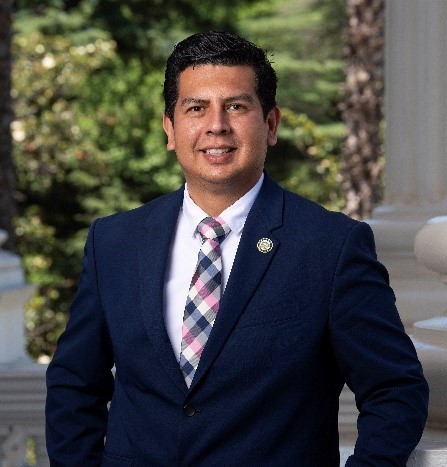
Asm. David Alvarez
Sponsored bills
Existing law imposes various limitations on emissions of air contaminants for the control of air pollution from vehicular and nonvehicular sources. Existing law generally designates the State Air Resources Board as the state agency with the primary responsibility for the control of vehicular air pollution and air pollution control and air quality management districts with the primary responsibility for the control of air pollution from all sources other than vehicular sources. Existing law requires the state board, no later than January 1, 2021, and every 5 years thereafter, to update its 2016 mobile source strategy to include a comprehensive strategy for the deployment of medium- and heavy-duty vehicles in the state for purposes of bringing the state into compliance with federal ambient air quality standards and reducing motor vehicle greenhouse gas emissions from the medium- and heavy-duty vehicle sector. Under its existing authority, the state board has adopted the Advanced Clean Truck Regulation, which requires manufacturers who sell medium- and heavy-duty vehicles to sell zero-emission vehicles as an increasing percentage of their annual sales and requires certain fleet operators to report to the state board certain information regarding their vehicular usage. This bill would, before January 1, 2026, prohibit the state board from enforcing any regulations requiring the purchase and use of zero-emission vehicles with a gross vehicle weight rating of over 8,500 pounds operating in a land port of entry on the California-Mexico border within a commercial zone, as defined. The bill would, on and after January 1, 2026, prohibit the state board from enforcing any regulations requiring the purchase and use of zero-emission vehicles with a gross vehicle weight rating of over 8,500 pounds operating at a land port of entry on the California-Mexico border within a commercial zone under certain conditions. The bill would specify that the state board has the burden of proof in demonstrating the fleet operator has reasonable access to an economically feasible charging or fueling infrastructure in enforcing those regulations for vehicles operating at a land port of entry on the California-Mexico border within a commercial zone. This bill would require the Legislative Analyst, on or before September 1, 2024, to report to the Legislature on certain information regarding international commerce at the state's land ports of entry on the California-Mexico border within commercial zones.
Existing law makes all persons eligible and qualified to be prospective trial jurors, except persons who, among other things, are not citizens of the United States. This bill would instead make a person eligible and qualified to be a prospective juror if they are a lawful permanent resident.
Existing law gives control of the state park system to the Department of Parks and Recreation, and requires the Director of Parks and Recreation to promote and regulate the use of the state park system in a manner that conserves the scenery, natural and historic resources, and wildlife for the enjoyment of future generations. Existing law authorizes the department to collect fees, rents, and other returns for use of any state park system area, as provided. Existing law prohibits the department from collecting from any group of pupils in kindergarten or grades 1 to 12, inclusive, or their escorts, any fee, rental, or other return for use of any unit in the state park system when the group is visiting the area pursuant to a school outing or field trip under the direction of a school personnel, as provided. This bill, commencing on July 1, 2024, would require the department to waive the day use entrance fees to a unit of the state park system for any child in the 4th grade, or the 4th grade equivalent, who holds a valid federally issued "Every Kid Outdoors" pass, as provided. The bill would require the department to post on its internet website information on how to obtain the federal "Every Kid Outdoors" pass, including a hyperlink to the federal program establishing the pass.
Existing law, the Mental Health Services Act (MHSA) , an initiative measure enacted by the voters as Proposition 63 at the November 2, 2004, statewide general election, establishes the continuously appropriated Mental Health Services Fund to fund various county mental health programs, including the Adult and Older Adult Mental Health System of Care Act. Existing law authorizes the MHSA to be amended by a 23 vote of the Legislature if the amendments are consistent with and further the intent of the MHSA. This bill would establish within the State Department of Health Care Services an Older Adult Behavioral Health Services Administrator to oversee behavioral health services for older adults. The bill would require that position to be funded with administrative funds from the Mental Health Services Fund. The bill would prescribe the functions of the administrator and their responsibilities, including, but not limited to, developing outcome and related indicators for older adults for the purpose of assessing the status of behavioral health services for older adults, monitoring the quality of programs for those adults, and guiding decisionmaking on how to improve those services. The bill would require the administrator to receive data from other state agencies and departments to implement these provisions, subject to existing state or federal confidentiality requirements. The bill would require the administrator to report to the entities that administer the MHSA on those outcome and related indicators by July 1, 2024, and would require the report to be posted on the department's internet website. The bill would also require the administrator to develop a strategy and standardized training for all county behavioral health personnel in order for the counties to assist the administrator in obtaining the data necessary to develop the outcome and related indicators. By expanding the purposes for which funds from a continuously appropriated fund may be spent, this bill would make an appropriation. This bill would declare that it is consistent with and furthers the intent of the MHSA.
Existing property tax law, in accordance with the California Constitution, provides for a "welfare exemption" for property used exclusively for religious, hospital, scientific, or charitable purposes and that is owned or operated by certain types of nonprofit entities, if certain qualifying criteria are met. Existing property tax law states that property is within that welfare exemption if the property is owned and operated by a nonprofit corporation, otherwise qualifying for the welfare exemption, that is organized and operated for the specific and primary purpose of building and rehabilitating single or multifamily residences for sale at cost to low-income families, with financing in the form of a zero interest rate loan and without regard to religion, race, national origin, or the sex of the head of household. This bill would provide, for property tax lien dates occurring on or after January 1, 2024, that property is exempt from taxation and is within the welfare exemption if that property is owned and operated by a nonprofit corporation, as described, that is organized and operated for the specific and primary purpose of building or rehabilitating residential units for sale or rent at an affordable cost and if at least one residential unit on the property is subject to an agreement that requires the unit to be made available at an affordable cost to buyers or renters and is recorded with the appropriate local agency. The bill would provide that the exemption shall be equal to the percentage of the value of the property that is equal to the percentage that the number of units meeting the aforementioned specifications represents of the total number of residential units available for rent or sale on the property. By adding to the duties of local tax officials, the bill would impose a state-mandated local program. Existing law requires any bill authorizing a new tax expenditure to contain, among other things, specific goals, purposes, and objectives that the tax expenditure will achieve, detailed performance indicators, and data collection requirements. This bill would state the intent of the Legislature to comply with those provisions. The California Constitution requires the state to reimburse local agencies and school districts for certain costs mandated by the state. Statutory provisions establish procedures for making that reimbursement. This bill would provide that, if the Commission on State Mandates determines that the bill contains costs mandated by the state, reimbursement for those costs shall be made pursuant to the statutory provisions noted above. Existing law requires the state to reimburse local agencies annually for certain property tax revenues lost as a result of any exemption or classification of property for purposes of ad valorem property taxation. This bill would provide that, notwithstanding those provisions, no appropriation is made and the state shall not reimburse local agencies for property tax revenues lost by them pursuant to the bill. This bill would take effect immediately as a tax levy.
Existing law establishes various agencies and programs for the purpose of safeguarding consumer financial protections. Existing law establishes the Department of Financial Protection and Innovation within the Business, Consumer Services, and Housing Agency and places the department under the direction of the Commissioner of Financial Protection and Innovation. Under existing law, the department has charge of the execution of specified laws relating to various financial institutions and financial products and services. Existing law, the California Public Banking Option Act, requires the Treasurer to convene the CalAccount Blue Ribbon Commission, as specified, and requires the commission to conduct, by contracting with one or more entities with appropriate expertise, and deliver, as prescribed, a market analysis to determine if it is feasible to implement a "CalAccount Program," which, if implemented, would have certain characteristics, including that it would be a program established by the state for the purpose of protecting consumers who lack access to traditional banking services from predatory, discriminatory, and costly alternatives. This bill would enact The California Emergency Savings Account Option Act. The bill would require the Treasurer to convene, on or before September 1, 2024, the Emergency Savings Account Commission to be composed of certain members, including the Commissioner of Financial Protection and Innovation and the Treasurer or their respective designees. The bill would require the commission to conduct, on or before July 1, 2026, by contracting with one or more entities with appropriate expertise, and deliver, an analysis on the extent of the problem of Californians who do not have access to sufficient funds when faced with financial emergencies, as specified. The bill would condition the implementation of these provisions on an appropriation by the Legislature for this express purpose and would repeal the bill's provisions on January 1, 2032.
Existing law establishes the County of San Diego and various offices within the county for administration of the county government. The Personal Income Tax Law and the Corporation Tax Law allow various credits against the taxes imposed by those laws, including motion picture credits for taxable years beginning on or after January 1, 2020, to be allocated by the California Film Commission on or after July 1, 2020, and before July 1, 2025. This bill would establish the San Diego Regional Film Financial Incentive Pilot Program to be administered by the San Diego Regional Film Financial Incentive Pilot Program Office within the County of San Diego for purposes of awarding grants, beginning on July 1, 2024, to qualified projects that, among other things, have a production budget with at least 70% of expenditures to laborers, retailers, or suppliers who are permanent residents of the County of San Diego. The bill would require an applicant to submit a specified application to the office, and would require the office to award grants in order of priority based on the ratio of the total moneys expected to be paid by the applicant as wages to laborers who are permanent residents of the County of San Diego divided by the total production budget. The bill would appropriate $25,000,000 to the County of San Diego over a 3-year period for purposes of the program, including administrative costs. The bill would require the office to submit, on or before January 1, 2027, a report to the Legislature and the California Film Commission on the results of the program. By placing new requirements on the County of San Diego, the bill would impose a state-mandated local program. The bill would repeal these provisions on January 1, 2028. This bill would make legislative findings and declarations as to the necessity of a special statute for the County of San Diego. The California Constitution requires the state to reimburse local agencies and school districts for certain costs mandated by the state. Statutory provisions establish procedures for making that reimbursement. This bill would provide that, if the Commission on State Mandates determines that the bill contains costs mandated by the state, reimbursement for those costs shall be made pursuant to the statutory provisions noted above.
The California Global Warming Solutions Act of 2006 designates the State Air Resources Board as the state agency charged with monitoring and regulating sources of emissions of greenhouse gases. The act authorizes the state board to include the use of market-based compliance mechanisms. Existing law requires all moneys, except for fines and penalties, collected by the state board as part of a market-based compliance mechanism to be deposited in the Greenhouse Gas Reduction Fund and to be available upon appropriation. Existing law requires the Department of Finance, in consultation with the state board and any other relevant state agency, to develop, as specified, a 3-year investment plan for the moneys deposited in the fund. Existing law requires the investment plan to allocate, among other things, a minimum of 25% of the available moneys in the fund to projects located within, and benefiting individuals living in, disadvantaged communities and an additional minimum of 5% to projects that benefit low-income households or to projects located within, and benefiting individuals living in, low-income communities located anywhere in the state. This bill would increase those amounts from 25% to 50% and from 5% to 15%.
Existing law, the Watershed, Clean Beaches, and Water Quality Act, among other things, provides that it is the intent of the Legislature that the purpose of maintaining clean beaches, clean water, and an integrated and coordinated watershed program is to protect beaches, coastal waters, rivers, lakes, and streams from contaminants, pollution, and other environmental threats. The act requires the State Water Resources Control Board, in consultation with the State Coastal Conservancy, to award grants to public agencies and nonprofit organizations for projects designed to improve water quality at public beaches, as specified. This bill would require the board, to the extent feasible, to identify and implement projects to improve beach access and address ocean water quality on public beaches that experience significant restrictions of use, as defined, due to bacteria levels that exceed public health standards, whether the source is from urban runoff or transboundary flows.