

Existing law establishes the California State University, under the administration of the Trustees of the California State University, as one of the segments of public postsecondary education in the state. Existing law requires the trustees to provide by rule for the government of their appointees and employees, including, among other things, rules related to appointment, classification, and duties. Existing law requires certain community college employees to be a person who meets specified minimum qualifications, as provided. This bill would explicitly require the instructor of record for a course of instruction to be a person who meets the rule provided by the trustees to serve as a faculty employee, as described, teaching credit instruction or noncredit instruction. The bill would also explicitly require a California State University faculty employee to be a person who meets the rule provided by the trustees to serve in that position.
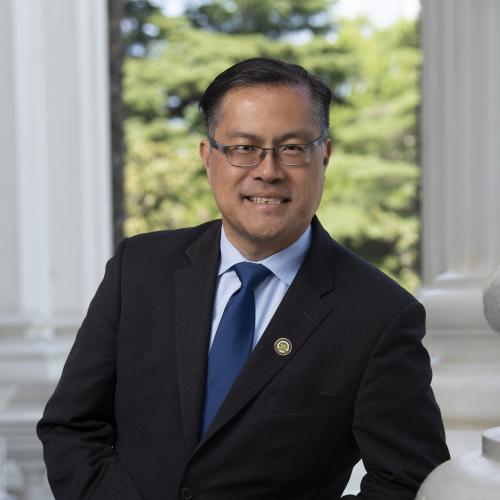
Asm. Mike Fong
Sponsored bills
Existing law generally regulates the business of renting passenger vehicles to the public. The law prohibits a rental company from taking various actions, including requiring the purchase of a damage waiver, optional insurance, or another optional good or service, and using electronic surveillance technology to track a renter in order to impose fines or surcharges relating to the renter's use of a rental vehicle. This bill would require any privately owned vehicle rented by, or furnished to, any federal, state, or local law enforcement agency for the use of detaining, arresting, or transporting persons who have violated, or are suspected of having violated, any law, to display a temporary decal displaying the agency name and logo, as specified. The bill would authorize certain attorneys, including the Attorney General, to pursue a civil action against the entity renting the vehicle from the private owner for failure to comply with these provisions. The bill would require the rental car contract to include a term that compliance with state law is mandatory. The bill would exempt privately owned vehicles rented or otherwise furnished or loaned to a law enforcement agency for specified purposes and rental car contracts entered into prior to January 1, 2027, from these provisions. The bill would make related findings and declarations.
Existing law appropriates $10,000,000 from the General Fund for the 2021–22 fiscal year to the Superintendent of Public Instruction to administer the Dual Language Immersion Grant Program for the purpose of expanding access to quality dual language learning and fostering languages that English learners bring to California's education system. Under that program, the State Department of Education is required to award a minimum of 25 one-time Dual Language Immersion Grants over a period of 3 fiscal years of up to $380,000 per grant to an eligible entity to expand or establish dual language immersion programs. This bill would require, upon appropriation by the Legislature, the department, on or before July 1, 2027, to establish a Dual Language Immersion Coordinator to provide coordination between local educational agencies, as defined, to share resources and knowledge on dual language immersion programs, as defined. The bill would require the Dual Language Immersion Coordinator to (1) act as the point of contact within the department for local educational agencies seeking to, among other things, establish new or expand existing dual language immersion programs, and (2) establish, publish, and maintain on the department's internet website, on or before January 1, 2028, a directory of operative dual language immersion programs, as specified. To the extent the bill would impose additional duties on local educational agencies relating to the establishment and maintenance of the directory, the bill would impose a state-mandated local program. The California Constitution requires the state to reimburse local agencies and school districts for certain costs mandated by the state. Statutory provisions establish procedures for making that reimbursement. This bill would provide that, if the Commission on State Mandates determines that the bill contains costs mandated by the state, reimbursement for those costs shall be made pursuant to the statutory provisions noted above.
Existing law establishes the California State University, under the administration of the Trustees of the California State University, the University of California, under the administration of the Regents of the University of California, the California Community Colleges, under the administration of the Board of Governors of the California Community Colleges, and independent institutions of higher education, as defined, as 4 segments of postsecondary education in the state. This bill would establish the Designation of California Asian American- and Native Hawaiian Pacific Islander-Serving Institutions to recognize campuses of those segments of postsecondary education that excel at providing academic resources to Asian American, Native Hawaiian, and Pacific Islander students. The bill would establish a California Asian American- and Native Hawaiian Pacific Islander-Serving Institutions governing board to designate colleges and universities as California Asian American- and Native Hawaiian Pacific Islander-Serving Institutions and would require the office of the Chancellor of the California Community Colleges to, among other duties, develop the application processes and to process and present initial and renewal applications to receive this designation to the governing board, as specified. The bill would make an initial and renewal designation valid for 5 years.
The Donahoe Higher Education Act sets forth, among other things, the missions and functions of California's public and independent segments of higher education and their respective institutions of higher education. The act requests the Regents of the University of California, and requires the Trustees of the California State University, to require each campus in their respective segments to grant students the right to reenroll in their baccalaureate degree program after withdrawing or stopping out, if the student was in good academic standing with the university. This bill, commencing with the 2027–28 academic year, would require a campus of the University of California, the California State University, or the California Community Colleges, a private postsecondary educational institution, or an independent institution of higher education to adopt a written policy to allow a student to take a voluntary medical leave of absence for a period to be determined by the postsecondary educational institution, or for a period of up to one academic year, whichever is longer. The bill would prohibit the leave of absence policy from, among other things, requiring a student who takes a medical leave of absence to submit an official notice of withdrawal to the postsecondary educational institution. The bill would require a postsecondary educational institution, among other things, to post the medical leave of absence policy on the institution's internet website and notify students and faculty of the location of the posted policy on its internet website by sending an email at the beginning of each academic semester or term. These provisions would apply to the University of California only to the extent that the regents, by appropriate resolution, make them applicable. By imposing additional duties on community college districts, the bill would impose a state-mandated local program. The California Constitution requires the state to reimburse local agencies and school districts for certain costs mandated by the state. Statutory provisions establish procedures for making that reimbursement. This bill would provide that, if the Commission on State Mandates determines that the bill contains costs mandated by the state, reimbursement for those costs shall be made pursuant to the statutory provisions noted above.
Existing law establishes the California Community Colleges, under the administration of the Board of Governors of the California Community Colleges, the California State University, under the administration of the Trustees of the California State University, and the University of California, under the administration of the Regents of the University of California as the 3 segments of public postsecondary education in the state. This bill would require the office of the Chancellor of the California Community Colleges and the California State University, and would request the University of California, to (1) as specified, jointly convene and participate in an intersegmental working group to develop and present recommendations for generative artificial intelligence (GenAI) system procurement standards and training, which the bill would require to be submitted on or before January 1, 2028, (2) provide the training to students, faculty, or staff, as applicable, (3) review the training developed by the working group at least once per academic year, update the training as necessary, and maintain records of completed trainings for each student, faculty member, and staff member who receives a training, as provided, and (4) within 60 days following the execution of a systemwide contract for a GenAI system and until procurement standards are adopted, submit a written report to the Legislature and certain legislative policy committees with a description of, among other things, the process used in evaluating and selecting the GenAI system, as provided.
Existing law states the policy of the State of California is to afford all persons in public schools, regardless of their disability, gender, gender identity, gender expression, nationality, race or ethnicity, religion, sexual orientation, or any other specified characteristic, equal rights and opportunities in the educational institutions of the state. Existing law establishes the Office of Civil Rights, under the administration of the Government Operations Agency. Existing law requires the Office of Civil Rights to employ a Religious Discrimination Prevention Coordinator, a Race and Ethnicity Discrimination Prevention Coordinator, a Gender Discrimination Prevention Coordinator, and an LGBTQ Discrimination Prevention Coordinator. Existing law requires each of the coordinators be appointed by the Governor and confirmed by the Senate. This bill would require the Office of Civil Rights to employ a Disability Discrimination Prevention Coordinator to be appointed by the Governor and confirmed by the Senate. The bill would change the title of the LGBTQ Discrimination Prevention Coordinator to instead be the LGBTQ+ Discrimination Prevention Coordinator. The bill would require each of the coordinators, in consultation with the State Department of Education, and under the supervision of the Government Operations Agency, to, among other things, (1) develop, consult on, and provide discrimination education to teachers, staff, governing board and body members, administrators, and other local educational agency personnel to identify and proactively prevent discrimination, as provided, (2) provide technical assistance, upon specified request, to local educational agencies to access restorative justice resources, training, and practitioners, and (3) engage with local educational agencies to ensure administrators are equipped to address conflicts at an early stage with the goal of proactively resolving incidents of discrimination, as specified. This bill would require the Office of Civil Rights to employ a Deputy Coordinator on Anti-Black Racism, a Deputy Coordinator on Anti-Asian American, Native Hawaiian, and Pacific Islander (Anti-AANHPI) Discrimination, a Deputy Coordinator on Anti-Latino Discrimination, and a Deputy Coordinator on Anti-Native American Discrimination, and would require these deputy coordinators to report directly to the Race and Ethnicity Discrimination Prevention Coordinator. The bill would require the Office of Civil Rights to provide resources and training on how to properly assist in cases of discrimination that involve the intersectionality of protected characteristics, as provided.
This measure would urge the President of the United States and Congress of the United States to immediately restore full and consistent funding and staffing for the National Park Service.
This measure would recognize the month of October each year as Student Financial Aid Awareness Month, and that it is important to increase student participation in financial aid programs to ensure that students receive clear, timely, and accessible information about application requirements, deadlines, and available resources.
Maddy summaryCalifornia Assembly Resolution 140 designates August 2026 as Children's Get Offline and Get Outdoors Month to promote awareness of the benefits of screen-free play for child development. The resolution cites research linking excessive social media use and reduced free play time to increased rates of anxiety, depression, and other behavioral issues among teenagers. It encourages families and communities to support unstructured outdoor activities and highlights ongoing federal efforts to protect children's mental health through technology guardrails.