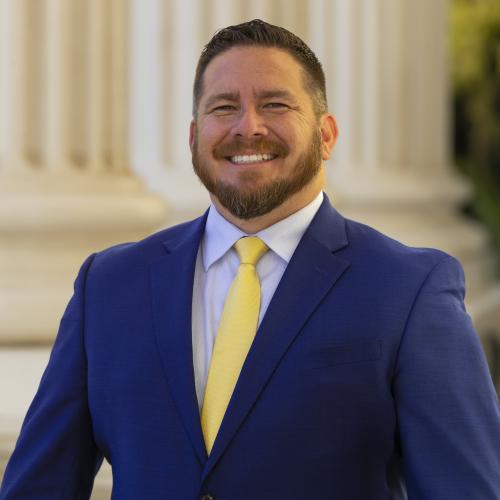
Photo of Juan Alanis
R California Assembly · District 22 On the 2026 ballot

Asm. Juan Alanis

Compare
Total votes
10,307
all sessions
Attendance
93%
551 missed
Lower than 85% of chamber peers
With party
95%
of cast votes
Near the chamber average
Bipartisan score
3%
crosses aisle rarely
Near the chamber average
Sponsored
1,102
bills & resolutions
Higher than 91% of chamber peers
Committees
19
assignments
1,102 bills and resolutions

Sponsored bills

Total
1,102
Primary
101
Co-sponsor
1,001
This page
1,102
matching current filters
Co-sponsor HR 84
Passed · California Assembly · Co-sponsor
Relative to condemning racism.

Maddy summaryCalifornia House Resolution 84 formally condemns a social media post by President Donald Trump that depicted former President Barack Obama and former First Lady Michelle Obama as apes, characterizing the imagery as racist dehumanization. The resolution calls on the President to issue a public apology to the Obamas and Black Americans nationwide for promoting this content. It also urges all elected officials, regardless of party affiliation, to reject the use of dehumanizing imagery against Black communities. Finally, the Assembly reaffirms its commitment to advancing policies that confront systemic racism and protect civil rights within the state.

Passed Feb 9, 2026 1 co-sponsor
Co-sponsor HR 79
Passed · California Assembly · Co-sponsor
Relative to Unclaimed Property Month.

Maddy summaryThis bill designates February 2026 as Unclaimed Property Month in California to raise awareness about state-held financial assets. It encourages residents to check the state Controller's website to claim unclaimed funds such as uncashed checks and insurance proceeds. The resolution does not change any laws or policies but serves as a public awareness campaign to help people locate and claim their abandoned property. It directs the Assembly Chief Clerk to distribute copies of the resolution for public distribution.

Passed Feb 5, 2026 1 co-sponsor
Co-sponsor HR 77
Passed · California Assembly · Co-sponsor
Relative to school governance.

Maddy summaryThis House Resolution declares January 2026 as School Board Recognition Month to honor the nearly 5,000 school board members across California's 1,000 school districts and county offices of education. The resolution recognizes these locally elected officials for their work in guiding public education and serving diverse communities, emphasizing their role in ensuring students' academic, social-emotional, and health needs are met. It calls on community members to join in acknowledging the dedication of school board members and collaborate to improve the education system. The bill has no operational effect beyond this symbolic recognition and does not change any laws or policies.

Passed Feb 5, 2026 1 co-sponsor
Co-sponsor HR 76
Passed · California Assembly · Co-sponsor
Relative to affordable homeownership.

Maddy summaryThis House Resolution formally recognizes the importance of affordable homeownership for California families, particularly those with lower incomes, and highlights how nonprofit-led programs help build generational wealth and reduce economic disparities. The document emphasizes that existing state programs like CalHome support the construction and preservation of affordable homes through competitive funding to cities, counties, indigenous communities, and nonprofit builders such as Habitat for Humanity. While the resolution does not create new laws or funding, it serves as an official acknowledgment of homeownership's role in improving educational outcomes, health, civic participation, and neighborhood stability. The text also notes California's significant housing deficit and racial wealth gaps as context for why expanding affordable ownership opportunities is a priority for state policy.

Passed Feb 5, 2026 1 co-sponsor
Co-sponsor SCR 106
Signed into law · California Senate · Co-sponsor
Relative to Korean American Day.

Maddy summarySCR 106 designates January 13, 2026, as Korean American Day within the state. This ceremonial resolution officially recognizes the contributions of Korean Americans to the state's cultural and social fabric. It affects state records and calendar designations, adding a specific date for commemoration. The bill became law on February 3, 2026, as Chapter 2 of the Statutes of 2026.

Signed into law Feb 3, 2026 1 co-sponsor
Co-sponsor AB 12
Failed · California Assembly · Co-sponsor
Low-carbon fuel standard: regulations.

The California Global Warming Solutions Act of 2006 establishes the State Air Resources Board as the state agency responsible for monitoring and regulating sources emitting greenhouse gases. The act requires the state board to adopt rules and regulations to achieve the maximum technologically feasible and cost-effective greenhouse gas emissions reductions to ensure that the statewide greenhouse gas emissions are reduced to at least 40% below the statewide greenhouse gas emissions limit, as defined, no later than December 31, 2030. Pursuant to the act, the state board has adopted the Low-Carbon Fuel Standard regulations. This bill would void specified amendments to the Low-Carbon Fuel Standard regulations adopted by the state board on November 8, 2024.

Failed Feb 2, 2026 1 co-sponsor
Co-sponsor AB 1058
Failed · California Assembly · Co-sponsor
Motor Vehicle Fuel Tax Law: suspension of tax.

Existing law, the Motor Vehicle Fuel Tax Law, imposes a tax upon each gallon of motor vehicle fuel removed from a refinery or terminal rack in this state, entered into this state, or sold in this state, at a specified rate per gallon. Existing unfair competition laws establish a statutory cause of action for unfair competition, including any unlawful, unfair, or fraudulent business act or practice and unfair, deceptive, untrue, or misleading advertising and acts prohibited by false advertisement laws. This bill would suspend the imposition of the tax on motor vehicle fuels for one year. The bill would require that all savings realized based on the suspension of the motor vehicle fuels tax by a person other than an end consumer, as defined, be passed on to the end consumer, and would make the violation of this requirement an unfair business practice, in violation of unfair competition laws, as provided. The bill would require a seller of motor vehicle fuels to provide a receipt to a purchaser that indicates the amount of tax that would have otherwise applied to the transaction. This bill would also direct the Controller to transfer a specified amount from the General Fund to the Motor Vehicle Fuel Account in the Transportation Tax Fund. By transferring General Fund moneys to a continuously appropriated account, this bill would make an appropriation. This bill would declare that it is to take effect immediately as an urgency statute.

Failed Feb 2, 2026 1 co-sponsor
Primary AB 1174
Failed · California Assembly · Lead sponsor
Clean Transportation Program: eligible programs and projects: electric vehicle charging stations: vandalism deterrence.

Existing law establishes the Clean Transportation Program, administered by the State Energy Resources Conservation and Development Commission, to provide funding to certain entities to develop and deploy innovative technologies that transform California's fuel and vehicle types to help attain the state's climate change policies. Existing law limits funding under the program to specified categories of programs and projects. Existing law creates the Alternative and Renewable Fuel and Vehicle Technology Fund, to be administered by the commission, and requires the moneys in the fund, upon appropriation by the Legislature, to be expended by the commission to implement the program. This bill would add to the categories of programs and projects eligible for funding under the Clean Transportation Program programs and projects to deter and combat vandalism of publicly available electric vehicle charging stations.

Failed Feb 2, 2026 0 co-sponsors
Co-sponsor AB 1228
Failed · California Assembly · Co-sponsor
Electricity: expedited utility distribution infrastructure undergrounding program.

Existing law vests the Public Utilities Commission with regulatory authority over public utilities, including electrical corporations. Existing law requires the commission to establish an expedited utility distribution infrastructure undergrounding program for large electrical corporations. In order to participate in the program, existing law requires a large electrical corporation to submit to the Office of Energy Infrastructure Safety a distribution infrastructure undergrounding plan, as provided. Upon approval of the plan by the office, existing law requires the large electrical corporation to submit to the commission an application requesting review and conditional approval of the plan's costs and other specified information. This bill would specify that the approval of a distribution infrastructure undergrounding plan is not a project for purposes of the California Environmental Quality Act, as specified.

Failed Feb 2, 2026 1 co-sponsor
Primary AB 332
Failed · California Assembly · Lead sponsor
Employment: agricultural workers.

Existing law makes a farm labor contractor successor to any predecessor farm labor contractor that owed wages or penalties to a former employee of the predecessor, whether or not the predecessor was licensed by the Labor Commissioner to carry on the business, activities, or operations of a farm labor contractor, liable for those wages and penalties, if the successor farm labor contractor meets one or more specified criteria including using substantially the same facilities or workforce to offer substantially the same services as the predecessor. Existing law provides an exception and an affirmative defense to the liability for wages and penalties owed to a former employee of the predecessor farm labor contractor if the farm labor contractor has operated for at least the preceding 3 years, and certain conditions apply. Existing law makes a person who violates farm labor contractor requirements guilty of a misdemeanor punishable by specified fines, or imprisonment in the county jail for not more than 6 months, or both. This bill would decrease the amount of time that a farm labor contractor would be required to have operated with a valid license in order to have an affirmative defense to liability for wages and penalties owed to a former employee of the predecessor farm labor contractor to a least the preceding year and would make other related changes. Existing law also makes a farm labor contractor successor liable for wages and penalties owed to a former employee, as described above, if the successor farm labor contractor is an immediate family member, as defined, of any owner, partner, officer, licensee, or director of the predecessor farm labor contractor or of any person who had a financial interest in the predecessor farm labor contractor. This bill would expand the definition of "immediate family member" for purposes of the provision described above that makes a farm labor contractor successor liable for wages and penalties owed to a former employee of the predecessor farm labor contractor to include a step-parent, adoptive parent, foster parent, half-sibling, and step-grandparent. By expanding the requirements placed upon farm labor contractor successors, the violation of which would be a crime, the bill would impose a state-mandated local program. The California Constitution requires the state to reimburse local agencies and school districts for certain costs mandated by the state. Statutory provisions establish procedures for making that reimbursement. This bill would provide that no reimbursement is required by this act for a specified reason.


Failed Feb 2, 2026 0 co-sponsors
Showing 281 to 290 of 1,102 bills
Previous 1 … 28 29 30 … 111 Next