Maddy summaryACR 112 is a resolution designating September 2025 as Deaf Awareness Month in California. It does not create new laws or policies but formally recognizes this month to promote awareness of Deaf culture and communities. The resolution directly affects Californians by encouraging public recognition and educational efforts during September 2025. As a ceremonial measure, it has no binding effect or concrete policy changes beyond the symbolic designation.
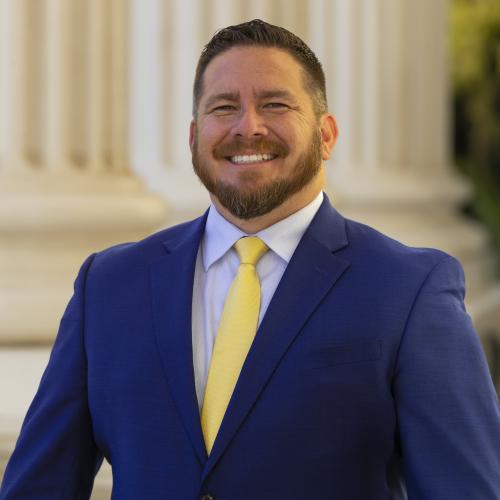
Asm. Juan Alanis
Sponsored bills
Existing law, the Motor Vehicle Fuel Tax Law, imposes a tax upon each gallon of motor vehicle fuel removed from a refinery or terminal rack in this state, entered into this state, or sold in this state, at a specified rate per gallon. Existing unfair competition laws establish a statutory cause of action for unfair competition, including any unlawful, unfair, or fraudulent business act or practice and unfair, deceptive, untrue, or misleading advertising and acts prohibited by false advertisement laws. This bill would suspend the imposition of the tax on motor vehicle fuels for one year. The bill would require that all savings realized based on the suspension of the motor vehicle fuels tax by a person other than an end consumer, as defined, be passed on to the end consumer, and would make the violation of this requirement an unfair business practice, in violation of unfair competition laws, as provided. The bill would require a seller of motor vehicle fuels to provide a receipt to a purchaser that indicates the amount of tax that would have otherwise applied to the transaction. This bill would also direct the Controller to transfer a specified amount from the General Fund to the Motor Vehicle Fuel Account in the Transportation Tax Fund. By transferring General Fund moneys to a continuously appropriated account, this bill would make an appropriation. This bill would declare that it is to take effect immediately as an urgency statute.
Existing law, the California Emergency Services Act (CESA) , among other things, authorizes the Governor to proclaim a state of emergency in an area affected by or likely to be affected thereby, if specified conditions exist and either specified local officials request the Governor to make that proclamation, or the Governor determines that local authority is inadequate to cope with, the emergency. During a state of emergency, existing law confers on the Governor, to the extent the Governor deems necessary, complete authority over all agencies of the state government and the right to exercise within the area designated all police power vested in the state by the Constitution and laws of the state to effectuate the purposes of the CESA. This bill, instead, would authorize the Governor to exercise within the area designated all executive power vested in the state by the Constitution and laws of the state to effectuate the purposes of the CESA. Existing law requires the Governor to proclaim the termination of a state emergency at the earliest possible date that conditions warrant. Existing law requires all of the powers granted to the Governor by the CESA with respect to a state of emergency to terminate when the state of emergency has been terminated by proclamation of the Governor or by concurrent resolution of the Legislature declaring it at an end. This bill would require a state of emergency that has not been terminated by the Governor to automatically terminate 90 days after the Governor's proclamation unless the Legislature extends it by a concurrent resolution, as specified.

The Personal Income Tax Law allows various credits against the taxes imposed by that law, including, for taxable years beginning on or after January 1, 2014, and before January 1, 2026, a credit for hiring qualified full-time employees within a designated census tract or economic development area, except as specified, in an amount equal to 35% of the qualified wages paid to those employees multiplied by the applicable percentage for that taxable year. This bill would make a nonsubstantive change to this provision.
Existing law requires the Director of Pesticide Regulation to conduct a pesticide residue monitoring program for produce destined for processing to determine which pesticides are most likely to leave a residue and to what extent it is necessary to monitor the produce. Existing law requires the director to continuously interpret the results of the pesticide residue monitoring program in order to assess its general effectiveness at preventing public exposure to illegal pesticide residues, to release comprehensive summaries of the results of the pesticide residue monitoring program, and to identify in the reports the specific county where unprocessed agricultural foods have been discovered to contain illegal pesticide residue levels, the specific commodity, and the county where the commodity was produced, as specified. This bill would make nonsubstantive changes to that latter provision.
Existing law sets forth the purposes of certain provisions governing pest control operations. This bill would make nonsubstantive changes to those purposes.
This measure would designate the portion of State Route 101 in the County of Santa Clara from Story Road to the junction with State Highway Route 280 and State Highway Route 680 as the Little Saigon Freeway. The measure also would request the Department of Transportation to determine the cost of appropriate signs showing that special designation and, upon receiving donations from nonstate sources sufficient to cover the cost, to erect those signs.
Maddy summaryThis bill is a House Resolution that formally recognizes the history of Japanese American incarceration during World War II and honors the service of Japanese American veterans. It details how Executive Order 9066 led to the removal of over 125,000 people of Japanese ancestry from their homes and describes the subsequent military contributions of these individuals, including recipients of the Medal of Honor. The resolution also acknowledges the government's admission that the incarceration was based on racial prejudice rather than military necessity and notes previous state and federal apologies and reparations. By citing these historical facts, the bill serves to educate the public and reaffirm the state's commitment to preventing similar civil rights violations in the future.
Maddy summaryThis bill designates February 15, 2026, as Angelman Syndrome Awareness Day in California to highlight a rare genetic disorder affecting speech, movement, and development. The resolution recognizes the condition's impact on individuals and their families while promoting public understanding of its symptoms and current lack of a cure. By officially acknowledging this date, the legislature aims to support awareness efforts similar to those held internationally on the same day.
Maddy summaryThis House Resolution officially recognizes February 17, 2026, as the beginning of the Lunar New Year in California. It acknowledges the cultural significance of the holiday for over 3 million Asian and Pacific Islander residents who celebrate it as a time to renew family ties and start fresh. The resolution highlights the state's diverse population and the contributions of Asian and Pacific Islander communities to California's social, cultural, and economic life. It formally extends best wishes for a peaceful and prosperous Lunar New Year to all Californians.