

Existing law, the Knox-Keene Health Care Service Plan Act of 1975, requires the Department of Managed Health Care to license and regulate health care service plans and makes a willful violation of the act a crime. Existing law requires an individual or small group health care service plan contract issued, amended, or renewed on or after January 1, 2017, to include, at a minimum, coverage for essential health benefits pursuant to the federal Patient Protection and Affordable Care Act. Existing law requires a health care service plan contract to cover the same health benefits that the benchmark plan, the Kaiser Foundation Health Plan Small Group HMO 30 plan, offered during the first quarter of 2014, as specified. This bill would express the intent of the Legislature to review California's essential health benefits benchmark plan and establish a new benchmark plan for the 2027 plan year for health care service plans. The bill would require, commencing January 1, 2027, if the United States Department of Health and Human Services approves a new essential health benefits benchmark plan for the state, as specified, the benchmark plan for health care service plans to include certain additional benefits, including coverage for specified fertility services and specified durable medical equipment. Because a violation of the bill by a health care service plan would be a crime, the bill would impose a state-mandated local program. The California Constitution requires the state to reimburse local agencies and school districts for certain costs mandated by the state. Statutory provisions establish procedures for making that reimbursement. This bill would provide that no reimbursement is required by this act for a specified reason.
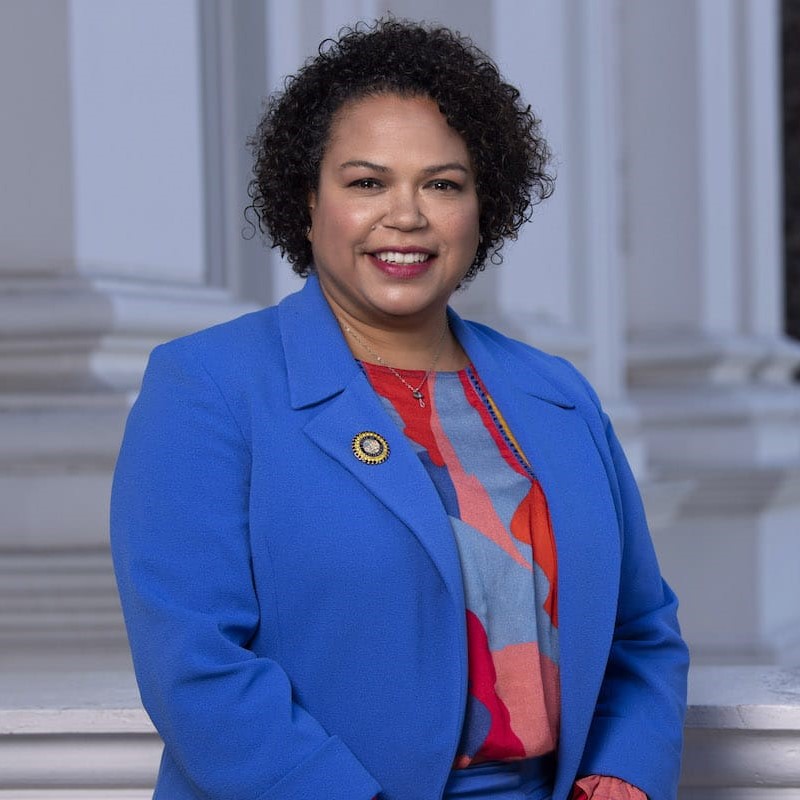
Asm. Mia Bonta
Sponsored bills
Existing law establishes the California State University, under the administration of the Trustees of the California State University, as one of the segments of public postsecondary education in the state. Existing law requires the trustees to control and expend all money appropriated for the support and maintenance of the university. Former law, until July 1, 2023, established the Task Force to Study and Develop Reparation Proposals for African Americans, with a Special Consideration for African Americans Who are Descendants of Persons Enslaved in the United States (Task Force) . Former law required the Task Force, among other things, to identify, compile, and synthesize the relevant corpus of evidentiary documentation of the institution of slavery that existed within the United States and the colonies, as specified, and to recommend the form of compensation that should be awarded, the instrumentalities through which it should be awarded, and who should be eligible for this compensation. This bill would authorize the use of up to $6,000,000, as specified, for the purpose of enabling the California State University to conduct research in furtherance of the recommendations of the Task Force, thereby making an appropriation. The bill would authorize the California State University to partner with other universities or nonprofit institutions in furtherance of the bill. The bill would require, before the start of each fiscal year, the California State University to consult with the California Legislative Black Caucus to propose a list of research components to be addressed through the appropriation, as provided. This bill would require the California State University to explore options to determine how to confirm an individual's status as a descendant of an enslaved person, as defined. The bill would also require the California State University to establish a process for conducting or verifying genealogical research for the purpose of confirming an individual's status as a descendant of an enslaved person for eligibility for reparative claims on or before the start of the 2029–30 academic year and to commence the work of establishing the process on or before the start of the 2026–27 academic year. The bill would authorize the funding described above to be used to support student participation in support of this goal. The bill would require the California State University, on or before October 1 of each year and until funding is exhausted, to submit to the Legislature and Governor a report with a status update of pending research projects, and any research projects that have been completed within the prior year. The bill would require the final report to include research findings, recommendations with options, and timelines for statewide implementation, including costs, developed pursuant to these provisions.
Existing law establishes the Civil Rights Department within the Business, Consumer Services, and Housing Agency to enforce civil rights laws with respect to housing and employment and to protect and safeguard the right of all persons to obtain and hold employment without discrimination based on specified characteristics or status. Existing law requires a private employer that has 100 or more employees to submit an annual pay data report to the Civil Rights Department that includes the number of employees by race, ethnicity, and sex in 10 specified job categories, the number of employees by race, ethnicity, and sex whose pay falls within federal pay bands, within each job category the median and mean hourly rate for employees having any combination of those characteristics, and the total number of hours worked by each employee counted in each pay band during the "Reporting Year," as specified. This bill would require an employer to collect and store any demographic information gathered by an employer or labor contractor for the purpose of submitting the pay data report separately from employees' personnel records, and, beginning January 1, 2027, increase the number of job categories, as specified above, to 23. Existing law authorizes the department, if it does not receive the pay data report, to seek an order requiring an employer to comply with these provisions. Existing law provides that upon the request of the department, a court may impose a civil penalty upon any employer for failure to file the required report, which shall be payable to the Civil Rights Enforcement and Litigation Fund. This bill would require a court to impose a civil penalty against an employer that fails to file the report if requested to do so by the department.
Under existing law, a prisoner can reduce their term of imprisonment by earning credit for, among other things, continuous incarceration, good behavior, and participation in approved rehabilitative programming. Existing law makes an inmate of a county jail or state prison who has completed training for assignment to a conservation camp, state or county facility, or a correctional institution as an inmate firefighter, or who is assigned to a state or county facility or a correctional institution as an inmate firefighter, and who is eligible to earn one day of credit for every one day of incarceration, instead eligible to earn 2 days of credit for every one day served in that assignment or after completing that training. Existing law authorizes a juvenile court to order placement of a ward at the Pine Grove Youth Conservation Camp if specified criteria are met, including if the county has entered into a contract with the Department of Corrections and Rehabilitation and the department has found the ward amenable. Existing law authorizes the department to enter into contracts with counties to operate the Pine Grove Youth Conservation Camp through a state-local partnership, or other management arrangement, to train justice-involved youth, as specified, in wildland firefighting skills. This bill would require an incarcerated individual hand crew member, in addition to receiving credits, and a ward or youth hand crew member placed at the Pine Grove Youth Conservation Camp to be paid an hourly wage equal to $7.25 while assigned to an active fire incident. The bill would require that wage rate to be reviewed annually. The bill would require the Department of Corrections and Rehabilitation and counties to maintain regulations regarding an administrative adjudication and remedy process for any disputes over sums owned pursuant to these provisions. This bill would declare that it is to take effect immediately as an urgency statute.
(1) Existing law requires the Superintendent of Public Instruction to establish and implement a system of complaint processing, known as the Uniform Complaint Procedures, for specified educational programs, and requires the State Department of Education to review those regulations pertaining to uniform complaint procedures for specified types of complaints, including those that allege unlawful discrimination, harassment, intimidation, or bullying against any protected group, as provided. Existing law requires the department to, on or before March 31, 2019, commence rulemaking proceedings to revise those regulations, as necessary, to conform to specified provisions. Beginning July 1, 2026, this bill would require, upon receipt by the department of a complaint subject to the Uniform Complaint Procedures that alleges unlawful discrimination, harassment, intimidation, or bullying, the Superintendent to collect specified information, including, among other things, a description of the complaint received. The bill would require the Superintendent to create and post on the department's internet website a summary report of the data described above. (2) Existing law, the California Fair Employment and Housing Act, among other things, establishes the Civil Rights Department and authorizes it to receive, investigate, conciliate, mediate, and prosecute complaints alleging various civil rights violations, including violations of provisions regarding individuals with disabilities. Existing law, the Lesbian, Gay, Bisexual, Transgender, and Intersex Disparities Reduction Act, requires the Civil Rights Department, among other specified state entities, in the course of collecting demographic data directly or by contract as to the ancestry or ethnic origin of Californians, to collect voluntary self-identification information pertaining to sexual orientation, gender identity, and variations in sex characteristics/intersex status, as specified. Existing law, the California Public Records Act, generally requires public records to be open for inspection by the public. Existing law provides numerous exceptions to this requirement. This bill would require the Civil Rights Department to collect, for a complaint received, certain demographic information, including the ethnicity, race, and gender of the individual submitting the complaint, and certain information related to the complaint. The bill would require the department, commencing July 1, 2027, to publish a summary report no later than October 1 of each year of the compiled information for the preceding calendar year on its internet website. This bill would require, for any information or data acquired pursuant to the bill's provisions, that information or data to be confidential and protected from public disclosure, including disclosure pursuant to the California Public Records Act, except that the information may be disclosable pursuant to that act to the same extent as the underlying complaint. The bill would also prohibit the above-described summary reports, dashboards, and transmitted data from containing any personally identifying information about any individual. The bill would require information in the summary reports, dashboards, and transmitted data to be sufficiently deidentified to prevent the identification of the individuals involved in a complaint. (3) Existing constitutional provisions require that a statute that limits the right of access to the meetings of public bodies or the writings of public officials and agencies be adopted with findings demonstrating the interest protected by the limitation and the need for protecting that interest. This bill would make legislative findings to that effect.
Existing law, subject to available funding, requires the State Department of Social Services to contract with qualified nonprofit legal services organizations to provide legal services to unaccompanied undocumented minors who are transferred to the care and custody of the federal Office of Refugee Resettlement and who are present in this state or are residing with a family member or other sponsor. Existing law requires contracts awarded pursuant to the above-described provision to be executed with qualified nonprofit legal services organizations that meet certain requirements, including having experience representing individuals in removal proceedings and asylum applications. This bill would, subject to available funding, provide legal counsel to immigrant youth in the State of California. The bill would define immigrant youth. The bill would require the department to allocate funding for these purposes, and would require the department to consider whether federal funding has been made available and dispersed to organizations or relevant projects in the state in determining the amount and allocation of contracts awarded. The bill would require the department to contract with qualified nonprofit legal services organizations that meet the above-described requirements or an office of the public defender that meets certain requirements. The bill would also authorize the department to fund social work services contracted by qualified nonprofit legal services organizations to assist immigrant youth.
Existing law creates the Vocational Nurse Education Program within the Department of Health Care Access and Information for persons agreeing to serve in an eligible county health facility, state-operated health facility, or a health workforce shortage area, before completing vocational nursing school. Existing law authorizes a person who qualifies for admission to a vocational nursing program to apply for funding under the program, as specified. Existing law establishes the Vocational Nurse Education Fund for the purpose of promoting the education of vocational nurses and related administrative costs. This bill would create the California Nurse-Midwifery Education Fund within the department for the purpose of establishing California-based, master's level, nurse-midwifery education programs within the California State University, the University of California, or both. The bill would require the department to administer the fund, and receive moneys from the General Fund for these purposes upon appropriation by the Legislature. The bill would require the department to establish a competitive application criteria to ensure the optimal sites selection for the education programs within the California State University system or the University of California, would require the department to ensure that a master's degree is an option for students as the culminating degree of the education programs receiving funds, and would require the education programs to meet specified requirements. The bill would also require the fund to support the annual operating costs for the development, operation, and maintenance of the education programs through the graduation of the first cohort of matriculated students, or 5 years, whichever is shorter.
The Political Reform Act of 1974 regulates the use of campaign funds held by candidates for elective office, elected officers, and campaign committees. The act authorizes a candidate or elected officer to use campaign funds to pay or reimburse the state for the reasonable costs of installing and monitoring a home or office electronic security system or for another tangible item related to security, and for the reasonable costs of providing personal security to a candidate, elected officer, or the immediate family or staff of a candidate or elected officer, provided that the threat or potential threat to safety arises from the candidate's or elected officer's activities, duties, or status as a candidate or elected officer or from staff's position as staff of the candidate or elected officer. The act permits a candidate or elected officer to expend a maximum of $10,000 of campaign funds for these purposes during their lifetime. This bill would eliminate that monetary cap until January 1, 2029. Beginning January 1, 2029, the bill would instead permit a candidate or elected officer to expend a maximum of $10,000 of campaign funds for these purposes per calendar year. Existing law exempts payments to a relative, within the third degree of consanguinity, of a candidate or elected officer from the definition of "security expenses." This bill would instead exempt payments to the candidate's or elected officer's spouse, child, parent, grandparent, grandchild, brother, sister, parent-in-law, brother-in-law, sister-in-law, nephew, niece, aunt, uncle, or first cousin or the spouse of any such person from the definition of "security expenses." This bill would incorporate additional changes to Section 89517.5 of the Government Code proposed by AB 808, to be operative only if this bill and AB 808 are enacted and this bill is enacted last. The Political Reform Act of 1974, an initiative measure, provides that the Legislature may amend the act to further the act's purposes upon a 23 vote of each house of the Legislature and compliance with specified procedural requirements. This bill would declare that it furthers the purposes of the act.
Existing law establishes various healing arts boards within the Department of Consumer Affairs that license and regulate various healing arts licensees. Existing laws, including, among others, the Medical Practice Act and the Dental Practice Act, make it a crime for a person who is not licensed as a specified health care professional to use certain words, letters, and phrases or any other terms that imply that they are authorized to practice that profession. Existing law requires, with certain exemptions, a health facility, clinic, physician's office, or office of a group practice that uses generative artificial intelligence, as defined, to generate written or verbal patient communications pertaining to patient clinical information, as defined, to ensure that those communications include both (1) a disclaimer that indicates to the patient that a communication was generated by generative artificial intelligence, as specified, and (2) clear instructions describing how a patient may contact a human health care provider, employee, or other appropriate person. Existing law provides that a violation of these provisions by a physician shall be subject to the jurisdiction of the Medical Board of California or the Osteopathic Medical Board of California, as appropriate. This bill would make provisions of law that prohibit the use of specified terms, letters, or phrases to falsely indicate or imply possession of a license or certificate to practice a health care profession, as defined, enforceable against an entity who develops or deploys artificial intelligence (AI) or generative artificial intelligence (GenAI) technology that uses one or more of those terms, letters, or phrases in its advertising or functionality. The bill would prohibit the use by AI or GenAI technology of certain terms, letters, or phrases that indicate or imply that the advice, care, reports, or assessments being provided through AI or GenAI is being provided by a natural person with the appropriated health care license or certificate. This bill would make a violation of these provisions subject to the jurisdiction of the appropriate health care profession board, and would make each use of a prohibited term, letter, or phrase punishable as a separate violation. By expanding the scope of existing crimes, this bill would impose a state-mandated local program. The California Constitution requires the state to reimburse local agencies and school districts for certain costs mandated by the state. Statutory provisions establish procedures for making that reimbursement. This bill would provide that no reimbursement is required by this act for a specified reason.
Existing law, the California Health Care Quality and Affordability Act, establishes within the Department of Health Care Access and Information the Office of Health Care Affordability to analyze the health care market for cost trends and drivers of spending, develop data-informed policies for lowering health care costs for consumers and purchasers, set and enforce cost targets, and create a state strategy for controlling the cost of health care and ensuring affordability for consumers and purchasers. Existing law requires the office to conduct ongoing research and evaluation on payers, fully integrated delivery systems, and providers to determine whether the definitions or other provisions of the act include those entities that significantly affect health care cost, quality, equity, and workforce stability. Existing law defines multiple terms relating to these provisions, including a health care entity to mean a payer, provider, or a fully integrated delivery system and a provider to mean specified entities delivering or furnishing health care services. This bill would update the definitions applying to these provisions, including defining a provider to mean specified entities delivering or furnishing health care services. The bill would include additional definitions, including, but not limited to, a hedge fund to mean a pool of funds managed by investors for the purpose of earning a return on those funds, regardless of strategies used to manage the funds, subject to certain exceptions. The bill would require the office to conduct ongoing research and evaluation on management services organizations, as specified, and to establish requirements for management services organizations to submit data and other information as necessary to carry out the functions of the office. Existing law requires a health care entity to provide the Office of Health Care Affordability with written notice of agreements or transactions that do specified actions, including sell or transfer, among other things, a material amount of its assets to one or more entities. The bill would similarly require a noticing entity, as defined, to provide the office written notice of agreements or transactions between the noticing entity and a health care entity or management services organization, or an entity that owns, or controls the health care entity or management services organization that perform the same specified actions described above. The bill would additionally require a management services organization to provide the office with written notice of any agreement or transaction between the organization and any other entity.