

Maddy summaryThis bill requires e-cigarette and vapor material manufacturers to obtain an annual license from Wyoming's Department of Revenue, costing $1,000. Manufacturers must submit detailed certifications verifying compliance with federal tobacco trafficking rules, provide business information, and non-resident manufacturers must post a $25,000 bond. The department will publish a public list of licensed manufacturers starting July 1, 2025, and prohibit the sale of products from unlicensed manufacturers. This directly affects manufacturers seeking to operate in Wyoming and retailers who must verify products against the published license list.
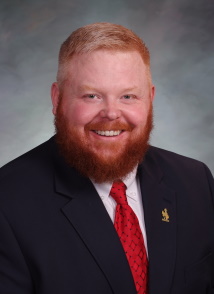
Rep. Cody Wylie
Sponsored bills
Maddy summaryHB 276 requires Wyoming county sheriffs to negotiate written agreements with the U.S. Attorney General to enforce federal immigration laws, including detaining individuals for immigration purposes. County sheriffs must report annually on agreement status to the Wyoming Attorney General, who then reports to a legislative committee, with counties failing to pursue agreements losing eligibility for certain law enforcement funds. This bill directly affects all Wyoming county sheriffs and their counties, mandating specific cooperation with federal immigration enforcement under 8 U.S.C. § 1357(g).
Maddy summaryHB 76 requires Wyoming health insurers to have Wyoming-licensed physicians or healthcare providers make decisions on prior authorization denials and review appeals, instead of relying solely on insurance company staff. It amends state insurance code sections to mandate that all such decisions be made by licensed providers with current Wyoming practice permits. The law applies to all prior authorization decisions made on or after July 1, 2025. This directly affects insurers, healthcare providers, and patients seeking coverage approvals in Wyoming.
Maddy summaryHB 126 repeals a sales tax on services that repair, alter, or improve tangible personal property (like car repairs or home renovations) in Wyoming. This directly affects businesses providing these services and their customers, who will no longer pay this tax on such work. The bill amends tax code sections to remove the tax requirement for these services, while keeping sales tax on digital products separate. The repeal takes effect July 1, 2025, with the Department of Revenue required to adopt implementing rules by that date.
Maddy summarySF 144 creates the Wyoming-Ireland Trade Commission to promote economic collaboration between Wyoming and Ireland. The commission, composed of nine appointed members (including representatives from Wyoming businesses, higher education, and the Irish-American community), will focus on expanding trade, investment, and business/academic exchanges. It requires quarterly meetings, annual reports to the governor and legislature, and reimburses non-legislative members for travel and per diem expenses. This bill directly establishes a formal structure to advance Wyoming-Ireland economic partnerships, affecting businesses, educational institutions, and the Irish-American community through their representation on the commission.
Maddy summaryThis Wyoming joint resolution (SJ 8) requests Congress to propose a constitutional amendment allowing states and Congress to establish reasonable limits on money spent to influence elections. It specifically seeks authority to distinguish between natural persons (individuals) and artificial entities like corporations, unions, or AI when setting these limits. The resolution argues that current Supreme Court interpretations equating unlimited spending with free speech undermine political equality, election integrity, and local representation. It does not create new laws but formally asks Congress to initiate a constitutional amendment process to address these concerns.
Maddy summarySF 121 creates special "Rodeo - The Official Sport of Wyoming" license plates for non-commercial vehicles. Owners can choose to donate $1 or more per plate, with funds distributed annually to support rodeo programs at the University of Wyoming and Wyoming community colleges. The plates require a $1+ fee beyond standard registration and will stop production if fewer than 500 are issued by December 2031. Production begins January 2026, with plates designed to include the official sport designation.
Maddy summaryWyoming's SF 39 allows vehicle owners to automatically transfer title to a named beneficiary upon death, bypassing probate. Owners complete a beneficiary designation form listing the vehicle details, all current owners, and the beneficiary's name, then sign it. Upon the owner's death, the beneficiary presents the form, proof of death, and a fee to the county clerk to receive a new title - without needing court involvement or the estate's approval. This applies only to vehicles with a properly executed form and does not affect existing liens or ownership interests.
Maddy summarySF 151 amends Wyoming's rules for distributing monthly ad valorem taxes collected from mineral production. It requires county treasurers to distribute these taxes by the 10th day of the following month, except for taxes collected after final reconciliation. Crucially, it prohibits distributing taxes to government entities that don't levy taxes under specific statutes (W.S. 39-13-104(k)), and mandates holding such taxes until reconciliation is complete. This bill directly affects county treasurers and local governments receiving mineral tax revenue, effective July 1, 2025.
Maddy summaryHB 172 repeals restrictions on concealed weapons in specific public spaces, allowing permit holders to carry guns in government meetings, school athletic events on public property, and school facilities (like classrooms and offices). It also strengthens Wyoming’s state law by preventing local governments from regulating firearms, declaring that only the state legislature can set rules for guns, ammunition, and weapons. The bill includes exceptions for health facilities, explosive materials, and private property rules, and adds penalties for blocking someone from entering permitted areas. School districts must establish training rules for employees carrying concealed weapons, requiring 16 hours of initial training and annual 12-hour recertification.