

Maddy summaryThis bill directs the Joint Committee on the Library to procure a statue of Benjamin Franklin and place it in the U.S. Capitol. The committee must secure the statue within two years of the bill's enactment and install it in a public-accessible location by January 1, 2026, for viewing during Capitol Visitor Center guided tours. It is a procedural measure with no policy changes or direct impact on constituents or legislation.
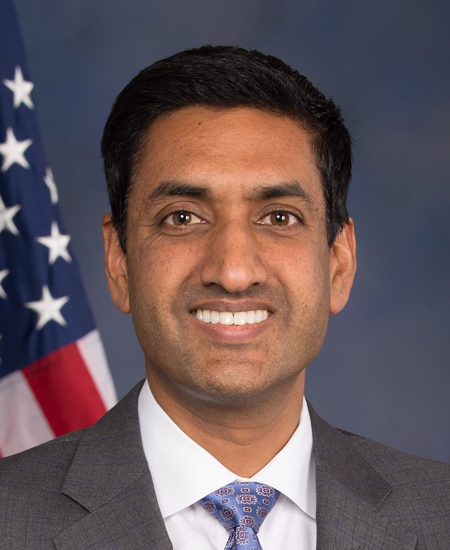
Rep. Ro Khanna
Sponsored bills
Maddy summaryThe Biotech Futures Act requires the Secretary of Defense to create a detailed roadmap for the Department of Defense’s biotechnology efforts. This roadmap must include specific goals, funding estimates, workforce planning (including position needs and training), risk assessments, and international collaboration strategies, with clear timelines for each element. The bill mandates annual updates to Congress and public posting of an unclassified version online. It directly affects how the DoD manages its biotechnology programs, personnel, and partnerships across military branches and defense agencies.
Maddy summaryHR 9626, the AIxBio Defense Sandbox Act, establishes a secure computing and data storage environment within the Department of Defense (DoD) for testing artificial intelligence models trained on biological data. It directly affects DoD-funded projects at the intersection of AI and biotechnology, requiring the Under Secretary of Defense for Research and Engineering to manage the "AIxBio sandbox" using existing DoD infrastructure. Key provisions include selecting projects with proven feasibility for defense applications - such as developing medical countermeasures or biomanufacturing solutions - and creating streamlined processes for collaboration between DoD, labs, and private entities. The bill mandates a report to Congress within one year detailing the sandbox plan and its implementation.
Maddy summaryHR 9639, the AI Ads Act, amends the Federal Election Campaign Act to prohibit using AI-generated content (like deepfakes or synthetic media) in campaign materials as fraudulent misrepresentation of campaign authority or fraudulent fund solicitation. It directly affects political campaigns, candidates, committees, and anyone creating campaign ads by requiring that AI-generated content cannot falsely claim to represent a candidate, party, or committee. The bill updates existing rules to explicitly include "content generated in whole or in part with artificial intelligence" within the definitions of fraud under Sections 322(a)(1) and 322(b)(1). This ensures that misleading AI-generated ads - such as those falsely attributing a statement to a candidate - would be treated as illegal fraud under current campaign finance law.
Maddy summaryThe ACTIVATE Act directs the U.S. Secretary of Defense to contract a federal research center to assess adversarial biotechnology capabilities, focusing on nations like China, Iran, and Russia. The assessment will identify scientific gaps and future needs of these adversaries in biotechnology and develop recommendations for U.S. defense planning. The Secretary must appoint DoD liaisons, provide necessary access to classified materials, and ensure proper security clearances for the research center. By October 1, 2025, the Secretary must submit an unclassified report (with a classified annex if needed) to congressional defense committees and the National Security Commission on Emerging Biotechnology, detailing findings and recommendations. This bill affects U.S. defense strategy and intelligence efforts related to biotechnology threats, without altering existing laws or imposing new obligations on the public.
Maddy summaryThis bill amends a provision in the U.S. Code to clarify that health care professionals providing specific examinations or assessments (under Section 10206) to reserve component military members must hold appropriate licensure. It directly affects reserve service members receiving these health evaluations and the health care professionals conducting them. The key change ensures that only licensed providers can perform these required health readiness assessments, strengthening oversight for reserve personnel's medical readiness. (Procedural bill; summary limited to 2 sentences as requested.)
Maddy summaryHR 820, the Foreign Adversary Communications Transparency Act, requires the Federal Communications Commission (FCC) to publish and annually update an online list of communications companies (like phone and internet providers) that have ownership ties to governments of specific countries deemed "covered" by the law: China, Russia, Iran, North Korea, Cuba, and Venezuela. The list includes entities holding FCC licenses or authorizations where a foreign government owns equity, or where the FCC determines it's necessary after consulting national security agencies. This bill directly affects telecommunications companies with such foreign government connections by mandating public transparency about their ownership structure. The key mechanism is the FCC's annual public listing, aiming to increase visibility into foreign influence in U.S. communications infrastructure.
Maddy summaryThe American Housing and Economic Mobility Act of 2024 provides down payment assistance to first-time homebuyers, expands Fair Housing Act protections to include gender identity, sexual orientation, marital status, source of income, and veteran status, and makes significant reforms to the Community Reinvestment Act to improve access to credit in underserved communities. The bill also provides housing loan benefits for direct descendants of veterans who served between 1944 and 1968, increases accessibility requirements for housing constructed with federal funds, and includes estate tax changes for high-value estates. It aims to address housing affordability, reduce discrimination in housing, and improve access to credit in underserved communities.
Maddy summaryHRES 1437 is a ceremonial resolution designating the week beginning September 9, 2024, as "National Hispanic-Serving Institutions Week." It recognizes Hispanic-serving institutions (HSIs) - colleges and universities with at least 25% Hispanic enrollment - and their role in educating low-income students, advancing economic mobility, and serving 31.7% of all undergraduate students. The resolution calls for the public and organizations to observe this week with ceremonies and activities during Hispanic Heritage Month. It does not create new laws, allocate funding, or change existing policies - it is purely a symbolic gesture of recognition.
Maddy summaryThis bill designates the U.S. Postal Service facility at 130 South Patterson Avenue in Santa Barbara, California, as the "Brigadier General Frederick R. Lopez Post Office Building." It updates all official U.S. government references to the building to reflect this new name, with no policy changes or funding impacts.