

Maddy summaryHR 8538 establishes a new interagency committee, chaired by the Office of Science and Technology Policy Director, to coordinate federal biotechnology regulation across agencies like USDA, FDA, and EPA. The committee must streamline oversight by creating clear regulatory pathways, reducing duplication, and developing a unified process to determine if biotech products could occur naturally. It requires annual reports to Congress detailing regulatory timelines, progress on coordination, and specific actions for emerging areas like molecular farming. The bill excludes human medical products regulated solely by the FDA and mandates a Comptroller General review to assess the committee's effectiveness. This aims to create a more predictable system for biotech developers while maintaining environmental and health protections.
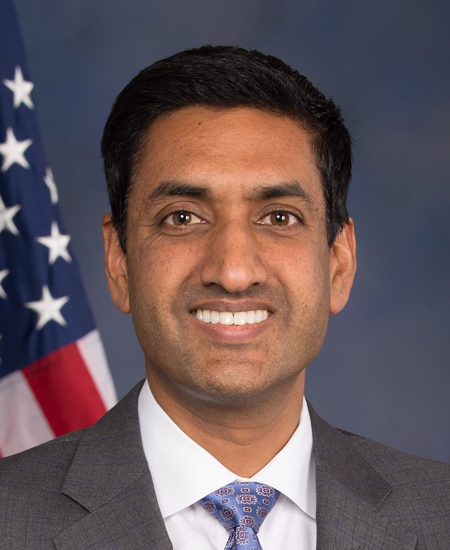
Rep. Ro Khanna
Sponsored bills
Maddy summaryHR 8096, the Future of Water Act of 2024, amends the Commodity Exchange Act and related law to prohibit the trading of water, water rights, or water-related financial products (like indices or data) as commodities for future delivery. This change directly affects commodity markets, futures traders, and entities seeking to create financial instruments based on water resources. The bill adds specific language to existing statutes to explicitly exclude water and water rights from being traded as future commodities, preventing their inclusion in futures contracts or related financial products. It does not alter water management, rights, or usage rules, only restricting their financial speculation in commodity markets.
Maddy summaryThe SPECTRUM Act (HR 9436) creates a competitive grant program at the National Science Foundation to fund peer-led research on autism spectrum disorder specifically focused on women and girls. It directs the NSF to support studies examining characteristics like masking or camouflaging in autistic girls/women, communication dynamics between autistic and neurotypical women (including the "double empathy problem" theory), and other related topics. The grants are intended to strengthen research opportunities through participatory approaches where community members collaborate with researchers. This legislation directly affects researchers and organizations seeking federal funding for autism studies centered on gender-specific experiences, without creating new regulations or benefits for individuals.
Maddy summaryHR 7588, the Agricultural Food Chemical Reassessment Act of 2024, requires the USDA to reassess seven specific chemical additives used in meat, poultry, and egg products by December 31, 2026. The bill mandates the Secretary of Agriculture to evaluate whether each additive (including BHA, BHT, sodium nitrite, and titanium dioxide) makes these products unfit for human consumption under existing food safety laws. Based on this review, the USDA must initiate potential rulemaking to update regulations governing these ingredients. The law directly affects food producers using these additives and sets a clear timeline for the reassessment process. This is a procedural requirement focused on reviewing current safety standards, not an immediate regulatory change.
Maddy summaryHR 6915, the Public Lands Telecommunications Act, requires federal land management agencies (like the National Park Service and Bureau of Land Management) to collect rental fees from telecom companies for infrastructure (such as cell towers) on federal lands. These fees must be set at fair market value, not exceeding existing Interior Department schedules, and deposited into special agency accounts. The collected funds can only be used by each agency to manage telecom sites - covering activities like processing permits, planning site locations, and improving access - without affecting other existing fee collections. The bill establishes a clear system for fee collection, valuation, and restricted spending to support telecom infrastructure on public lands.
Maddy summaryHR 9299, the IRAN Act, requires the U.S. Secretary of State to lead federal efforts promoting internet freedom and access to information in Iran. It amends a 2012 law to mandate specific strategy updates, including evaluating how activists use virtual private networks (VPNs) and satellite tech, developing guidance to prevent sanctions from blocking internet tools for Iranians, and planning to bypass government internet blackouts. The bill directs the State Department to coordinate with Treasury, Commerce, USAID, and intelligence agencies to implement these updates. This affects U.S. government agencies' coordination and aims to improve internet access for Iranian civil society activists.
Maddy summaryThe Campus Accountability and Safety Act amends the Clery Act to require colleges and universities to collect and report more detailed statistics about campus incidents of domestic violence, dating violence, sexual assault, sexual harassment, and stalking. It establishes new requirements for institutions to provide confidential support through "sexual and interpersonal violence specialists" who can help victims navigate reporting options and campus resources without triggering investigations. The bill mandates trauma-informed training for staff involved in addressing these incidents and requires institutions to provide clear information about their disciplinary processes and support services. It also creates specific reporting requirements about how many cases were reported to Title IX coordinators, how many victims sought campus disciplinary action, and how many cases were resolved through campus processes. Institutions that fail to comply may face civil penalties of up to 1% of their operating budget.
Maddy summaryThe NO BAN Act (HR 9244) prohibits U.S. immigration authorities from denying visas or entry based on national origin, religion, or sex. It amends immigration law to explicitly ban such discrimination in visa decisions and tightens restrictions on the president’s power to suspend entry of certain groups under Section 212(f). The bill requires specific evidence, narrow tailoring, time limits, and congressional notification for any entry restriction, while mandating public reports on visa denials and waivers. It directly affects nonimmigrant visa applicants (e.g., students, workers) and federal agencies administering immigration policy.
Maddy summaryHR 9253, the National Gun Violence Research Act, repeals longstanding restrictions that blocked federal funding for gun violence research, including the 1996 Dickey Amendment. It establishes a National Gun Violence Research Program to support scientific studies on gun-related injury and death, with $200 million authorized over six years (2025-2030). The program directs agencies like the CDC, NIH, and National Institute of Justice to fund research, train researchers, develop safety standards, and share gun trace data with researchers through new protocols. This bill directly affects federal research institutions and public health agencies by enabling evidence-based study of gun violence causes and prevention strategies.
Maddy summaryHRES 1394 is a non-binding resolution celebrating the U.S.-India partnership based on shared democratic values, religious pluralism, and human rights, while highlighting the contributions of the Indian diaspora in the United States. It specifically recognizes the 50th anniversary of BAPS Swaminarayan Sanstha's community work, including its spiritual centers (mandirs) and volunteer efforts across the country. The resolution does not create legal obligations but formally acknowledges these ties and achievements.