

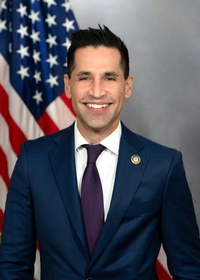
Photo of Tarik Khan
D Pennsylvania House · District 194 On the 2026 ballot

Rep. Tarik Khan

Compare
Total votes
3,935
all sessions
Attendance
100%
of floor votes
Near the chamber average
With party
99%
of cast votes
Near the chamber average
Bipartisan score
0%
crosses aisle rarely
Lower than 78% of chamber peers
Sponsored
2,225
bills & resolutions
Higher than 97% of chamber peers
Committees
5
assignments
2,225 bills and resolutions

Sponsored bills

Total
2,225
Primary
87
Co-sponsor
2,138
This page
2,225
matching current filters
Co-sponsor HB 1460
Passed · Pennsylvania House · Co-sponsor
An Act providing for approval from the Department of Health and the Office of Attorney General before certain transactions involving health care entities within this Commonwealth.

Maddy summaryHB 1460, the Health System Protection Act, requires health care entities (like hospitals and clinics) and certain investors (such as private equity firms) to obtain pre-approval from Pennsylvania's Department of Health and Attorney General before completing major transactions. This applies to sales of assets worth $10 million or more, ownership changes, or large financial distributions that could affect competition, costs, or access to care. The law prohibits transactions deemed "against the public interest," such as those reducing competition, raising prices, or limiting services in rural or low-income areas. Health care entities must either file a notification with a waiting period or get written approval before proceeding.

Passed Jun 24, 2026 1 co-sponsor
Primary HB 2648
In committee · Pennsylvania House · Lead sponsor
An Act amending Title 40 (Insurance) of the Pennsylvania Consolidated Statutes, in regulation of insurers and related persons generally, providing for health insurance alteration prohibitions.

Maddy summaryThis bill prohibits licensed health insurers in Pennsylvania from increasing costs such as premiums, copayments, coinsurance, or deductibles for specific health care services that were already covered under a policy. The law applies to individual and group health insurance plans but excludes self-funded employer plans and other limited benefit policies. Insurers may still raise costs if a service was obtained through fraud or if the U.S. Food and Drug Administration issues a warning about safety or if a drug manufacturer announces a discontinuance. Violations of these rules would be treated as unfair trade practices and could result in a civil penalty of up to $1,000 for the insurer.

In committee Jun 23, 2026 0 co-sponsors
Co-sponsor HB 2626
In committee · Pennsylvania House · Co-sponsor
An Act amending the act of December 17, 1968 (P.L.1224, No.387), known as the Unfair Trade Practices and Consumer Protection Law, further providing for definitions.

Maddy summaryThis bill amends Pennsylvania's Unfair Trade Practices and Consumer Protection Law to specifically define "dynamic pricing" and regulate its use in physical retail stores. It defines dynamic pricing as prices that change in near real-time based on fluctuating conditions, while explicitly excluding standard promotional discounts or loyalty program benefits. Under the new rules, retailers cannot use electronic displays in their brick-and-mortar locations to show prices that can be remotely altered by automated systems using this method. The legislation aims to clarify what constitutes deceptive pricing practices for the Attorney General and District Attorneys to enforce, and it will take effect 60 days after being signed into law.

In committee Jun 23, 2026 1 co-sponsor
Co-sponsor HB 2184
In committee · Pennsylvania House · Co-sponsor
An Act amending Title 66 (Public Utilities) of the Pennsylvania Consolidated Statutes, in general provisions, further providing for definitions; in powers and duties, providing for public interest; and, in rates and distribution systems, further providing for rates to be just and reasonable, for voluntary changes in rates and for rates fixed on complaint and investigation of costs of production.

Maddy summaryHB 2184 amends Pennsylvania's public utilities law to define "public interest" and require the Public Utility Commission (PUC) to consider eight specific factors when making utility decisions. These factors include residential rate affordability, energy strategy (renewables, distributed generation, energy efficiency), grid modernization, environmental protection, economic growth (jobs, tax revenue), reliability, and environmental justice. The bill updates existing provisions about "just and reasonable" rates (Section 1301), mandatory 60-day notice for rate changes (Section 1308), and complaint-based rate investigations (Section 1309). It directly affects all utility companies operating in Pennsylvania and the PUC, which must now document how decisions align with these public interest factors. The bill takes effect 60 days after enactment.

In committee Jun 23, 2026 1 co-sponsor
Co-sponsor HB 550
In committee · Pennsylvania House · Co-sponsor
An Act providing for bisphenol A-free container products for infants.

Maddy summaryHB 550, the BPA-free Container Products for Infants Act, prohibits the manufacture, sale, or distribution of infant food and beverage containers containing bisphenol A (BPA) above 0.1 parts per billion. It requires manufacturers to use the least toxic alternative when replacing BPA and bans substitutions with EPA-identified carcinogens or reproductive toxicants. The law applies to all containers intended for infants under one year old and will take effect 60 days after enactment. Violations would be enforced under Pennsylvania's Unfair Trade Practices and Consumer Protection Law, subjecting offenders to civil penalties and private lawsuits.

In committee Jun 23, 2026 1 co-sponsor
Co-sponsor HR 363
Passed · Pennsylvania House · Co-sponsor
A Resolution directing the Joint State Government Commission to study Pennsylvania's early childhood education system, including the impact of public and private equity in child care and make recommendations for improvements that are necessary to increase access to affordable, high-quality care for all families across this Commonwealth.

Maddy summaryThis resolution directs Pennsylvania's Joint State Government Commission to study how private equity ownership affects child care services. The study will examine impacts on costs, quality, and access for families, then propose recommendations to limit negative effects. It directly affects child care providers operating under private equity ownership and families using these services. The Commission must complete this work and report findings to the legislature.

Passed Jun 23, 2026 1 co-sponsor
Co-sponsor HB 462
Passed · Pennsylvania House · Co-sponsor
An Act amending Title 42 (Judiciary and Judicial Procedure) of the Pennsylvania Consolidated Statutes, in limitation of time, further providing for infancy, insanity or imprisonment; in matters affecting government units, further providing for exceptions to sovereign immunity and for exceptions to governmental immunity; and making a repeal.

Maddy summaryHB 462 amends Pennsylvania law to extend time limits for filing lawsuits involving minors, individuals with mental incapacity, or those imprisoned. It also clarifies when government units (like cities or counties) can be sued by specifying exceptions to sovereign immunity. The bill directly affects citizens seeking legal action against government entities and the government units themselves, by changing deadlines and liability rules. Key provisions include updating filing deadlines for specific vulnerable groups and defining clearer scenarios where governments lose immunity from lawsuits. This is a substantive policy change to court procedures, not a procedural or commemorative measure.

Passed Jun 23, 2026 1 co-sponsor
Co-sponsor HB 464
Passed · Pennsylvania House · Co-sponsor
A Joint Resolution proposing an amendment to the Constitution of the Commonwealth of Pennsylvania, further providing for courts to be open and suits against the Commonwealth.

Maddy summaryHB 464 is a constitutional amendment proposal that would ensure Pennsylvania courts remain open for lawsuits against the state government (the "Commonwealth"). It directly affects residents, businesses, and local governments who may need to sue the state for issues like contract disputes or government actions. The key provision would amend the state constitution to guarantee access to courts for such cases, removing potential barriers to filing suit. This is a procedural change to constitutional access, not a new law with specific funding or regulations.

Passed Jun 23, 2026 1 co-sponsor
Co-sponsor HB 2643
In committee · Pennsylvania House · Co-sponsor
An Act amending Title 7 (Banks and Banking) of the Pennsylvania Consolidated Statutes, providing for virtual currency kiosks; imposing requirements on the Department of Banking and Securities; establishing the Virtual Currency Kiosk Public Education Campaign Fund; and imposing penalties.

Maddy summaryThis bill would allow Pennsylvania to regulate virtual currency kiosks by requiring most businesses to obtain a license from the Department of Banking and Securities, while exempting existing banks and credit unions. To operate legally, applicants must meet specific financial standards and use a centralized online system for registration, and the kiosks must provide clear information to customers about the exchange process. The legislation also creates a dedicated fund to support public education efforts regarding virtual currency and establishes penalties for operating without a license or violating other rules.

In committee Jun 22, 2026 1 co-sponsor
Co-sponsor HB 2657
In committee · Pennsylvania House · Co-sponsor
An Act providing for the regulation and sale of kratom products; imposing a tobacco products tax on natural kratom products; imposing duties on the Department of Health; and imposing penalties.

Maddy summaryThis bill establishes a regulatory framework for the sale of kratom products in Pennsylvania, requiring businesses to register with the Department of Health and prohibiting the sale of synthetic kratom varieties. It mandates that retailers verify customers are at least 21 years old using electronic ID scanners and strictly forbids sharing this data, while also enforcing specific labeling and child-resistant packaging requirements. Additionally, the legislation imposes a tax on natural kratom products and outlines penalties for violations, aiming to standardize oversight and protect public health.

In committee Jun 22, 2026 1 co-sponsor
Showing 81 to 90 of 2,225 bills
Previous 1 … 8 9 10 … 223 Next