

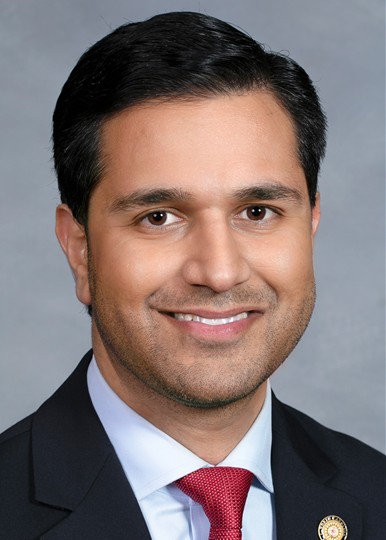
Photo of Mujtaba Mohammed
D North Carolina Senate · District 38 On the 2026 ballot

Sen. Mujtaba Mohammed

Compare
Total votes
1,182
all sessions
Attendance
93%
78 missed
Near the chamber average
With party
97%
of cast votes
Near the chamber average
Bipartisan score
1%
crosses aisle rarely
Near the chamber average
Sponsored
581
bills & resolutions
Higher than 91% of chamber peers
Committees
11
assignments
581 bills and resolutions

Sponsored bills

Total
581
Primary
61
Co-sponsor
520
This page
581
matching current filters
Co-sponsor SB 441
In committee · North Carolina Senate · Co-sponsor
Revive High-Need Retired Teachers Program.

Maddy summarySB 441 revives and expands a program allowing retired teachers to return to work in high-need North Carolina schools without losing their retirement benefits. The bill requires school districts to certify these teachers to the retirement system annually and mandates monthly reports on their employment terms and pay. Retired educators rehired under this program retain their full retirement allowance, and school districts must cover employer health insurance premiums for them. This directly affects retired teachers returning to high-need schools, school districts hiring them, and the state retirement system’s benefit calculations. The program expires June 30, 2027, unless IRS status is jeopardized, triggering automatic repeal.

In committee Mar 25, 2025 1 co-sponsor
Co-sponsor SB 432
In committee · North Carolina Senate · Co-sponsor
Home Ownership Market Manipulation.

Maddy summarySB 432 prohibits large business entities from purchasing 100 or more single-family homes in qualifying counties (population over 150,000) for rental use. It directly affects real estate investment firms and corporations that buy homes solely as rentals, aiming to prevent artificial inflation of home prices by limiting excessive bulk acquisitions. The law defines "single-family home" as detached, semi-detached, or townhomes meeting specific separation criteria and imposes civil penalties of up to $100 per day per home for violations. Enforcement is handled by the Attorney General or individuals through civil lawsuits, with remedies including damages, attorney fees, and joint liability for affiliated entities. The bill applies to home purchases occurring on or after its effective date.

In committee Mar 25, 2025 1 co-sponsor
Co-sponsor SB 436
In committee · North Carolina Senate · Co-sponsor
Age with Dignity Act (Caregiver Tax Credit).

Maddy summarySB 436, the Age with Dignity Act, creates a new tax credit for North Carolina taxpayers who care for adult dependents. It provides a $15,000 credit for caregivers supporting a veteran relative and $12,000 for others, directly affecting families claiming dependent adults as tax exemptions. To qualify, taxpayers must earn below specific income thresholds ($75,000 single, $112,500 head of household, $150,000 married filing jointly) and have adjusted gross income under these limits. The credit reduces state tax liability for qualifying taxpayers and takes effect for 2025 tax years.

In committee Mar 25, 2025 1 co-sponsor
Co-sponsor SB 426
In committee · North Carolina Senate · Co-sponsor
Student Borrowers' Bill of Rights.

Maddy summarySB 426, the Student Borrowers' Bill of Rights, requires the North Carolina Commissioner of Banks to license and regulate student loan servicers operating in the state, directly affecting borrowers who took out loans for education at North Carolina institutions or for in-state school expenses. The bill mandates that all student loan servicers (excluding banks, credit unions, state entities, and certain educational institutions) obtain a license through the Nationwide Multistate Licensing System, ensuring fair treatment and clear accountability. It establishes a Student Loan Ombudsman position to handle borrower complaints and defines key terms like "servicer" and "overpayment" to clarify protections. The law aims to prevent unfair practices by standardizing servicer conduct and providing borrowers with a formal complaint pathway.

In committee Mar 25, 2025 1 co-sponsor
Co-sponsor SB 392
In committee · North Carolina Senate · Co-sponsor
Safeguard Fair Elections.

Maddy summarySB 392 creates new criminal penalties for threatening or pressuring voters, election officials, or poll workers to influence voting choices or election participation. It makes it a felony to threaten someone for voting, voting for a specific candidate, registering to vote, or for election workers performing duties, and prohibits fraudulent challenges to voter eligibility. Employers cannot condition pay or employment on voting behavior, with violations carrying fines up to $100,000 or five years in prison. Convicted individuals must pay restitution fines that fund voter education programs, and election workers can seek civil damages for intimidation.

In committee Mar 25, 2025 1 co-sponsor
Co-sponsor SB 437
In committee · North Carolina Senate · Co-sponsor
Middle Class Momentum Act.

Maddy summarySB 437, the "Middle Class Momentum Act," increases North Carolina's standard income tax deduction for individual filers starting in 2026. It raises the standard deduction to $26,000 for married couples filing jointly (from $25,500), $19,500 for heads of household (from $19,125), and $13,000 for single filers (from $12,750). This change directly affects most North Carolina individual taxpayers who claim the standard deduction instead of itemizing deductions. The bill takes effect for taxable years beginning January 1, 2026.

In committee Mar 25, 2025 1 co-sponsor
Co-sponsor SB 431
In committee · North Carolina Senate · Co-sponsor
Protect Whistleblower LEOs from Retaliation.

Maddy summarySB 431 protects law enforcement officers (including criminal justice and justice officers) who report excessive force or misconduct by colleagues. It requires officers to report such incidents within 72 hours to a supervisor not involved, and prohibits retaliation like termination or discipline for making a good-faith report. The bill explicitly allows agencies to still discipline officers for misconduct that occurred *before* the report was made. It also allocates $50,000 each to two training commissions for implementing these changes, effective December 2025.

In committee Mar 25, 2025 1 co-sponsor
Co-sponsor SB 433
In committee · North Carolina Senate · Co-sponsor
Restore Educator Longevity.

Maddy summarySB 433 reinstates longevity pay for North Carolina educators, directly affecting teachers, instructional support staff, principals, and assistant principals in public schools. It sets specific annual payment rates based on years of state service: 1.5% for 10-14 years, 2.25% for 15-19 years, 3.25% for 20-24 years, and 4.5% for 25+ years, paid as a lump sum each year. The bill appropriates $140.3 million from the General Fund for the 2025-2026 fiscal year to fund these payments. It becomes effective July 1, 2025, restoring previously cut longevity benefits.

In committee Mar 25, 2025 1 co-sponsor
Co-sponsor SB 452
In committee · North Carolina Senate · Co-sponsor
End Child Marriage.

Maddy summarySB 452 raises North Carolina's minimum marriage age to 18 for all individuals, eliminating exceptions that previously allowed 16- and 17-year-olds to marry with court approval or parental consent. The bill repeals existing provisions (G.S. 51-2(a1) and G.S. 51-2.1) that permitted judicial authorization for marriages involving minors under 18, including requirements for court orders, guardian ad litem appointments, and best-interest determinations. This change directly affects minors under 18 who would have sought marriage under the previous law, removing all pathways for underage marriage except for those 18 or older. The policy shift standardizes the marriage age without exceptions, aligning North Carolina with states that prohibit marriage for individuals under 18.

In committee Mar 25, 2025 1 co-sponsor
Co-sponsor SB 476
In committee · North Carolina Senate · Co-sponsor
Allow Widow/Widower To Hyphenate Name.

Maddy summaryThis bill allows widows and widowers in North Carolina to legally hyphenate their pre-marriage surname with their late spouse's surname. It amends state law to add this option as a specific choice when changing a name after the death of a spouse, alongside existing choices like resuming a maiden name or using a prior spouse's surname. To implement this, individuals would apply to their county clerk of court with proof of the spouse's death, similar to current name change procedures. The change directly affects widows and widowers seeking a formal, legally recognized hyphenated surname combining their pre-marital and deceased spouse's last names.

In committee Mar 25, 2025 1 co-sponsor
Showing 161 to 170 of 581 bills
Previous 1 … 16 17 18 … 59 Next