

Maddy summaryThis bill modifies North Carolina's Cosmetic Art Act to create a new professional category called "hair designer" specifically for natural hair care services. It reduces the training hours required to become a licensed cosmetologist and removes the apprenticeship requirement for licensure. The legislation also formally defines "natural hair care" as services that involve tension on hair strands through twisting, wrapping, extending, or locking. These changes aim to deregulate certain hair care practices while establishing new licensing pathways for specialists in that field.

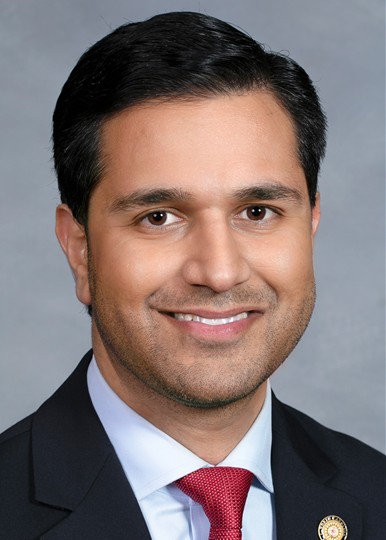
Sen. Mujtaba Mohammed
Sponsored bills
Maddy summaryThis bill adds a new member to the General Statutes Commission of North Carolina, representing the High Point University School of Law. The amendment changes the commission's composition to include 14 members instead of 13, ensuring one seat is filled by an appointment from the dean of that specific law school. Appointments for this new seat will occur in odd-numbered years, with the initial term scheduled to begin in September 2026 and end in August 2029. The legislation affects the structure of the body responsible for reviewing and updating the state's legal code.
Maddy summaryThis Senate resolution formally initiates the process to confirm Nathaniel Denny as the Secretary of North Carolina's Department of Information Technology. The bill requires the Senate to review and vote on the Governor's nomination for this leadership position, as mandated by state law and the state constitution. It does not change any laws or policies but serves as a procedural step to evaluate the appointment before it becomes official.
Maddy summaryThis bill establishes the North Carolina Economic Forecasting Initiative within the Kenan-Flagler Business School to collect and analyze county-level economic data. It appropriates $3 million in recurring funds starting in the 2026-2027 fiscal year to support this effort, with the goal of providing policymakers and businesses with data to foster local economic growth. The legislation requires state and local government agencies to cooperate by providing necessary data for accurate forecasting and mandates annual reports to legislative oversight committees beginning in December 2026.
Maddy summaryThis bill allocates $319 million from the state's General Fund to North Carolina's Medicaid program to cover anticipated changes in enrollment, service costs, and federal funding rates. The money is designated for the Department of Health and Human Services to use starting in the 2025-2027 fiscal year, with the funding officially beginning retroactively on July 1, 2025. By adjusting available funds based on projected healthcare shifts, the legislation aims to ensure the Medicaid program has sufficient resources to operate as demographics and costs evolve.
Maddy summaryThis North Carolina bill removes state funding limits on light rail and commuter rail projects and allocates money for rail safety. It amends existing statutes to allow the Department of Transportation to provide more than the current ten percent cap on state funding for these rail initiatives. Additionally, the legislation directs one million dollars from the Highway Fund to the Department of Transportation specifically for safety and security measures on the CATS Blue Lynx rail line. The changes are scheduled to take effect on July 1, 2026.
Maddy summaryThis North Carolina bill requires that the salaries of state legislators be held in escrow if the General Assembly does not pass a budget by June 30, 2026. If the Senate and House do not ratify a state budget for the 2026-2027 fiscal year by that deadline, the pay earned by legislators from July 1, 2026, forward will be withheld. The withheld funds will be released only after the legislature ratifies a budget or adjourns for the year. The legislation also sets aside ten thousand dollars to cover the administrative costs of managing the escrow account.
Maddy summarySB 1062 directs the North Carolina Department of Transportation to conduct a study on improving commuter transportation in the Piedmont Triad region, specifically focusing on Winston-Salem, High Point, and Greensboro. The bill requires the study to evaluate the feasibility of a commuter rail system while also considering other options like bus rapid transit, regional bus networks, and roadway expansions. It mandates an analysis of funding sources, governance structures for a potential regional transit authority, and the economic impacts of various transportation modes through 2050. The legislation appropriates $250,000 for this study, which must be completed and reported to state committees by December 29, 2026.
Maddy summaryThis bill updates North Carolina's foster care insurance rules to clarify how foster parents can remove coverage for children who no longer live with them and to create a new insurance program for foster youth. It requires the state insurance rate bureau to develop a specific policy option that allows foster children to be listed as named drivers on non-owner insurance policies, ensuring they can legally operate vehicles provided to them. Additionally, the legislation establishes a financial assistance program funded by $1 million to help cover the extra cost of adding foster children to a parent's insurance or to pay for separate non-owner policies, provided the youth has completed an approved driver's education course. These changes aim to ensure foster youth have valid liability coverage while reducing the financial burden on foster families and the state.
Maddy summaryThis North Carolina bill establishes a new regulatory framework specifically for large nonresidential electricity customers who consume 50 megawatts or more. It requires electric utilities to file tariffs that include strict contract terms, such as a minimum 20-year service agreement, mandatory load usage guarantees, and significant upfront payments to cover the cost of infrastructure upgrades needed to serve these clients. The legislation also mandates that these customers pay exit fees if they terminate service early or fail to meet their contracted energy demands, ensuring that other ratepayers are not financially burdened by their departure. Additionally, the bill creates a program allowing these large customers to purchase dedicated clean energy resources while ensuring that residential and small commercial customers are neither advantaged nor disadvantaged by these arrangements.