

Maddy summarySB 409 bans the sale, possession, and transfer of "ghost guns" (unserialized firearms like homemade kits) and "undetectable firearms" (e.g., plastic guns or those avoiding metal detectors). It directly affects most North Carolinians, including gun owners and sellers, with exceptions only for federally licensed firearm manufacturers under ATF rules. The law imposes Class I felony penalties for violations and takes effect December 1, 2025. Key provisions define prohibited items based on federal standards and prohibit all non-licensed activity involving them.
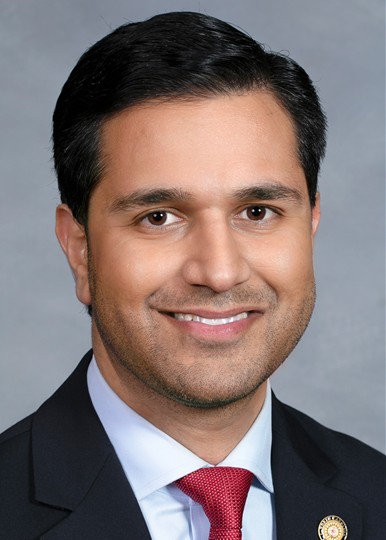
Sen. Mujtaba Mohammed
Sponsored bills
Maddy summarySB 413, titled "Right to Use Contraception," declares that North Carolina has no legitimate interest in limiting access to contraception for pregnancy prevention. It directly affects all residents by affirming their right to use contraception without state interference, adding a new legislative declaration to the state statutes. The bill’s key mechanism is a policy statement in Chapter 90 of North Carolina’s General Statutes, explicitly stating that preventing pregnancy through contraception is protected. It does not change existing laws or create new regulations but formally codifies this policy position. The measure is currently in early committee review after its initial filing and first reading.
Maddy summarySB 412 increases North Carolina's childcare subsidy rates to the 75th percentile of typical market rates starting July 2025, with an additional 10% boost for rural counties and infant/toddler care (birth to 3 years). It allocates $123.5 million annually for 2025-2027 to fund these rate increases for childcare centers and homes. The bill also provides $8 million for a two-year pilot program in western NC regions impacted by Hurricane Helene, managed by regional councils to recruit new childcare providers and establish mentorship for sustainability. The pilot will track new childcare centers, family homes, and slots created across five designated regions, with progress reports required for oversight.
Maddy summarySB 419 restores local governments' authority to down-zone (reduce density) in their communities by repealing a previous restriction (Section 3K.1 of S.L. 2024-57). This directly affects cities and counties, allowing them to adopt zoning changes that limit building density or height, such as converting high-density zones to lower-density uses. The bill applies retroactively to December 11, 2024, meaning any zoning ordinances affected by the repealed law are treated as valid from that date. It does not create new zoning rules but returns discretion to local governments that was previously restricted.
Maddy summarySB 398 bans the possession or carrying of dangerous weapons at North Carolina voting locations, within 100 feet of a polling place entrance, and while in line to vote. It directly affects voters and others near polling sites during voting hours, applying to all weapons defined under existing law (G.S. 14-277.2). The law creates a Class 1 misdemeanor penalty for violations, with an exception for law enforcement officers performing official duties. This bill aims to enhance safety at polling places by restricting weapons in specific proximity to voting areas during active voting periods.
Maddy summarySB 448 removes two key barriers to Medicaid eligibility for North Carolina workers with disabilities under the "Health Coverage for Workers with Disabilities" program. It eliminates the federal limits on unearned income (like Social Security benefits) and countable assets (savings) that previously disqualified people from maintaining Medicaid coverage while working. The bill requires the state to seek federal CMS approval within 90 days to remove these limits, with implementation effective after CMS approval (targeting a July 2025 effective date). This change directly affects individuals with disabilities who currently face penalties for saving money or receiving certain benefits while enrolled in Medicaid, allowing them to retain healthcare coverage without losing eligibility due to income or asset thresholds. The state will provide $165,000 annually in funding for implementation starting July 2025.
Maddy summarySB 466 ensures continuity of care for North Carolina Medicaid beneficiaries with behavioral health and intellectual disabilities (BH IDD) who use specialized "Tailored Plans." It allows these individuals to stay in the standard Medicaid fee-for-service program (Medicaid Direct) if their current healthcare providers aren't in their Tailored Plan's network, and to choose a Tailored Plan outside their geographic area if it offers better services or provider access. The bill also requires the state to submit CMS waiver amendments by July 2025 and report to lawmakers by August 2025 on promoting competition among managed care organizations to improve care quality. These changes directly affect BH IDD Medicaid participants and aim to reduce disruptions in their healthcare.
Maddy summarySB 434, the School Workers Fair Pay Act, requires North Carolina public schools to pay all noncertified employees (such as cafeteria workers, custodians, and administrative staff) a minimum hourly wage of $17.00, effective July 1, 2025. The bill mandates the State Board of Education to adjust salary schedules to meet this rate and allocates $144.7 million from the General Fund to the Department of Public Instruction for the 2025-2026 fiscal year to support this change. Funds must supplement existing salaries without replacing current state or local funding. This policy directly affects thousands of non-teaching school staff across all North Carolina public school districts.
Maddy summarySB 446 increases funding for North Carolina's Housing Trust Fund to address the state's affordable housing shortage. It allocates $30 million in one-time funding for the 2025-2026 fiscal year and establishes recurring revenue streams: 1.5% of property transfer fees and 33% of real estate excise tax proceeds will now flow directly to the fund. This funding supports affordable housing solutions like rentals, home ownership, and repairs for North Carolinians struggling with housing costs - over 815,000 residents currently lack access to affordable housing. The bill aims to rebuild the fund's capacity after a 68% funding decline over the past decade.
Maddy summarySB 473 creates the Capital for Communities Special Fund, a dedicated state fund that will receive 3.5% of certain investment earnings (when quarterly returns exceed 7%) from state funds managed by the Treasurer. The fund will provide grants for economic development projects in North Carolina, specifically targeting affordable housing, childcare centers, healthcare facilities addressing shortages, medical research, workforce development, living-wage jobs, and nonprofit education facilities. These grants must directly support community-based initiatives meeting the specified criteria. The bill establishes clear eligibility rules for fund usage but does not detail application processes or allocation priorities.