

Maddy summarySB 548 requires North Carolina law enforcement officers (LEOs) to report observed excessive force or improper activity within 72 hours to a superior officer, and prohibits retaliation against LEOs for making such reports. The bill explicitly states that officers cannot be terminated, disciplined, or retaliated against for reporting, though disciplinary action for unrelated misconduct prior to the report remains permitted. It also makes knowingly false reports a Class 2 misdemeanor and extends protection to officers disclosing any violation of law, rule, or regulation to supervisors or government agencies. The law takes effect December 1, 2025, applying to reports made on or after that date.
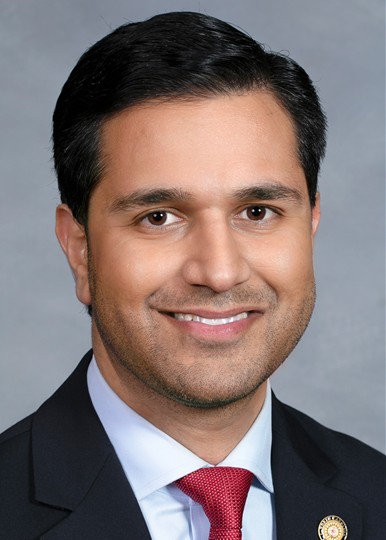
Sen. Mujtaba Mohammed
Sponsored bills
Maddy summarySB 623 would allow firefighters, police officers, and EMTs (first responders) in North Carolina to collectively bargain with local governments or state agencies over wages, benefits, and working conditions. It amends a current law that prohibits such negotiations for first responders, making it the first time they could formally negotiate as a group. The bill maintains the existing ban on strikes by public employees. If passed, it would directly affect all first responders statewide, changing their labor rights under state law.
Maddy summarySB 534 allocates $237.5 million in one-time state funding from the Capital and Infrastructure Fund for capital projects at two North Carolina universities. Specifically, it provides $125 million to North Carolina A&T State University for an Agricultural Research Classroom and $112.5 million to Winston-Salem State University for a Health, Physical Education, and Recreation Complex. The funding is designated for the 2025-2026 fiscal year and becomes effective July 1, 2025. This bill directly affects the operations and infrastructure development of these two public universities.
Maddy summarySB 632 ("Homes for Heroes") creates a homebuyers' assistance program for North Carolina public servants (including teachers, firefighters, law enforcement, and emergency medical personnel) who are first-time homebuyers. It provides up to $25,000 or 10% of a home's purchase price - covering down payments, mortgage insurance, and closing costs - using $200 million in state funds, with mortgage assistance limited to 60 months. Separately, it establishes a tax credit for volunteer firefighters and rescue workers who incur unreimbursed work expenses, capping the credit at $5,000 or the taxpayer's annual income tax liability, requiring 36 hours of annual training. The program begins July 1, 2025, and the tax credit applies to taxable years starting January 1, 2025.
Maddy summarySB 560 establishes a state task force to address racial disparities in cases involving missing and murdered Black, Indigenous, and People of Color (BIPOC) women and girls. The task force, composed of state agency representatives and community members with lived experience, will develop policies to improve law enforcement responses, collect better data on missing persons, and create public awareness campaigns. It will specifically focus on ending the misclassification of cases (e.g., labeling Black girls as "runaways"), addressing systemic barriers in reporting, and developing culturally competent protocols for first responders. The task force must submit a report with recommendations within two years of the bill’s enactment.
Maddy summarySB 592 allocates $25 million annually from 2025-2027 to fund one-time grants for North Carolina counties and private employers to expand child care capacity. The grants cover construction, equipment, facility upgrades, and playgrounds, with recipients required to provide a 25% matching contribution. Up to 9% of the grant funds can be used for administrative costs. The bill becomes effective July 1, 2025, directly supporting child care providers seeking to improve facilities and services.
Maddy summarySB 630, the School Mental Health Support Act, creates two programs to improve student mental health services in North Carolina public schools. It appropriates $50 million for a grant program to help schools hire mental health support personnel (like counselors and psychologists), prioritizing schools serving students without insurance or with disabilities. Additionally, it allocates $50 million for a loan repayment program covering 20% of student debt annually for mental health workers (e.g., counselors, psychologists) who graduated from UNC schools and work in high-need areas. Both programs require annual reporting to legislative committees on funding distribution and outcomes. The bill directly affects public school units and mental health professionals in North Carolina.
Maddy summarySB 622 requires North Carolina employers to provide earned paid sick leave, directly affecting over 1.6 million private-sector workers currently without access. Employees earn 1 hour of paid sick time for every 30 hours worked, with small businesses (10 or fewer employees) limited to 32 hours annually and larger employers to 56 hours. Workers can use this time for their own health needs, family care, or addressing domestic violence, sexual assault, or stalking. The law applies to all covered employees except certain exempt workers and volunteers, aiming to ensure workers don’t lose pay for essential health-related absences.
Maddy summarySB 641 reenacts North Carolina's refundable child tax credit, providing financial support to low- and moderate-income families with children. It offers $1,900 annually for each child under age 6 and $1,600 for older qualifying children, with credit amounts phasing out based on income (e.g., married couples filing jointly receive full credit up to $40,000 AGI, reduced to $100 between $40,000-$100,000, and none above $100,000). The credit is refundable, meaning families may receive a cash payment if the credit exceeds their state tax liability. This policy directly affects North Carolina households with children who meet income thresholds, aiming to reduce child poverty by supplementing family income. The bill takes effect for tax years beginning January 1, 2025.
Maddy summarySB 643 expands North Carolina's Teaching Fellows Program by increasing funding for forgivable loans to recruit and support future teachers in high-need areas. It directly affects students pursuing teaching careers in qualifying fields (like STEM, special education, and elementary education) and North Carolina public schools facing teacher shortages, especially in rural communities. The bill establishes a Trust Fund to cover loan costs, administrative expenses, and new support services - including mentoring for teachers in low-performing schools and recruitment efforts targeting regions with the worst teacher retention. Key provisions include prioritizing funding for rural schools and requiring the program to use stricter selection criteria for applicants based on academic performance.