

Maddy summaryHB 402 requires North Carolina state agencies to assess the financial impact of proposed permanent rules. If a rule would cost affected individuals or businesses $20 million or more over five years, it must be approved by the General Assembly before taking effect. For rules with a $1 million or more annual cost impact, agencies must prepare a fiscal note for review by the Office of State Budget and Management. The bill also mandates a two-thirds vote by agency boards to adopt rules exceeding the $1 million cost threshold. This directly affects state agencies creating regulations and the businesses or residents who would bear the costs of those rules.
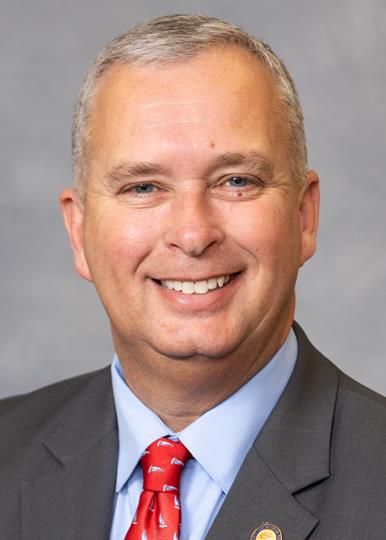
Rep. Todd Carver
Sponsored bills
Maddy summaryHB 193 would allow certain employees and volunteers at nonpublic schools (including private/religious schools) to carry firearms or stun guns on school property if authorized by the school board, trained in gun safety, and following written school policies. It also permits concealed handgun carry on school grounds only when attending religious services or ceremonies at affiliated places of worship (e.g., churches), outside school hours or during designated events. The bill increases penalties for assaulting elected officials or law enforcement officers and requires judges - not prosecutors - to set pretrial release conditions for such offenses. Currently withdrawn from committee after a first reading, this bill has not become law.
Maddy summaryHB 546 modernizes North Carolina's Medicaid program by requiring the state to develop team-based care coordination for individuals with alcohol and opioid use disorders, including screening, medication, and recovery support. The bill also allows telehealth-only providers to enroll in Medicaid without needing a physical office in the state and mandates a statewide specialty plan for children in foster care or receiving adoption assistance, to be implemented by December 2025. These changes directly affect Medicaid beneficiaries with substance use disorders, telehealth providers, and eligible children and families. The Department of Health and Human Services must report on the implementation of the substance use care and telehealth provisions by October 1, 2025.
Maddy summaryHB 612, the "Fostering Care in NC Act," updates North Carolina's laws governing child abuse, neglect, and dependency cases. It expands the definition of "abused juveniles" to include specific offenses like sexual crimes, human trafficking, and certain violent acts, affecting how cases are classified. The bill requires county social services directors to use either a family-centered assessment or a formal investigation when reviewing reports, and to collect military affiliation details of the juvenile's caregiver. It also clarifies that court jurisdiction over juveniles continues until age 18, emancipation, or death. These changes standardize responses to child welfare reports and improve information gathering for safety decisions.
Maddy summaryHB 373 allows University of North Carolina (UNC) institutions to offer tuition discounts to two specific groups: military students receiving federal or North Carolina National Guard tuition assistance, and students enrolled in employer-sponsored financial support programs approved by UNC. The discount covers the difference between the military/employer funding and full tuition, without creating new free tuition programs. UNC must report annually to the legislature on the number of students receiving these discounts and their financial impact on institutions. The policy takes effect for the 2025-2026 academic year.
Maddy summaryHB 251 prohibits North Carolina state agencies from denying disaster recovery assistance (like grants) based on a person's political affiliation or political speech. It applies to all applicants for state disaster aid, including U.S. citizens, nationals, and qualified aliens, and sets penalties of a Class I felony for violations. The bill also defines "temporary housing" (such as trailers or tents) and adds criminal penalties for stealing such housing during declared emergencies. These changes aim to ensure state disaster aid is distributed fairly and protect emergency housing resources.
Maddy summaryHB 79, "North Carolina Work and Save," creates a voluntary retirement savings program for North Carolina workers without access to employer-sponsored plans. It allows covered employers (small businesses not already offering tax-qualified retirement plans) to set up payroll deduction IRAs (traditional or Roth) for employees, enabling automatic retirement savings. The program is administered by a 12-member Board under the Department of Commerce, with funds held in a trust managed by private entities. It directly affects approximately 1.7 million North Carolina workers in small businesses, focusing on moderate- and lower-income households to improve retirement security. Participation is voluntary for both employers and employees, with no state funding required for employer participation.
Maddy summaryHB 59 would increase the income eligibility limit for North Carolina's elderly or disabled property tax homestead exclusion from $25,000 to $48,000 for taxable years beginning July 1, 2026. This change would directly affect homeowners aged 65 or older, or those who are totally and permanently disabled, who meet other criteria (like being a North Carolina resident and owning their home as a permanent residence). The bill modifies the existing rule that currently limits eligibility to those with incomes under $25,000, raising the threshold to $48,000 while maintaining the exclusion amount as the greater of $25,000 or 50% of the home's appraised value. The change aims to expand access to this property tax relief for qualifying low-to-moderate income homeowners. (Note: The bill was withdrawn in June 2025 and has not become law.)
Maddy summaryHB 480 creates a new pathway for doctors, physician assistants, and anesthesiologist assistants to obtain North Carolina medical licenses by transferring licenses from other states ("licensure by endorsement"). To qualify, applicants must have held an active license in another U.S. jurisdiction for at least five years (with two years of practice post-residency for doctors), have a verified full-time job offer in North Carolina, maintain good standing with no recent disciplinary actions, and meet practice hour requirements. The bill increases application fees for endorsement (e.g., $825 for physicians vs. $400 for standard licensure) and requires additional documentation within 180 days to keep the license active. This directly affects out-of-state medical professionals seeking to practice in North Carolina without retaking exams.
Maddy summaryHB 14 allows North Carolina taxpayers who itemize deductions to claim a state income tax deduction for gambling losses, aligning with federal tax treatment. It directly affects individual taxpayers who itemize deductions on their North Carolina state tax returns and have wagering losses exceeding winnings. The bill amends state tax code to explicitly permit deducting gambling losses under Section 165(d) of the federal tax code, subject to federal rules. This change takes effect for taxable years beginning January 1, 2024. The bill does not alter federal tax rules or affect taxpayers using the standard deduction.