

Maddy summaryHB 962 allocates $25 million in one-time funds to East Carolina University's College of Engineering and Technology for building improvements and equipment upgrades, and $4 million annually during the 2025-2027 fiscal biennium to expand faculty positions. The bill directly affects ECU's engineering programs by providing resources to modernize facilities and hire additional staff. These funds are designated for specific uses - infrastructure and equipment for the first allocation, and personnel expansion for the second - without specifying outcomes. The bill takes effect on July 1, 2025, and is currently pending in the House Appropriations Committee.
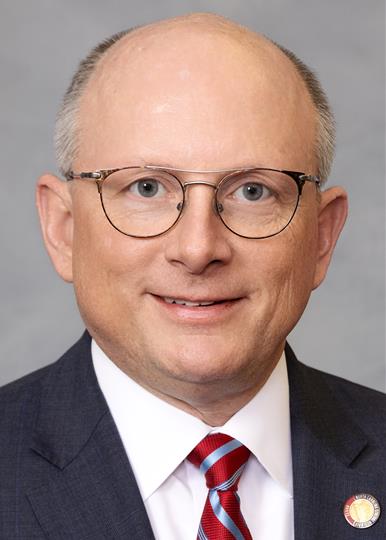
Rep. Tim Reeder
Sponsored bills
Maddy summaryThis bill requires North Carolina state agencies and local governments to only purchase U.S. and North Carolina flags made entirely in the United States using domestically grown or produced materials. It prohibits using public funds for any U.S. or state flags not 100% manufactured in America from domestic materials. The rule applies to all new flag purchases starting October 1, 2025. It directly affects all government offices responsible for buying flags with public money.
Maddy summaryHB 796, the Student Mental Health Line Awareness Act, requires all North Carolina public schools serving grades 6-12 to print three specific suicide prevention contact numbers on new student identification cards. The mandated information includes the 988 Lifeline (call/text), Crisis Text Line (text HOME to 741741), and the NC Statewide Warmline (1-855-733-7762), displayed prominently on the ID. Schools must verify these numbers are current annually and use updated contact information. The bill applies to local school boards, charter schools, regional schools, and laboratory schools, but explicitly states it does not require issuing student IDs. It takes effect for the 2025-2026 school year.
Maddy summaryHB 794 mandates the North Carolina State Highway Patrol to study and develop recommendations on four specific areas: overall and regional staffing needs, and overall and rank-specific salary scales. The study requires the Patrol to assess staffing requirements based on state and regional needs, along with salary structures for all ranks. The Patrol must submit findings and recommendations to relevant legislative committees by March 1, 2026. This bill is procedural and does not enact new policies or funding; it solely requires a study to inform future legislative decisions.
Maddy summaryHB 302 changes Pitt County's school board elections from nonpartisan to partisan, requiring candidates to run under political party affiliations. It affects Pitt County residents who vote in school board elections and candidates seeking those seats, as members will now be elected in partisan races during even-numbered years. The bill mandates single-member districts where only local voters can choose their district's representative, with vacancies filled by appointed members from the same district. This change applies to elections starting after December 1, 2026, while current members elected in 2022/2024 retain their terms.
Maddy summaryHB 71, the Respiratory Care Modernization Act, updates North Carolina's laws governing respiratory care practice. It creates a new "Advanced respiratory care practitioner" (ARCP) category for licensed professionals with postgraduate training, requiring Board-endorsed competency for advanced procedures. The bill clarifies that ARCPs cannot diagnose, prescribe, or perform invasive procedures without physician supervision, while defining their scope to include cardiopulmonary care and tasks delegated by physicians. This directly affects respiratory care practitioners and patients by standardizing advanced practice rules and ensuring procedures align with current professional standards. The changes aim to reflect modern respiratory care practices without altering basic licensing requirements.
Maddy summaryThis bill would regulate hemp-derived consumable products (like edibles, vapes, and beverages) by requiring retailers to obtain permits, limiting THC content to 0.3%, and mandating age verification for all sales. It directly affects vape shops, gas stations, convenience stores, and online sellers currently selling these products to minors. The law creates new enforcement rules for the Commission, requiring proof of age (e.g., driver's license) and banning sales to anyone under 21.
Maddy summaryHB 355 directs North Carolina's Legislative Research Commission (LRC) to study challenges facing rural fire departments, focusing on volunteer recruitment, funding, equipment needs, interdepartmental cooperation, firefighter well-being, and public education. The LRC must examine specific issues like financial incentives for volunteers, equitable resource distribution, mutual aid agreements, and community fire safety programs. It requires regional public hearings and a 90-day comment period before submitting interim and final reports to the 2025 and 2027 General Assemblies. This bill does not change current law but sets up a review process to inform future legislative action.
Maddy summaryHB 629 extends the deadline for North Carolina's Primary Care Payment Reform Task Force from May 1, 2024, to December 31, 2026. The task force studies primary care spending across Medicaid, the State Health Plan, and commercial insurance to evaluate system adequacy, define primary care services, and identify data collection methods. This extension allows the task force additional time to complete its analysis and submit reports to legislative committees, directly affecting state agencies like the Department of Health and Human Services responsible for implementing the study.
Maddy summaryThis bill establishes new regulations for hemp-derived consumable products (like edibles, vapes, and beverages) intended for human ingestion or inhalation, limiting THC content to 0.3% or less. It requires retailers to verify ages (21+), use child-resistant "exit packages" at point-of-sale, and obtain licenses from the Alcohol Law Enforcement Division. Manufacturers must use independent labs for testing, and sellers face fines up to $2,000 or license suspension for violations like selling to minors or exceeding THC limits. The rules exclude topical products and hemp seeds, focusing solely on ingestible/inhalable items.