

Maddy summaryHB 69, the Military and Veterans Educational Promise Act, provides two key benefits for military-affiliated individuals and veterans at North Carolina's University of North Carolina (UNC) schools. First, it requires UNC institutions to allow eligible military members (including reservists) and their spouses to defer admission for up to five years (for active duty) or two years (for reserve service) upon enrollment notice. Second, it establishes in-state tuition rates for honorably discharged veterans who served at least 90 days in the military, graduated from a North Carolina high school after 2004, had a North Carolina duty station, or received a Purple Heart. The bill applies to all UNC institutions beginning in the 2025-2026 academic year.
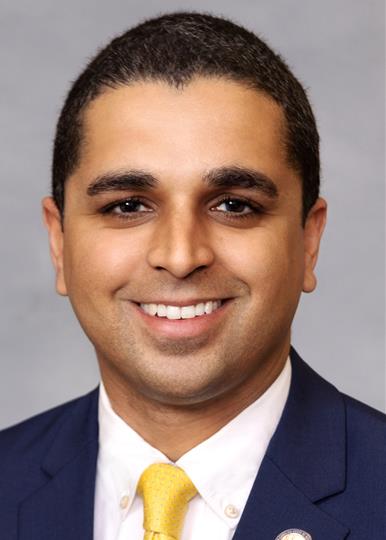
Rep. Dante Pittman
Sponsored bills
Maddy summaryHouse Bill 272, known as "The Sergeant Mickey Hutchens Act," allows certain law enforcement, probation/parole, and correctional officers in North Carolina to purchase additional retirement service credit. Officers who hold an advanced law enforcement or corrections certificate and have at least five years of membership service can buy up to four years of creditable service. This purchase applies to members of the Teachers' and State Employees' Retirement System or the Local Governmental Employees' Retirement System. To do so, they must pay a lump sum covering the full cost of the increased retirement system liability and an administrative fee, with the option for their employer to contribute to this cost.
Maddy summaryHB 912, known as the Hometown Opportunities for Mentoring Educators (H.O.M.E.) Act, establishes a grant program to encourage teachers to work in the same local school administrative units where they were previously students. The program provides a $500 monthly salary supplement to "eligible teachers," defined as individuals who attended or graduated from a high school in a specific local unit and agree to teach there. The Department of Public Instruction will manage the program and disburse grants to local school units, which are also tasked with promoting the program to high school students. The bill appropriates $10 million annually to fund these teacher salary supplements.
Maddy summaryHB 938, the Right to Repair Digital Electronics Act, requires manufacturers of digital electronics sold or used in North Carolina to provide independent repair shops and product owners with free access to diagnostic tools, repair information, and service parts at fair and reasonable prices. It mandates that manufacturers make available the same diagnostic software, firmware updates, and repair documentation they provide to their own authorized repair networks. The law prohibits manufacturers from forcing authorized repair providers to use proprietary formats if standardized alternatives exist, while protecting trade secrets and existing repair agreements. This directly affects independent repair businesses, owners of digital devices (like smartphones and computers), and manufacturers selling such products in the state.
Maddy summaryHB 933 increases Medicaid rates to ensure direct care workers for people with intellectual or developmental disabilities earn at least $18 per hour, affecting home/community providers, group homes, and waiver programs like NC Innovations. It adds 1,000 slots to the NC Innovations waiver program (with $36 million in annual state funding) and requires a 10-year plan to address unmet service needs. The bill also removes income and resource limits for Medicaid eligibility under the Health Coverage for Workers with Disabilities program. These changes take effect July 1, 2025, with $183 million in annual state funding supporting the wage increases and $36 million for new waiver slots.
Maddy summaryHB 943 appropriates $100,000 annually from 2025-2027 to expand North Carolina's Teacher Cadet Program (NCTCP), which targets high-achieving high school students - particularly those from underrepresented groups like people of color (42% of cadets vs. 21% of current teachers) and males (25% of cadets) - to enter teaching careers. The funds will support statewide teacher training workshops (in-person and online), prioritize expansion in counties with high teacher turnover (especially rural and low-performing schools), and develop training for underrepresented cadets using current teachers and students. This directly affects high school students in NCTCP participating in the program and their future schools, aiming to strengthen the teacher pipeline in underserved communities. The bill focuses on concrete funding for program growth, not policy changes to teaching standards or school operations.
Maddy summaryHB 986, "Support Our Teachers," prohibits North Carolina school districts from requiring teachers to post lesson plans or objectives and bans schools from assigning work during teachers' designated lunch breaks. It also mandates that school districts compensate teachers financially for time spent leading professional development sessions for colleagues. The bill directly affects public school teachers and administrators across North Carolina, taking effect for the 2025-2026 school year. These provisions aim to reduce administrative burdens and recognize teachers' time spent in professional roles.
Maddy summaryHB 883 establishes a grant program for North Carolina school districts to cover extraordinary costs for students with disabilities, particularly for placements outside regular schools (like private special education programs or homebound settings). School districts can apply for 75% reimbursement of eligible costs - such as specialized staff salaries, materials, or private school tuition - provided these costs exceed four times the state average per-pupil expenditure for disabilities. The bill requires annual IEP reviews, mandates that districts maintain legal responsibility for students in private placements, and directs the Department of Public Instruction to report on placements and costs by March 2026. It appropriates $1 million for the 2025-2026 fiscal year to fund this program.
Maddy summaryHB 877 establishes a pilot program to create affordable childcare facilities through public-private partnerships using state-owned property. It requires the Legislative Services Office to select a childcare operator by 2026 who must offer rates 25% below market (excluding land/building costs), pay staff 180% of federal minimum wage with health insurance, and reserve 80% of spots for state employees. The program leverages $5 million in state funds to cover facility upfitting and site costs, using state/university land leased at $500/month for 10+ years. This directly affects state employees seeking childcare and aims to lower costs for parents across all North Carolina counties through reduced capital expenses.
Maddy summaryHB 487 shortens the required separation period for retired assistant district attorneys and assistant public defenders before they can return to state employment. The bill changes North Carolina's retirement rules to allow these professionals to rejoin state work after 30 days instead of the standard six-month waiting period. This adjustment applies specifically to retired assistant district attorneys and public defenders who wish to return to state service. The policy change directly affects these two groups of retired state employees by providing greater flexibility for reemployment.