

Maddy summaryHB 807 raises teacher salaries for the 2025-2026 school year with new pay scales based on experience and adds supplements for certified teachers, school nurses, counselors, and specialists. It allocates $89.4 million annually and $109.2 million as a one-time fund to provide weighted, per-child funding for children with disabilities based on the cost of services provided. The bill also mandates free breakfast and lunch for all public school students, funded through state appropriations tied to school food authority evaluations, and includes funding for a one-to-one device refresh in public schools.
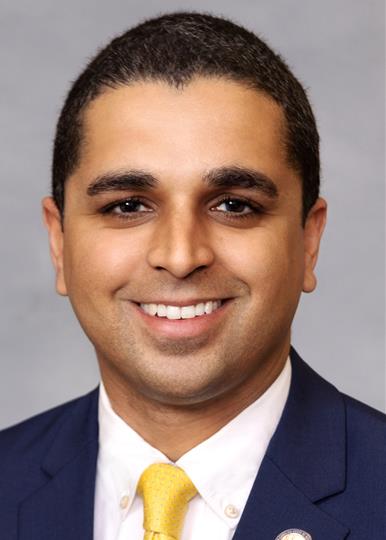
Rep. Dante Pittman
Sponsored bills
Maddy summaryHB 813 renames "multiunit assisted housing with services" as "registered residential facility" to clarify that these non-licensed residences are distinct from licensed adult care homes. It requires annual registration with the Department of Health and Human Services, mandates disclosure statements in rental contracts covering emergency systems and service costs, and prohibits these facilities from caring for residents needing ventilator support, 24-hour nursing care, or certain medical treatments without specific exceptions. The bill directly affects facilities currently operating under the old name and their residents, particularly those with complex medical needs. Key provisions include updated definitions, expanded restrictions on who can be served, and authorization for the Department to seek legal action against unregistered facilities.
Maddy summaryHB 816, the Voucher School Transparency Act, requires nonpublic schools receiving Opportunity Scholarship funds in North Carolina to meet new reporting and accountability standards. These schools must annually provide parents with student test scores, maintain criminal background checks for staff with decision-making authority, administer standardized tests for grades 3+, and submit financial audits to the state if enrolling 70+ scholarship students or receiving $100,000+ in funds. The bill also mandates detailed annual data submissions to the state Division, including enrollment, teacher licensing, facility safety, and disability support compliance. The State Auditor must annually review audits of at least three such schools to ensure accountability. This directly affects voucher-funded nonpublic schools and their reporting practices, not public schools or general education policies.
Maddy summaryHB 794 mandates the North Carolina State Highway Patrol to study and develop recommendations on four specific areas: overall and regional staffing needs, and overall and rank-specific salary scales. The study requires the Patrol to assess staffing requirements based on state and regional needs, along with salary structures for all ranks. The Patrol must submit findings and recommendations to relevant legislative committees by March 1, 2026. This bill is procedural and does not enact new policies or funding; it solely requires a study to inform future legislative decisions.
Maddy summaryHB 786, the "Working Families Act," reduces child care costs for low-income families by lowering parent copayments from 10% to 7% of income (effective 2025), reinstates a refundable state child tax credit with income-based payments (effective 2025), and phases up North Carolina’s minimum wage to $15/hour by 2030 with annual inflation adjustments. It also increases income limits for property tax relief, creates a homebuyers’ assistance program for public servants (like firefighters and EMTs) as first-time buyers, and establishes a paid family leave insurance program funded through an employer grant program. The bill directly affects working families, hourly workers, public-sector employees, and households using subsidized child care or property tax relief. Key mechanisms include phased wage increases, income-tiered tax credits, and targeted housing support, all designed to reduce financial strain on low-to-moderate-income households.
Maddy summaryHB 774 ("School Breakfast for All") mandates that all North Carolina public schools (pre-K through 12) provide free breakfast to every student, eliminating costs for families. It establishes a Farm-to-Table Initiative requiring schools to partner with local farmers for fresh, locally sourced ingredients in breakfast meals. The bill allocates $39 million in recurring state funds for the 2025-2026 fiscal year to cover program costs, while requiring annual reports on participation rates, costs, and impacts on student health and academic performance. This directly affects all public school students, school districts, and North Carolina agricultural producers.
Maddy summaryHB 753 allows eligible North Carolina law enforcement officers aged 59.5 or older to continue receiving retirement benefits while remaining actively employed. Retired officers who separated from service for at least six months may return to duty and retain their retirement benefits. The bill requires employers to cover both employee and employer retirement contributions during this period and clarifies that beneficiaries remain eligible for death benefits under specific conditions. It directly affects current and retired state/local law enforcement officers meeting age and service criteria.
Maddy summaryHB 683 expands North Carolina's property tax exclusion for disabled veterans by removing the $45,000 cap and excluding the **entire appraised value** of a qualifying veteran's primary residence from property taxes. It directly affects **disabled veterans** (with VA-certified service-connected disabilities) and their **unremarried surviving spouses**, who previously could only exclude the first $45,000 of their home's value. The bill requires the state to **reimburse local governments** for lost tax revenue through a "hold harmless amount" calculated by multiplying the excluded value by the local tax rate, with counties reporting this by September 1 and receiving funds by December 31 annually. This change takes effect for taxes due in 2026 and ensures no net revenue loss for local governments.
Maddy summaryHB 691, the "Voter Protection and Reliance Act," ensures voters' ballots are counted based on election-day rules by prohibiting the exclusion of valid ballots cast under procedures in place on election day. It requires courts and election officials to apply election rules as they existed on election day, not later changes, and mandates that technical registration errors (like incomplete forms) cannot invalidate a ballot if the voter relied on the process. The bill also creates expedited court procedures for election challenges filed within 90 days before an election or after an election concludes, directing such cases to Wake County Superior Court for faster resolution. This directly affects voters, election officials, and courts by prioritizing ballot integrity based on election-day procedures over post-election interpretations.
Maddy summaryHB 685, the Rural NC Reinvestment Act, allocates $605 million in nonrecurring state funds for rural North Carolina communities during the 2025-2026 fiscal year. It provides grants for water/sewer infrastructure ($200M), law enforcement/fire equipment ($10M), economic development land ($20M), rural school construction ($200M), broadband expansion ($50M), early childhood education ($100M), and physician placement ($5M). Local governments, schools, emergency services, and healthcare providers in rural areas directly receive these funds, with allocations prioritized based on need, efficiency, and community impact. The bill becomes effective July 1, 2025, focusing on tangible infrastructure and service improvements without creating new regulations.